Samsung’s next wave of flagship phones, the Galaxy S26 family, is already generating plenty of hype, but an unexpected twist is arriving from much lower down the lineup. While fans are focused on camera upgrades and Galaxy AI tricks, a humble mid-ranger, the upcoming Galaxy A57, is quietly shaping up to embarrass Samsung’s premium phones in one very basic everyday spec: how fast the battery refills when you plug it in.
A new listing on China’s 3C certification website, referencing model number SM-A5760, strongly suggests that the Galaxy A57 will support up to 45 W wired charging. 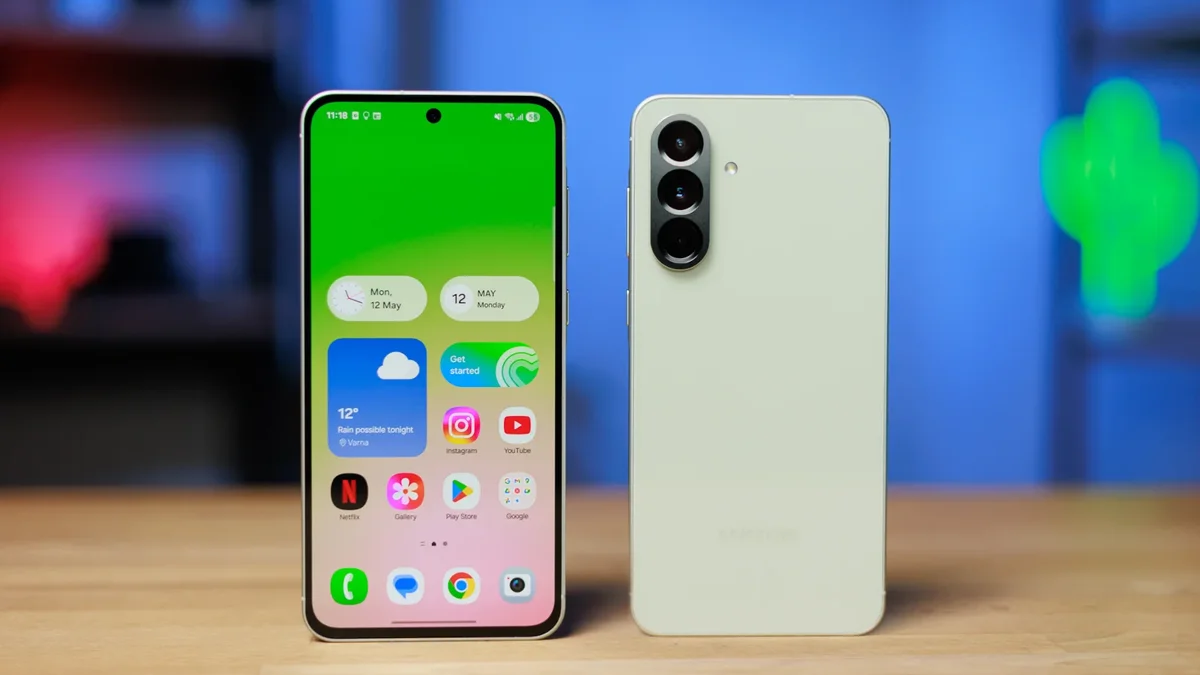
That is a serious bump for a mid-range device and, more importantly, it is higher than what the standard Galaxy S26 and Galaxy S26 Plus are currently rumored to offer. Multiple leaks point to Samsung once again sticking to 25 W wired charging on its mainstream S-series flagships, continuing a strategy that is starting to look less like caution and more like stubbornness.
This is not an isolated case. Samsung has been surprisingly conservative with both battery capacity and charging speeds on its flagship phones for years. The base Galaxy S25 is capped at 25 W charging, a figure that was competitive several generations ago but now feels dated. In contrast, the mid-range Galaxy A56 already hits 45 W, matching the speed of the much more expensive Galaxy S25 Ultra. When a five hundred dollar phone charges as fast as your top-tier Ultra model and faster than your standard flagship, something about the hierarchy starts to feel off.
If the A57 does indeed ship with 45 W charging while the Galaxy S26 and S26 Plus are stuck at 25 W, that gap becomes even harder to justify. Flagships are supposed to showcase the best of what a brand can do, not trail behind cheaper models in one of the most noticeable quality-of-life features. Fast charging may not be as flashy as a new camera sensor or an AI editing tool, but it is one of those things you notice every single day when you are rushing out the door with a low battery warning glaring at you.
Meanwhile, rivals are sprinting ahead in both charging speed and sheer battery capacity. Take the OnePlus 15 as a prime example. It reportedly pairs a hefty 7,300 mAh battery with up to 80 W wired charging in its global version. That combination means you can top up an enormous battery in a fraction of the time it takes a Galaxy flagship to crawl from red to green. Even Apple, historically as cautious as Samsung in this area, is moving forward: internal testing has put the iPhone 17 family at around 36 W wired charging, and that already feels snappier in day to day use.
Against this backdrop, Samsung’s 25 W standard looks increasingly like a relic. Yes, there are arguments for going slower: lower heat, potentially better long term battery health, and fewer safety headaches. But other manufacturers have shown that it is possible to implement higher charging speeds responsibly, using sophisticated power management, good thermal design, and smart charging modes that limit stress when you do not need a full blast. Sticking to 25 W while mid-rangers and rivals race ahead does not read as “we care about longevity” anymore; it reads as “we do not want to redesign our power systems”.
Of course, the Galaxy A57 will not outshine the S26 series across the board. Early information points to a mid-tier Exynos 1680 chipset rather than cutting edge silicon, and it is very unlikely that the A57 will support wireless charging at all. Do not expect a telephoto camera, either; zoom will almost certainly be handled purely by cropping the main sensor. On the software side, this mid-ranger will probably skip some of the more advanced Galaxy AI features that Samsung reserves for its top S lineup, including some of the heavier on-device generative tools.
That is the tradeoff Samsung appears comfortable with: the A-series phones become everyday workhorses that quietly overdeliver on basics like battery life and charging speed, while the S-series gets the prestige features, the sharper displays, the better cameras, and the marketing spotlight. But in 2025 and beyond, users are increasingly unwilling to accept that a phone costing around eight hundred dollars can charge noticeably slower than one that sits a few hundred dollars cheaper on the same store shelf.
The rumored March launch window for the Galaxy A57 makes this tension even sharper. If Samsung unveils the mid-ranger with 45 W wired charging and then steps on stage to talk up the Galaxy S26 and S26 Plus with 25 W, it will be hard to explain away the discrepancy. Tech-savvy buyers notice these details, and mainstream buyers are also starting to pay attention after years of marketing about fast charging on Android devices in general.
Fast charging will never be the single most important spec on a smartphone. Display quality, camera performance, software experience, and long term support all matter at least as much. Still, when you are paying flagship prices, you expect the spec sheet to look modern from top to bottom. You want the peace of mind that a ten or fifteen minute top-up before heading out will meaningfully move the battery meter. Right now, that promise is being met more convincingly by some of Samsung’s mid-range models and by competitors like OnePlus than by the mainstream Galaxy S line.
It is time for Samsung to move on from this cautious 25 W era. Whether that means standardizing 45 W across the entire S26 lineup, pushing the Ultra higher, or rethinking how it balances battery health with everyday convenience, the company needs to show that its flagships are not being quietly outclassed on the charging front by cheaper phones from its own catalog. The Galaxy A57 might be a fantastic value for buyers who care about fast charging, but the bigger story is what it says about Samsung’s flagship strategy: right now, the charging crown is sitting in the wrong place.
3 comments
Not everyone wants crazy fast charging but flagship should not be worse than midrange, that is just silly
Meanwhile my old OnePlus still goes from 0 to 60% while I make coffee, Samsung needs to wake up fr
people: we want better battery and faster charge, samsung: here, have more ai stickers 🤡