Samsung is preparing the Galaxy S26 Ultra to be more than a routine year on year refresh. On paper the headline change may look simple: the company is expected to keep using LPDDR5X RAM instead of jumping to LPDDR6, but crank bandwidth up from 8.5Gbps on the Galaxy S25 Ultra to around 10.7Gbps on the S26 Ultra. That sounds like a minor spec bump, yet the consequences for the camera, video pipeline, power efficiency and everyday responsiveness could be far more dramatic than most spec sheets suggest.
According to information shared by a well known tipster, the faster LPDDR5X modules in the Galaxy S26 Ultra will not just move data more quickly, they will also run at a lower voltage. In practice this means the phone can shovel more bits between the image sensor, NPU and storage while creating less heat. For a flagship that is already expected to push a next generation processor and advanced camera stack, that mix of higher bandwidth and improved efficiency is exactly what Samsung needs to unlock the next wave of features without cooking the chassis.
Faster RAM as the hidden camera upgrade
The camera is where this RAM bump should be felt first. 
Samsung is rumored to stick with a 200MP primary camera on the Galaxy S26 Ultra, but the way that sensor works will change thanks to memory. Capturing a full resolution frame or a heavily processed pixel binned shot throws a huge amount of data into the pipeline. With 10.7Gbps LPDDR5X, the S26 Ultra should be able to clear that information 20 to 25 percent faster than the S25 Ultra, cutting the time between tap and capture.
That shorter capture window may sound like a small detail, but it directly affects sharpness and reliability. Less time spent reading out the frame means less chance of hand shake ruining a shot, fewer rolling artifacts with moving subjects and more consistent bursts when you hold the shutter. It also frees up headroom so the NPU can dive straight into multi frame processing, stacking, and noise reduction without waiting for the buffer to empty.
Night photography in particular stands to benefit. Low light images on modern flagships often combine several long exposure frames plus heavy AI processing. A wider data highway between the sensor, RAM and NPU makes it easier to pull more frames, test more exposure combinations and run more complex denoising models in the same or even shorter time. The result should be brighter, cleaner night shots with better texture in hair, foliage and skin, instead of the smeared look that appears when the system is forced to simplify its algorithms to keep up.
Sharper 8K and steadier 4K thanks to higher bandwidth
Video is another area where the faster LPDDR5X should make the Galaxy S26 Ultra stand out from its predecessor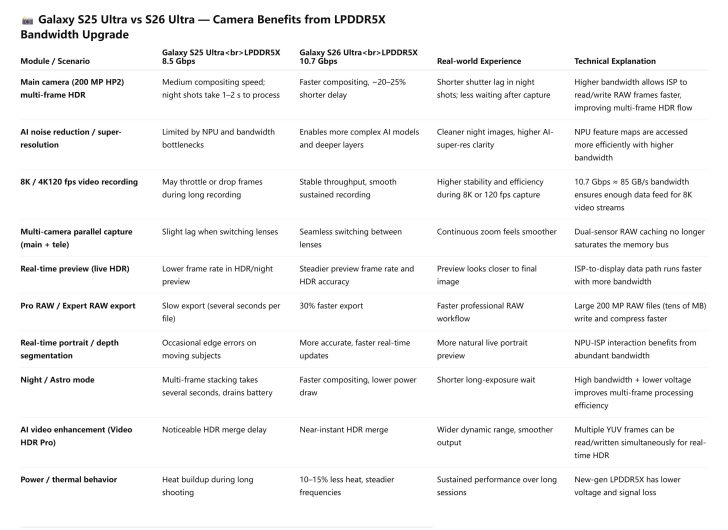
. Recording 4K or 8K footage at high frame rates requires a steady, uninterrupted stream of data. If the memory subsystem cannot keep up, the phone has to compromise on bitrate, compression, or stability. With 10.7Gbps memory bandwidth, the S26 Ultra should have a more comfortable margin to maintain consistent streams for 8K and high bitrate 4K modes, reducing dropped frames, micro stutters and sudden quality dips.
The benefits continue after you hit stop. Exporting clips to the gallery, applying filters or converting footage for social media all lean heavily on RAM throughput. Early estimates suggest around 30 percent faster export compared to the Galaxy S25 Ultra, which means less waiting while long HDR videos or cinematic mode clips render in the background. Portrait and HDR photos should also see improvements as bracketing and segmentation tasks can be completed faster and more frequently, allowing Samsung to be more aggressive with computational photography without making the camera feel sluggish.
Cooler thermals and more stable performance
The story is not just about speed. The new LPDDR5X generation expected in the Galaxy S26 Ultra is designed to hit that 10.7Gbps bandwidth at a lower operating voltage. Less voltage means lower power draw, and less power draw means reduced heat. For a slim metal and glass phone where every degree counts, that matters a lot. Early projections point to a 10 to 15 percent improvement in thermals compared to the Galaxy S25 Ultra under similar workloads.
That cooler behavior should help the S26 Ultra sustain high performance for longer during gaming, extended 4K and 8K recording, or continuous shooting with the 200MP sensor. Instead of hitting thermal limits quickly and throttling, the device can keep its CPU, GPU and NPU closer to peak performance over long sessions. This is exactly the kind of behind the scenes upgrade that does not sound exciting in a marketing slide, yet completely changes how the phone feels after a year of heavy use.
The elephant in the room: the 5000mAh battery
Not everyone is impressed by Samsungs strategy, though. One of the loudest complaints from long time fans is that the company has been stuck at around 5000mAh for several generations of Ultra phones. Users love the idea of cooler chips and more efficient RAM, but many still look at that familiar battery capacity and feel like they are getting the same endurance story year after year, even as prices climb and camera systems become more complex.
From a technical perspective, the move to faster and more efficient LPDDR5X is meant to help here too. If the memory subsystem consumes less power while doing more work, the phone can redirect that saved energy to the display, modem and camera, effectively stretching the same 5000mAh further. In the real world, though, the perception of progress is as important as the actual gains. Some users will argue that efficiency tweaks are nice, but a visible jump to, say, 5500mAh would be a more convincing sign that Samsung is listening to power users who push their phones through long days of 5G, gaming and video.
Waiting for real world verdicts
For now, the Galaxy S26 Ultra remains a phone built from leaks, roadmaps and industry logic rather than official slides. What seems clear is that its RAM upgrade is not just a spec race number, but a platform for better cameras, video and sustained performance. If Samsungs implementation of 10.7Gbps LPDDR5X delivers as promised, the S26 Ultra could feel like a much more responsive, cooler and camera focused evolution of the S25 Ultra, even if the sensor lineup and battery capacity look familiar on paper.
The real verdict will only arrive once retail units hit reviewers hands and users start stress testing them with real workloads, from 8K vacation footage to marathon gaming sessions and overnight astrophotography. Until then, the Galaxy S26 Ultra stands as an interesting example of how a component as invisible as RAM bandwidth can quietly shape almost every part of the smartphone experience.
2 comments
ngl this sounds great for 8K video, my S23 Ultra turns into a hand warmer after like 5 mins recording, hope the cooler thermals on S26U are real and not just marketing
as a mobile gamer im more hyped for stable fps than the 200mp flex, if that new ram keeps the chip from throttling im in