Exynos 2600 engineering sample posts M5-class single-core: what the leak does – and doesn’t – tell us
Samsung’s next flagship silicon, the Exynos 2600, just popped up again in a leak that is raising eyebrows across the industry. According to fresh Geekbench 6 scores attributed to an engineering sample, the chip’s single-core performance lands in the same ballpark as Apple’s M5 – an audacious claim for a smartphone SoC. The numbers look sensational, but sensational numbers always demand context. Here’s a clear, sober read on what was allegedly measured, why it matters, and where caution is still essential.
The claimed configuration and clocks
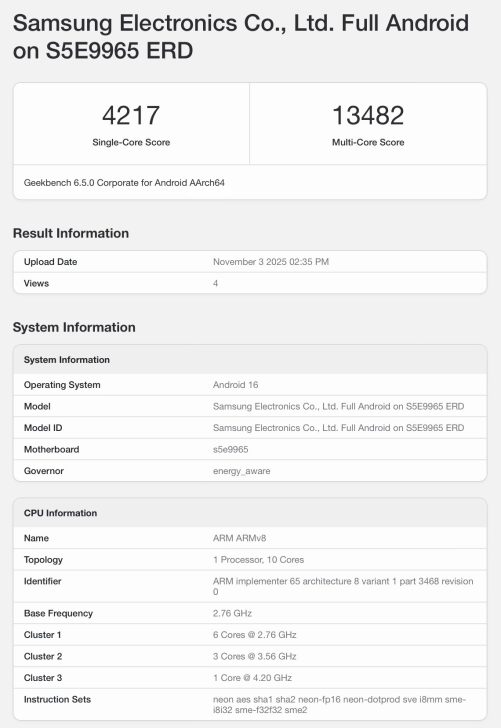
The Exynos 2600 is said to carry a deca-core CPU laid out in a 1 + 3 + 6 cluster: one ultra-performance core, three big performance cores, and six efficiency cores. In the latest run, the single fast core reportedly hit 4.20 GHz, the three performance cores ran at 3.56 GHz, and the efficiency cluster held 2.76 GHz. On paper, those are aggressive frequencies for a mobile part and consistent with Samsung pushing its first 2 nm gate-all-around (GAA) node to find the limits. Engineering samples often run permissive power and thermal envelopes to map out headroom, so treat these clocks as exploratory, not guaranteed shipping specs.
The scores at a glance
Attached to those clocks are the headline figures: a single-core score of 4,217 and a multi-core score of 13,482 on Geekbench 6. If accurate, that would meaningfully advance the chip from its earlier showing and place its single-threaded speed near Apple’s latest desktop-class silicon.
| Chip | Single-core | Multi-core | Delta vs prior |
|---|---|---|---|
| Exynos 2600 (previous run) | 3,455 | 11,621 | – |
| Exynos 2600 (new leak) | 4,217 | 13,482 | +22% SC / +16% MC |
| Apple M5 (initial GB6) | 4,263 | 17,862 | – |
Two things jump out. First, single-core: brushing the M5’s 4,263 is a symbolic milestone, because single-thread speed remains a strong predictor of responsiveness in day-to-day apps and UI. Second, multi-core: the Exynos 2600 still trails the M5’s 17,862 by roughly 32%, which is hardly surprising given the M5’s power and thermal budget. Still, for a phone-bound SoC, 13,482 would be formidable.
Power whispers and efficiency caveats
Earlier chatter around the same silicon suggested unusually low board power under load – reportedly completing Geekbench 6 multi-core at about 7.6 W and sipping 59% less power than Apple’s A19 Pro in that scenario. If those numbers and test conditions hold (big “if”), the efficiency story could be as interesting as the performance story. But the absence of corroborated power instrumentation here matters: board-level readings are notoriously sensitive to methodology, background processes, and cooling setups. Until standardized, apples-to-apples measurements appear, file efficiency claims under “promising, not proven.”
About that credibility question
The source trail goes through X (Twitter) user @lafaiel, and some observers have struggled to relocate the corresponding entries in the public Geekbench database. That can happen for several reasons – temporary takedowns, mislinked pages, mislabeled devices, or, yes, manipulated screenshots. Healthy skepticism is warranted. Bench databases track device identifiers, OS builds, and run metadata; when those don’t line up cleanly, it’s better to treat a score as provisional. None of this invalidates the idea that Samsung is hammer-testing early 2 nm GAA silicon – it almost certainly is – but it does mean conclusions about final retail behavior are premature.
What it could mean for real phones
If Samsung can approach M5-class single-core on a phone chip and sustain meaningful slices of that performance without throttling, the user-visible upside is big: faster app launches, snappier camera pipelines, and smoother heavy web pages. The multi-core gains should help with mixed workloads like photo stacks, on-device AI tasks, and background activity. Yet everything depends on sustained clocks within a smartphone’s tiny thermal envelope. A 4.20 GHz burst is exciting; a 4.20 GHz sustained thread under pocketable thermals is the moonshot. Scheduler tuning, DVFS behavior, and cooling design will decide how much of this benchmark glory survives contact with a chassis.
The bigger picture: beyond CPU
Even if the CPU core looks stellar, flagship experiences now hinge on the full platform: GPU efficiency under long gaming sessions, NPU throughput for on-device generative models, ISP quality for computational photography, and memory and storage latency. Samsung’s 2 nm GAA transition is a foundation for all of those blocks, but we’re still waiting on details – and real-world validation – before calling any races.
Timeline and expectations
On the current road map, the Exynos 2600 is expected to surface inside the Galaxy S26 family, with announcements widely tipped for February 2026. Between now and then, expect more engineering samples, more iterative runs, and more claims. Treat each as a piece of a moving puzzle. When retail firmware, thermal design, and modem stacks are locked, we’ll know what the chip is actually capable of in your hand – not just on a bench.
Bottom line
The take-home is simple: the leaked Exynos 2600 numbers – 4,217 single-core, 13,482 multi – are exciting, plausible for a no-holds-barred engineering sample, and still unconfirmed. If they hold, Samsung’s 2 nm era kicks off with a serious CPU statement. If they don’t, the arc still points toward bigger single-thread gains and strong multi-core for a phone-sized power budget. Either way, the next round of mobile performance is shaping up to be a lot more interesting than last year’s spec bumps.