Death Stranding 2: On the Beach is once again pushing PlayStation technology into new territory – this time through the console’s newly introduced Power Saver Mode. A recent deep-dive by the technical experts at Digital Foundry has revealed that Kojima Productions’ latest game isn’t just using this feature for simple energy savings – it may be quietly signaling how Sony plans to prepare its ecosystem for the future, possibly even the long-rumored PlayStation handheld.
Power Saver Mode, introduced in a recent PlayStation 5 firmware update, drastically reduces the console’s power draw by cutting CPU resources in half, halving memory bandwidth, and lowering CPU and GPU clocks. 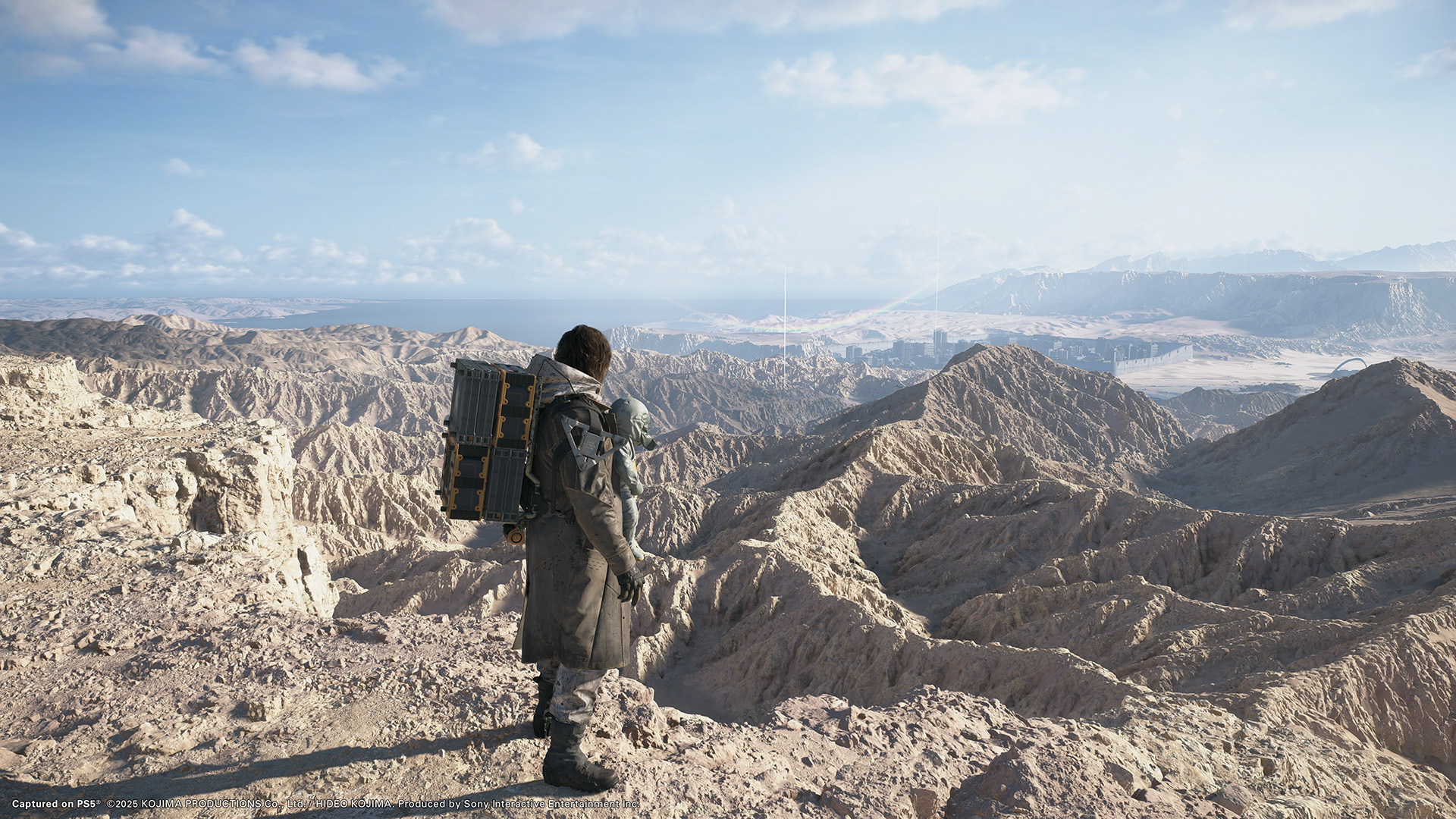
It’s meant to extend hardware life and reduce electricity consumption – but in a world of high-end performance gaming, this kind of mode is often considered secondary at best. Yet Death Stranding 2 treats it differently. Unlike Death Stranding: Director’s Cut – which was an upgraded PlayStation 4 title and handled the feature without much complexity – On the Beach integrates Power Saver Mode in a far more deliberate and technically intriguing way.
According to Digital Foundry’s latest analysis, enabling Power Saver Mode in Death Stranding 2 doesn’t just throttle performance. At first glance, the mode seems to run the game in what resembles the normal Performance Mode, capped at 30 frames per second. However, a closer inspection reveals that visual quality remains surprisingly high: tessellation and geometric detail are maintained at levels similar to Quality Mode, and the resolution stays around 1440p – dynamically adjusted, but still far beyond what one would expect from such a power-limited configuration.
This suggests that Kojima Productions took an unorthodox approach – rather than simply scaling down everything to save power, they rebalanced rendering priorities. The lower frame rate likely compensates for CPU and GPU limitations, allowing for richer visuals in certain scenes without drastically degrading overall fidelity. This method could serve as a valuable case study for developers exploring how to adapt high-end titles for systems with tighter power budgets.
But the bigger question remains: why go to such lengths for a feature that only a handful of players will ever use? Digital Foundry speculates that Sony might be using Power Saver Mode as a testbed – training studios to think modularly, optimizing games for multiple performance tiers. This could be an intentional move to ease the transition toward scalable hardware platforms, especially if the rumored PlayStation handheld becomes a reality.
However, experts are quick to clarify that the current Power Saver Mode implementation shouldn’t be mistaken for a direct preview of handheld performance. The PlayStation 5’s 115W target is far above what a portable device could sustain – expected to fall somewhere between 15W and 25W – and current Power Saver Mode games, often running at 1440p or higher, don’t yet reflect mobile-level efficiency. Still, the groundwork being laid here shows foresight: Sony and Kojima Productions are clearly experimenting with scalable game design, ensuring future hardware transitions won’t demand complete engine overhauls.
Aside from Death Stranding 2, only a few titles, such as Demon’s Souls Remake by Bluepoint Games, have integrated Power Saver Mode support. Each implementation provides new insight into how developers may soon be expected to design games that adapt seamlessly across performance ranges – from living room consoles to portable devices. Whether this all leads to a PlayStation handheld revival or simply a smarter, more efficient ecosystem, Death Stranding 2: On the Beach stands as a symbol of PlayStation’s quiet evolution beneath the surface of its stunning visuals.
1 comment
30fps but still 1440p?? wild optimization