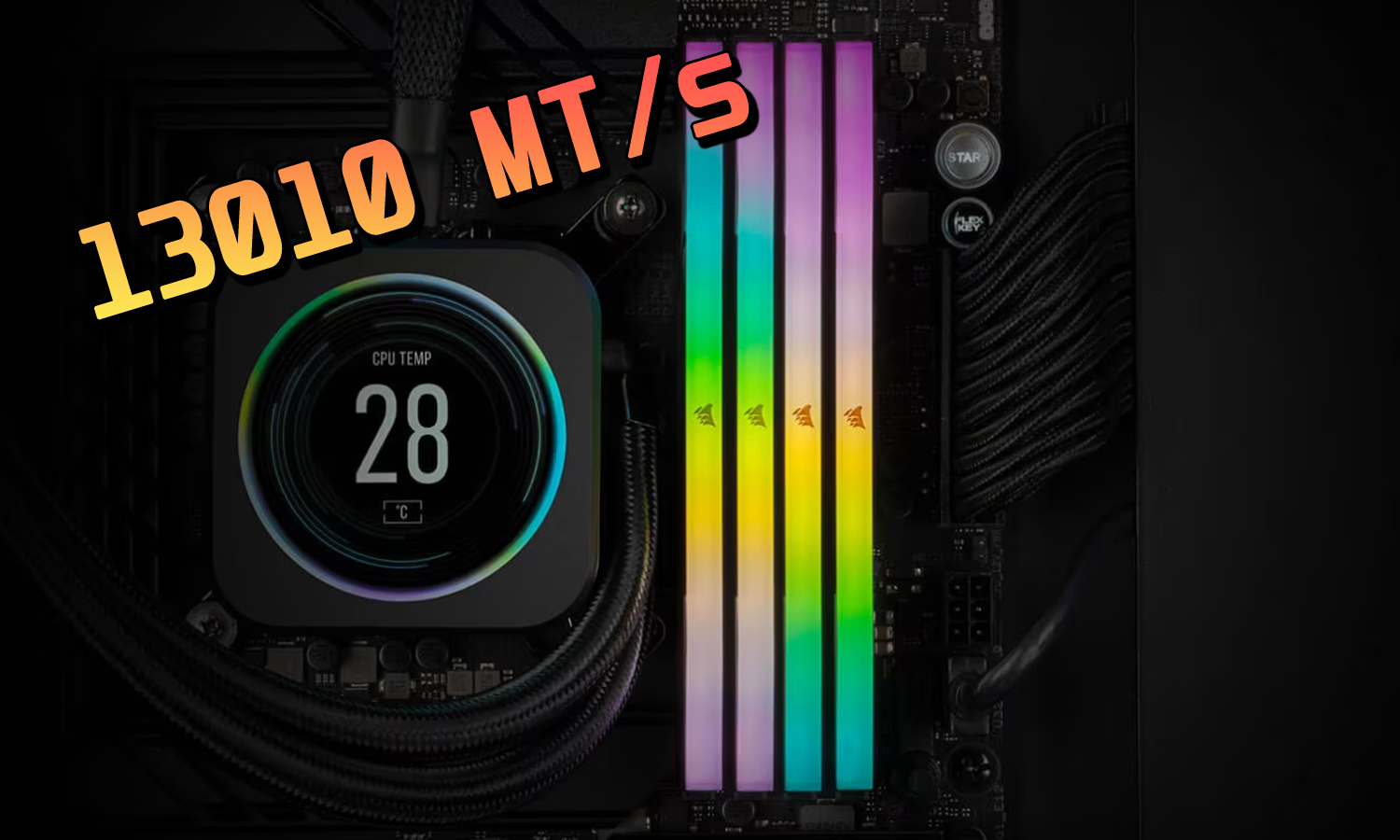
Corsair Vengeance DDR5 Shatters 13,000 MT/s Barrier: A New Milestone in Memory Overclocking
For years, the dream of pushing DDR5 memory beyond the 13,000 MT/s mark felt like chasing a ghost. Today, that ghost has finally been caught. Thanks to Corsair’s Vengeance DDR5 modules and GIGABYTE’s specialized Z890 Aorus Tachyon ICE motherboard, German overclocker sergmann has officially set a new world record at a staggering 13,010 MT/s.
The journey to this moment has been nothing short of a saga. Just weeks ago, overclocker saltycroissant came close, hitting 12,920 MT/s on the same motherboard platform. He even claimed to have reached beyond 13,000 MT/s unofficially – but before his attempt could be validated, sergmann swooped in to make it official under HWBot and CPU-Z verification. His setup, featuring a 24 GB Corsair Vengeance DDR5 kit paired with Intel’s flagship Core Ultra 9 285K processor, relied on liquid nitrogen cooling to keep temperatures stable during this extreme performance test.
According to the published results, the validated frequency of 6504.0 MHz (effective 13,010 MT/s) came with timings of CL68-127-127-127-2. While such latency is far from practical for daily use, it’s the kind of tuning needed for record-breaking runs where stability and validation matter more than real-world responsiveness. The Integrated Memory Controller (IMC) to Memory Clock ratio reached an extreme 3:190 – an engineering feat that highlights how finely balanced this achievement really was.
This breakthrough didn’t happen overnight. Since Intel’s Core Ultra 200S CPUs and the Z890 motherboards arrived, enthusiasts have relentlessly pushed DDR5’s potential, leaping from 10,000 to 12,000 MT/s over months of experimentation. But progress stalled near the 13,000 threshold. Now, with sergmann’s result, the community has a new benchmark – and a renewed sense of what’s possible. It’s a triumph of precision tuning, hardware excellence, and sheer persistence.
Of course, beyond the technical bravado, it’s important to remember that real-world performance gains from such speeds are minimal. Applications and games often don’t scale proportionally with raw memory frequency, and high latency offsets most advantages. Still, these achievements push the boundaries of engineering and inspire manufacturers to refine their designs for the next generation.
As sergmann himself wrote after the run: “Thanks Gigabyte, MIFCOM, Corsair (Sofos), Seasonic and ThermalGrizzly. Special thanks also to Salty! Stay tuned for more 😉.” The friendly rivalry and collaboration between top overclockers continue to drive the scene forward. The next milestone – 14,000 MT/s – may take much longer to reach. Each additional megatransfer now demands exponentially more precision, better silicon, and perhaps the dawn of DDR6 to make the next leap possible. But if history tells us anything, it’s that overclockers will never stop trying.
2 comments
lol by 2030 we’ll have DDR6 doing 26,000mt/s at this rate 🤣
Too bad this won’t make Arrow CPUs any faster lol 😂