In the world of extreme overclocking, records do not stand for long, but even by that standard the latest DDR5 showdown has been wild. 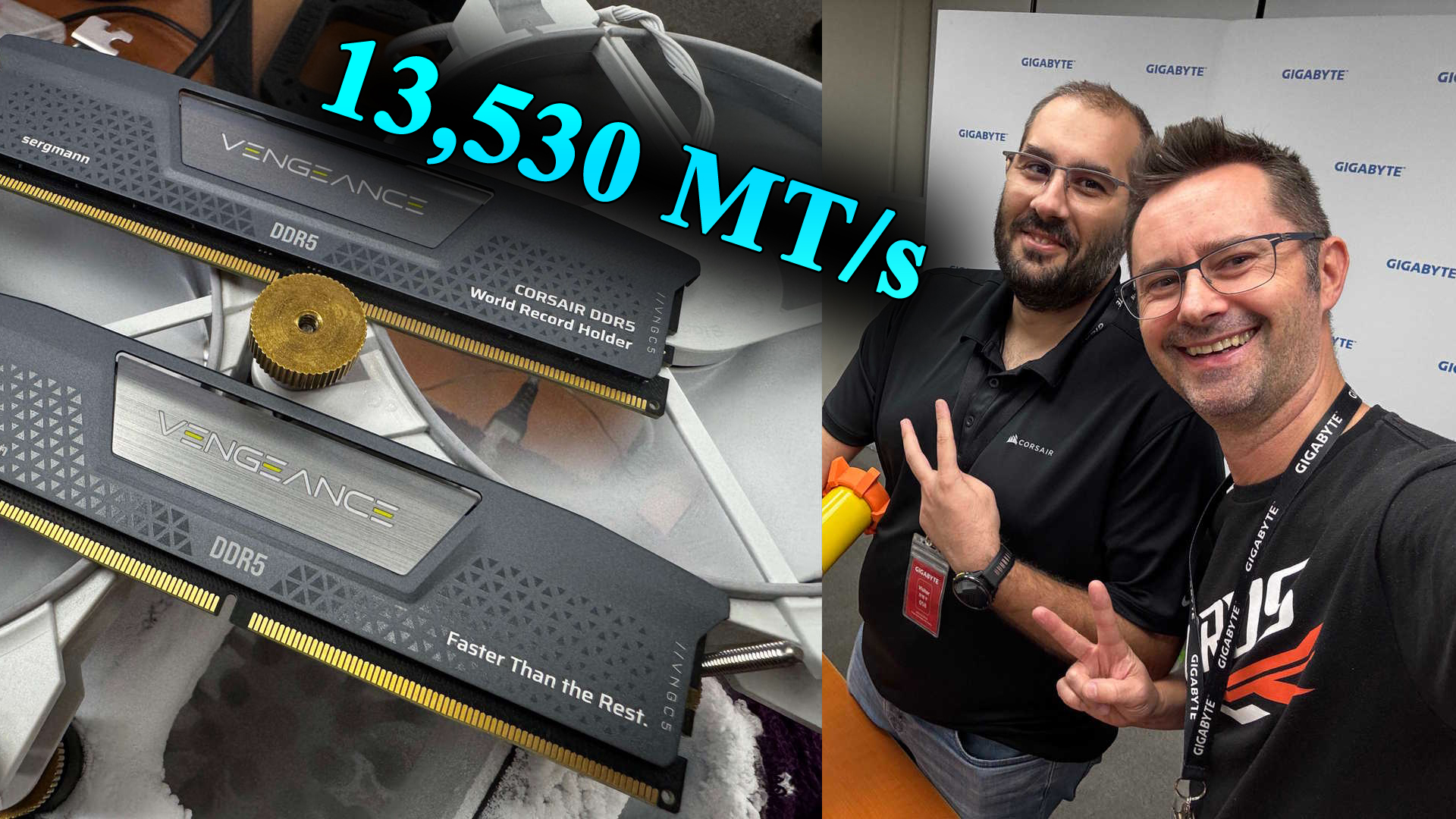
Within a single day, two well known names in the scene, Saltycroissant and Sergmann, traded blows at the very top of the memory frequency charts, pushing desktop DDR5 into territory that would have sounded like science fiction just a few years ago.
To understand why this matters, it helps to know what is actually being measured. DDR5 transfer rate is expressed in mega transfers per second, or MT/s, and it indicates how many data transfers the memory can perform each second. Mainstream gaming kits usually sit in the 5200 to 6400 MT/s range, already much faster than DDR4. Competitive overclockers, however, chase completely different goals: they push a single high quality module to the absolute limit under liquid nitrogen to grab a few more megahertz, a world record badge, and of course bragging rights on HWBot.
Just a week ago the landscape seemed settled when CENS set a formidable DDR5 world record at 13,322 MT/s. That run already represented a big step over previous champions and looked difficult to beat in the short term. Then Saltycroissant arrived with a new submission, again using Corsair Vengeance DDR5 in a 24 gigabyte capacity installed on the GIGABYTE Z890 AORUS Tachyon ICE, a motherboard that has quietly become the default choice for serious memory overclocking. Its stripped down design and tuned traces mean it shows up over and over again in the top ten memory frequency results.
On that familiar platform and with a heavy dose of liquid nitrogen, Saltycroissant pushed the single stick to 6703.9 megahertz effective, which translates to 13,407 MT/s. That was enough to edge past the CENS result by roughly 85 MT/s, a noticeable gain at these insane speeds. The run kept the same aggressive CL68-127-127-127-2 timings used in earlier attempts, but relied on a slightly higher UCLK to MCLK ratio of 3:196 to keep the memory controller stable while chasing that last bit of frequency.
The celebration barely had time to start before the next twist. Later the same day, another HWBot submission appeared: Sergmann, a regular fixture at the top of the memory charts, had responded. Using again a Corsair Vengeance DDR5 module and the Z890 AORUS Tachyon ICE motherboard but pairing them this time with an Intel Core Ultra 9 285K instead of the Core Ultra 7 265K used in Saltycroissant’s run, he managed to squeeze the frequency even higher. His validated result hit 6765.2 megahertz, or an incredible 13,530 MT/s.
What makes Sergmann’s run particularly impressive is not just the raw number but how he reached it. He was able to tighten the UCLK to MCLK ratio down to 3:192 while still holding stability at that frequency, something that is notoriously hard to do at these extremes. Achieving very high memory clocks at low controller ratios usually leads to instant instability, so improving both the ratio and the absolute speed in the same run underlines how dialed in the whole platform was, from IMC quality to board tuning and cold memory behaviour.
From the outside it might look like a niche duel, but feats like these matter to more than just the leaderboard. Every new record pushes vendors to bin memory ICs more aggressively, refine motherboard layouts, and improve BIOS options. Over time, that research trickles down into the affordable DDR5 kits that ordinary PC builders can buy. While forum jokers are quick to point out that their everyday rigs, maybe a gaming CPU with DDR5 running at a modest 5200 MT/s, are already more than enough for 1080p gaming, the bleeding edge experiments are what define the limits of the standard.
The community reaction to these back to back records has mixed awe with playful trolling. Some users tease that chasing 13,500 MT/s on a frozen test bench still leaves the platform slow compared to the next theoretical milestone, while others argue that they would rather have a cool running system than pour litres of liquid nitrogen for a single screenshot. Underneath the memes and animated gifs, though, there is genuine respect for the precision and patience required to coax a fragile DDR5 stick to such heights without crashing.
Perhaps the most exciting part is that nobody believes this is the end of the story. With both Saltycroissant and Sergmann already brushing against the limits of their hardware and clearly motivated by competition, the community now sees the once unimaginable 14,000 MT/s barrier as a realistic near term goal. Whether it is one of these two veterans or a new challenger who claims that milestone first, the race is on, and DDR5 keeps getting faster.
4 comments
this is the most expensive way possible to generate a single benchmark screenshot and some spicy forum drama
dropping my popcorn gif while watching these two yeet ddr5 sticks into outer space 🤣
imagine grabbing the record and then losing it the same day, that has to hurt but respect to both guys
platform is lowkey bottleneck here anyway, wake me up when they hit 14k mts hue