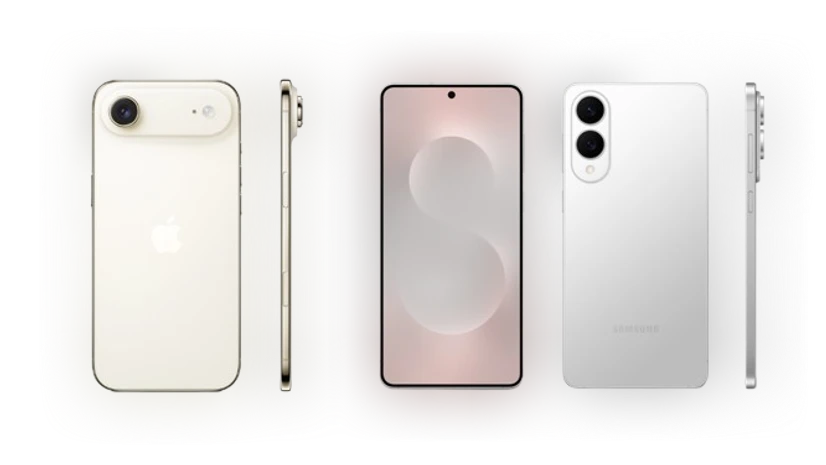
Apple iPhone Air vs Samsung Galaxy S25 Edge: A Deep Dive into the Slim Phone Rivalry
The smartphone industry has always been cyclical. What was once considered a fad often finds itself revived with new technology and better design. Slim phones are the latest comeback story, and the two giants of the market – Apple and Samsung – are once again set against each other. Apple’s brand-new iPhone Air and Samsung’s Galaxy S25 Edge represent two very different takes on how slimness, performance, and usability should come together in 2025. Both claim to be the perfect balance of elegance and function, but the real question is: who did slim better?
Design and Size: The Illusion of Thinness
At first glance, both devices live up to their promise of ultra-thin engineering. The iPhone Air measures 156.2 x 74.7 x 5.6 mm and weighs 165 grams, while Samsung’s Galaxy S25 Edge comes in slightly taller and wider at 158.2 x 75.6 x 5.8 mm but lighter at 163 grams. That two-gram difference and 0.2 mm variance in thickness are negligible for most users, yet Apple leans on rounded corners and a glossy titanium frame to trick the eye into perceiving an even slimmer body. Samsung, by contrast, opts for a matte titanium build that feels more subdued but sturdy. Color options also reflect their philosophies – Apple aiming for light, playful tones like Sky Blue and Cloud White, while Samsung anchors its palette in industrial finishes such as Titanium Icyblue and Jetblack.
One key difference lies in camera design. Apple’s camera ‘plateau’ juts out more prominently, while Samsung integrates its powerful optics into a tighter camera island. For those who care about pocket feel, that bump may become a daily irritation with the Air. Still, both devices have nailed the impression of lightness, a stark contrast to the growing bulk of Ultra or Max-sized flagships that feel more like small tablets than phones.
Display Technology: Brightness vs Sharpness
Samsung has long been considered the benchmark in displays, and the S25 Edge continues that tradition with a 6.7-inch LTPO OLED running at 1440 x 3120 resolution and 513 ppi density. The iPhone Air, however, isn’t far behind. Its 6.5-inch LTPO OLED pushes a 1260 x 2736 resolution at 460 ppi. Both support 120 Hz refresh rates, HDR10, and adaptive frame adjustments for efficiency. Where Apple strikes back is peak brightness: 3000 nits compared to Samsung’s 2600. That said, Apple’s number remains theoretical until tested in real-world usage, where Samsung’s past devices often overdeliver.
Both companies emphasize screen protection. Apple equips Ceramic Shield 2 while Samsung arms its display with Gorilla Glass Ceramic 2. Scratch resistance should be on par, but Apple sneaks in an anti-reflective coating – a small detail that matters for outdoor visibility. Samsung’s lack of this feature may be felt under direct sunlight.
Performance: Heat vs Speed
Apple’s A19 Pro chip is branded as the world’s fastest smartphone processor, built on 3 nm architecture. On paper, this should make the iPhone Air unbeatable, but without independent benchmarks, it’s speculation. Samsung’s Snapdragon 8 Gen Elite for Galaxy is a known powerhouse, especially when paired with its vapor chamber cooling system. In ultra-thin devices, heat management becomes critical, and this could be where Samsung holds a silent advantage. Apple’s design lacks any advanced cooling hardware, raising questions about sustained performance during gaming or heavy multitasking.
Storage configurations give Apple a small edge, scaling up to 1 TB versus Samsung’s 512 GB limit. Both start at 256 GB with 12 GB RAM, which should satisfy most users. The question boils down to whether storage expansion and thermals matter more than sheer speed claims.
Cameras: Pixel Count vs Processing Magic
This is where the rivalry gets spicy. Samsung flexes with a 200 MP main shooter and a 12 MP ultrawide, capable of 8K video at 30 fps or 4K up to 120 fps. Apple counters with a 48 MP sensor and an 18 MP front-facing camera capable of 4K video at 60 fps. On raw specs, Samsung appears to dominate – but smartphone photography isn’t about numbers alone. Apple’s reputation for computational photography may close the gap significantly, especially since higher megapixels don’t always translate to better photos. Many users point out that a solid 48 MP sensor with Apple’s processing can rival larger sensors in low light or portrait depth accuracy.
Still, the lack of an ultrawide lens on the iPhone Air is a clear omission, especially for travelers and creatives who rely on versatile focal lengths. Samsung’s inclusion of both ultrawide and stereo speaker support makes the S25 Edge feel like a more complete multimedia tool.
Battery and Charging: Physics Has Limits
Battery life remains the Achilles’ heel of thin phones. Samsung squeezes in a 3900 mAh cell compared to Apple’s modest 3149 mAh. This 23% difference is significant in real-world endurance. Add in Samsung’s faster 25W wired charging (55% in 30 minutes), and it’s hard to argue against the practicality of the S25 Edge. Apple claws back with slightly quicker wireless charging at 20W versus Samsung’s 15W, but most consumers prioritize wired charging speeds and battery longevity over wireless trickle charging.
Connectivity and Extras: Modern vs Practical
Both devices support Wi-Fi 7 and ultra-wideband (UWB), but Apple integrates the newer second-generation UWB and Bluetooth 6.0, whereas Samsung is on Bluetooth 5.4. On paper, Apple seems more forward-looking. Yet, Samsung keeps the physical SIM slot, stereo speakers, and a faster USB Type-C 3.2 port, while Apple insists on eSIM-only and a slower Type-C 2.0 connector. These choices highlight Apple’s focus on future-proofing and ecosystem control versus Samsung’s appeal to practicality and versatility.
Pricing: The Deciding Factor
Perhaps the most critical difference lies in the wallet. The Galaxy S25 Edge launches at roughly $840/€725, while the iPhone Air demands $1000/€1200. That’s not pocket change, especially when Samsung packs in a larger battery, better cameras, faster wired charging, stereo speakers, and a physical SIM slot. Apple’s higher price reflects brand positioning, premium materials, and software ecosystem integration, but for consumers choosing based on specs, Samsung makes a stronger case.
Verdict: Who Wins the Slim War?
Samsung’s Galaxy S25 Edge emerges as the more complete package for most users: bigger battery, versatile camera system, stereo audio, and lower price. Apple’s iPhone Air, however, may still seduce loyalists with its premium feel, lighter software experience, and brighter screen. But without hands-on testing of Apple’s new chip and camera processing, it’s too early to declare a knockout. Slim phones are niche by nature, but both companies show there’s still room to innovate in comfort and style rather than brute force specs.
At the end of the day, it comes down to preference. If you value practical features and price-to-performance, Samsung holds the crown. If you want cutting-edge Apple design, ecosystem perks, and future-proof networking, the iPhone Air will feel worth it. Either way, slim phones are no longer just nostalgic gimmicks – they are back, and they’re better than ever.
1 comment
E-sim only on the Air is annoying af, some carriers don’t even support it well