Apple has once again set the tech world abuzz with the unveiling of its latest iPad Pro lineup, this time powered by the new M5 chip. The announcement confirms two refreshed models – the 11-inch and 13-inch iPad Pro – both inheriting Apple’s latest generation of silicon and connectivity innovations. 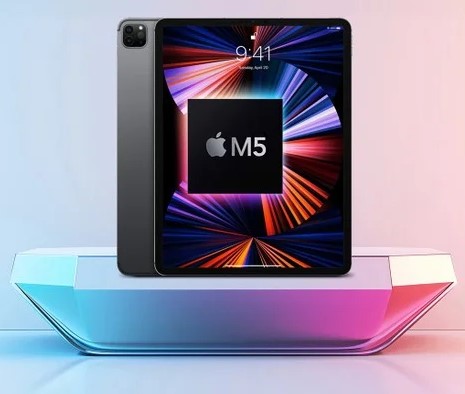
While the design remains visually identical to the M4 versions, the changes under the hood are anything but minor.
The star of the show is the M5 chip, which debuts alongside the new 14-inch MacBook Pro and the Apple Vision Pro. It features a 10-core CPU with four high-performance cores and six efficiency cores. Apple boldly claims these performance cores are the fastest in any consumer device, paired with a 10-core GPU that integrates neural accelerators directly into each core. The chip’s memory bandwidth leaps to 153GB/s, while ray tracing performance climbs by 1.5x compared to the M4. AI processing, Apple says, has skyrocketed – up to 3.5 times faster than before – thanks to the next-generation Neural Engine, promising improved results in creative apps like Final Cut Pro and Logic Pro.
For content creators, the gains are palpable. Video transcoding speeds in Final Cut Pro are up to 20% faster, and 3D rendering in apps that utilize ray tracing has seen a major leap. The M5’s architecture has also boosted power efficiency, which should mean cooler operation and extended battery life, even under heavy workloads. For professionals, this kind of performance in a tablet could make the new iPad Pro an even more viable substitute for a laptop – though critics continue to note that the iPad’s software limits its full potential.
Another quiet but significant upgrade is in display output. The M5-powered iPads can now output to external displays at up to 120Hz, with support for Adaptive Sync (VRR). This means smoother playback and gaming experiences for users with compatible monitors. Meanwhile, memory capacity has also been upgraded: the 256GB and 512GB configurations now come with 12GB of RAM (up from 8GB), while the higher-tier 1TB and 2TB options continue to feature 16GB.
Connectivity receives a notable boost as well. The addition of the new N1 wireless chip and C1X modem – both previously exclusive to this year’s iPhones – introduces faster and more stable wireless performance. Cellular models should particularly benefit from improved 5G reliability and efficiency.
Charging speeds have also improved. The new iPad Pro models support Apple’s latest fast-charging standard, matching the iPhone 17 lineup. Using the 40W Dynamic Power Adapter with 60W Max, users can get a 50% charge in about 30 minutes on the 11-inch model and roughly 35 minutes on the 13-inch.
Outside of these internal leaps, little has changed in appearance. The iPad Pro still sports the stunning Tandem OLED Ultra Retina XDR display, a 12MP rear camera, and a 12MP front camera with Center Stage. Audio performance continues to impress with the four-speaker system, and the Thunderbolt/USB4 port remains present for professional-grade accessories.
Pricing remains unchanged – $999 for the 11-inch and $1,299 for the 13-inch base models, while cellular versions start at $1,199 and $1,499 respectively. For loyal Apple fans, this continuity might be comforting; for skeptics, it may feel like more of the same. Some enthusiasts are calling for macOS support on the iPad to truly unlock the hardware’s capabilities, while others argue that Apple’s ecosystem strategy will keep the tablet firmly in its current lane.
Still, the new M5 chip represents a clear step forward in raw power and efficiency, and for creators or professionals already invested in the Apple workflow, the 2025 iPad Pro may finally justify its ‘Pro’ name – if only just.
2 comments
if you’re gonna buy one get the 13-inch, trust me it feels like a laptop
wait till qualcomm drops 12 core cpu on 1.8nm, apple will cry lol