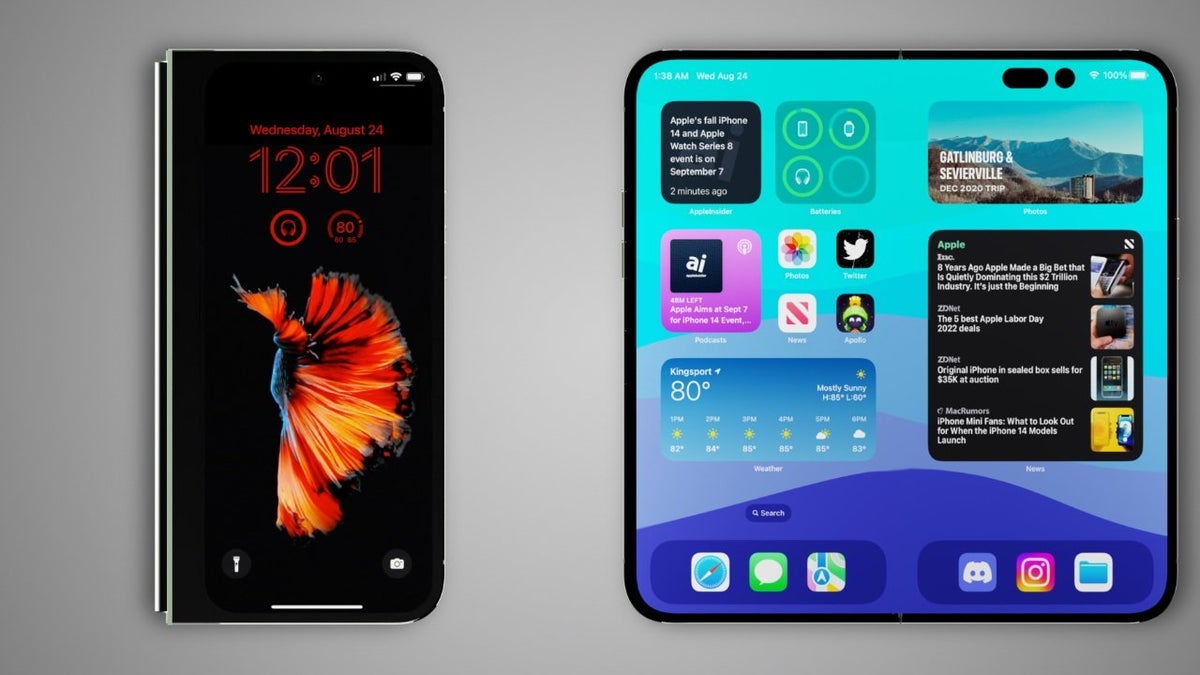
Apple’s foldable iPhone moves from myth to milestone: parts stockpiled, timelines firming, expectations rising
For years the foldable iPhone lived on the horizon line – always discussed, never dated. That horizon just moved closer. Multiple supply chain whispers now point to Apple building inventory for a first-generation foldable iPhone, a strong tell that the project has stepped into pre-production. In practical terms, that means procurement teams are locking in long-lead components, validating yields, and preparing the pipeline so factory lines can ramp without last-minute bottlenecks.
A well-known Chinese tipster with a track record for Apple supply intel says the company is stockpiling key parts. While nobody outside Cupertino’s inner circle is listing exact SKUs, the usual suspects are obvious: foldable-grade OLED panels, precision hinge assemblies, and premium frame materials such as titanium paired with aluminum or stainless steel. This behavior mirrors Apple’s standard playbook before major hardware pivots – get essential pieces secured early, burn down risk through engineering validation, then scale.
What stockpiling signals about Apple’s timeline
Component hoarding is not a flex; it is a schedule control tactic. Foldable displays have longer lead times and tighter yield windows than flat panels, and hinges are tiny machines in their own right, each with tolerances that make watchmakers wince. By bringing parts in early, Apple can cycle through EVT, DVT, and PVT stages with enough buffer to tweak tooling and firmware without punting the launch. The working consensus now orbits around a 2026 debut window, with many watchers aligning that with the iPhone 18 family in September. Slippage to late 2026 remains possible – but the signal strength around 2026 is the clearest it has ever been.
Form factor: a book-style fold, pocket-friendly when shut, tablet-like when open
Expect a book-style layout similar to the Galaxy Z Fold class rather than a clamshell. Rumors peg a compact outer screen around 5.5 inches for one-hand tasks – calls, messages, navigation – and a large inner canvas near 7.8 inches for apps that love space: spreadsheets, split-view messaging, creative tools, and video. This is the quintessential promise of foldables: phone when closed, iPad-adjacent when opened.
One of the loudest talking points is the crease – or rather Apple’s quest to make it a non-issue. Current scuttlebutt suggests the company is leaning on a refined hinge geometry (often nicknamed a water-drop fold) and a carefully tuned panel stack with ultra-thin glass to reduce visible and tactile indentation. No foldable is literally fold-line invisible under every lighting angle, but Apple appears determined to make the fold line something you do not notice in daily scrolling or stylus-free interaction.
Biometrics, cameras, and the front layout
Leakers expect a punch-hole selfie on the outer display and a clean inner canvas without intrusive cutouts. For authentication, chatter points to Touch ID built into the side button rather than Face ID hardware under display. That would simplify the inner screen and avoid durability questions for moving TrueDepth modules. Around back, early units are said to carry a dual-camera system – consistent with Apple’s habit of prioritizing sensor quality, computational photography, and stabilization over sheer lens count on first-gen designs.
Materials, durability, and thinness goals
Two analysts with strong Apple resumes have floated different metal blends: titanium with aluminum in one camp, titanium with stainless steel in another. The hinge may incorporate a high-hardness alloy sometimes described as Liquidmetal to resist wear over hundreds of thousands of folds. A striking claim is a chassis roughly 4.5 mm thin when opened, which would make the device thinner than many conventional phones laid flat. If Apple hits that target, titanium makes sense for stiffness-to-weight, helping the device feel premium while resisting torsion – and, yes, avoiding any echo of bendgate headlines.
Why Apple is late – and why that could be good for you
Samsung, OnePlus, and Google have already taught the world what works and what breaks in foldables. Apple’s lateness is therefore not just caution; it is strategy. Arriving after the first wave lets Apple ship a device that feels polished on day one: hinge smoothness dialed in, panel durability realistic, software transitions fluid, and accessory ecosystem ready. Expect deep integration across iOS and iPad-style multitasking ideas, with continuity features that make moving between outer and inner screens feel automatic. Picture replying on the cover display, opening to the big panel, and finding your thread exactly where you left it – layout preserved, media snapped to the right pane, keyboards sized smartly.
Software ambitions on a bigger canvas
A 7.8-inch inner display begs for enhanced split-screen, floating windows for video or Notes, and Shortcuts that can trigger two-pane workflows in one tap. Apple’s services will likely be tuned accordingly: Fitness+ demos that breathe on a larger canvas, News layouts that feel magazine-native, and pro-leaning features in Files, Freeform, and GarageBand to make the fold feel less like a gimmick and more like a productivity multiplier.
Battery life, thermals, and everyday practicality
Two displays, one body, and the same expectations for all-day stamina – that is the foldable equation Apple has to solve. Expect a staggered cell design split across both halves, with tight control over refresh rates and touch polling to stretch runtime. On the thermal side, a larger internal surface can help spread heat during bursts (gaming, video editing, Maps in AR), while the hinge cavity itself may double as a clever space for cable runs and structural ribs rather than wasted volume.
Should you wait?
If a foldable iPhone sits on your wish list, 2026 looks like a realistic circle on the calendar. The rumored hardware – thin titanium chassis, crease-mitigation hinge, pragmatic biometrics – paired with Apple’s ecosystem advantages suggests a first-gen that aims to feel like the third. If you upgrade annually, you can keep rolling. If you prefer longer cycles and want a phone that doubles as a mini-tablet without the compromises that define early foldables, the patience play may finally pay off.
Bottom line: Apple’s parts stockpile is more than logistics; it is a launch precursor. The company appears to be lining up displays, hinges, and frames to turn a long-running rumor into hardware reality. When the iPhone 18 era arrives, do not be surprised if one of its headliners opens like a book – and rewrites what an iPhone can be.
1 comment
dual cam only on a fold? hope the sensors are huge then