Apple vs Samsung: Why the Galaxy Z Fold 7’s Success May Pave the Way for the Foldable iPhone
Apple has often been criticized for being late to the party when it comes to certain innovations. From larger screens to 5G connectivity, the company has historically chosen to wait until the market matures before making its move. Now, as we approach the end of 2025, the glaring absence of a foldable iPhone has become one of the loudest criticisms Apple faces. But what if this delay is deliberate – and actually part of a larger strategy?
Let’s start with the obvious: Apple is not a company struggling to engineer a foldable device. With resources surpassing $3.5 trillion in market capitalization, Cupertino has both the talent and the financial might to develop groundbreaking hardware. The decision not to launch a foldable iPhone earlier was not about capability, but about timing. Apple prefers to enter markets once the consumer base has shown readiness to adopt new formats. And that readiness might finally have arrived – thanks to Samsung.
Samsung’s Breakthrough with the Galaxy Z Fold 7
The Galaxy Z Fold 7 launched on July 9, 2025, and within just weeks, it broke records across Europe. More than 250,000 units were sold in its first month, making it the fastest-selling foldable Samsung has ever released and the top-selling foldable overall in Western Europe. That’s no small feat, especially considering the foldable market was previously seen as a niche playground for early adopters and tech enthusiasts.
Sales of the Fold 7 are not only double those of the Fold 6, but also around 70% higher than the Fold 4, which previously held Samsung’s sales crown. The summer season is traditionally slow for premium tech purchases, yet this phone managed to defy trends, setting itself up for an even bigger holiday surge during Black Friday, Cyber Monday, and the Christmas shopping rush. For Samsung, the Fold 7 isn’t just a commercial victory; it’s proof that foldables are no longer just a novelty – they’re edging into the mainstream.
Design has played a significant role in this success. The Fold 7 may not boast the biggest battery, but its sleek profile, improved hinge durability, and thin build resonate with buyers who once dismissed foldables as bulky or fragile. Priced around $2,000, it’s a high-end device, but its strong early adoption shows people are now willing to pay a premium for the innovation it brings.
Apple’s Calculated Patience
Why hasn’t Apple launched a foldable yet? Critics argue it’s falling behind, but history tells a different story. Apple didn’t launch the first smartphone, the first smartwatch, or the first tablet. Instead, it waited, observed competitors, and then redefined the category with its own take. The same strategy may be at play with foldables. By letting Samsung and others test the waters – and bear the risk of devices that may have sold poorly – Apple ensured it would enter at the moment consumers were ready.
This strategy isn’t without risks, though. The AI front is where Apple’s “wait-and-see” approach has backfired. Despite Siri receiving an upgrade with iOS 26, the consensus among users is that Apple Intelligence, Cupertino’s AI suite, lags far behind competitors like Google’s Gemini or Microsoft’s Copilot. Unlike AI, however, foldables are hardware-driven innovations, and Apple’s core strength lies in making polished, premium devices that tie deeply into its ecosystem. This could play to its advantage when it finally enters the foldable race.
What We Know About the Foldable iPhone
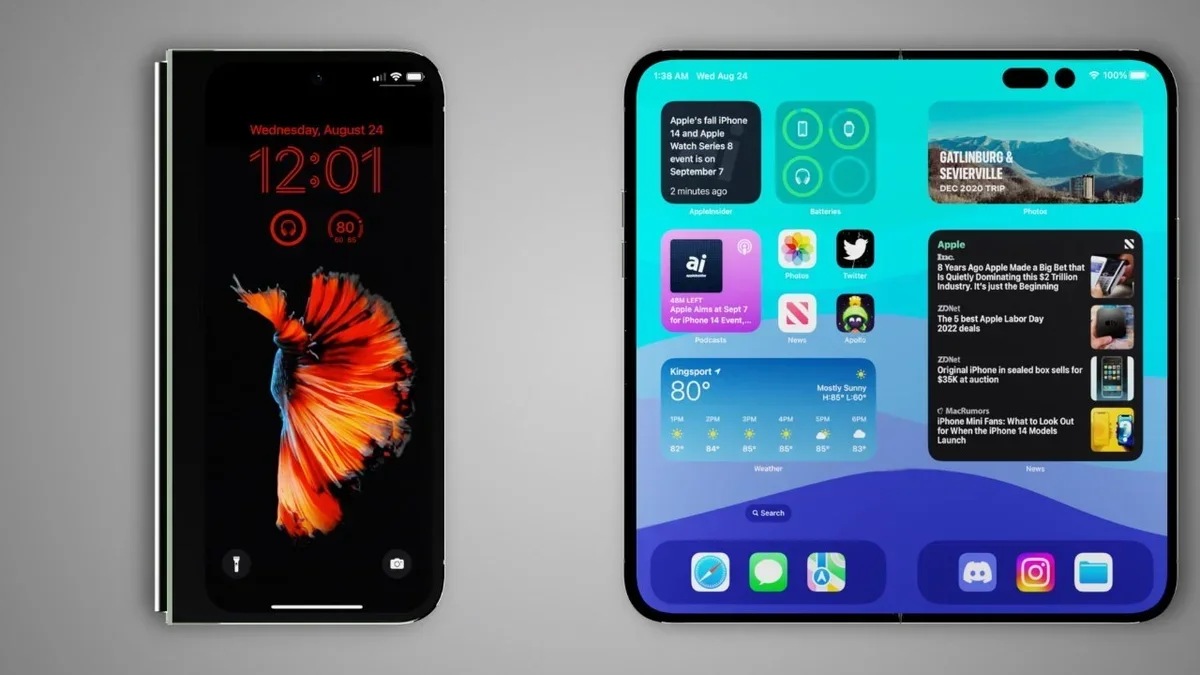
Reports suggest Apple’s foldable iPhone – likely dubbed the iPhone Fold – will debut in 2026. Early leaks point to a device with a nearly crease-free 7.8-inch inner display and a 5.5-inch external screen, designed with slightly wider proportions compared to the Galaxy Z Fold 7. Apple is also rumored to be using advanced hinge materials such as titanium, aiming for durability that outpaces rivals.
Under the hood, the iPhone Fold is expected to run on the A20 chipset built on a 2nm process, promising not only blazing-fast speeds but also improved energy efficiency. Battery life could see a major leap, with capacities rumored between 5,000 and 5,500 mAh. Combined with Apple’s optimized iOS power management, this might give the device the stamina foldable users have long wished for. Additionally, Apple may push boundaries with an under-display selfie camera inside the main screen, while keeping a traditional outer camera for convenience.
The design trade-off may come in thickness. At 4.5–4.8mm unfolded, the iPhone Fold could be slightly bulkier than the Galaxy Z Fold 7. Yet, many users might gladly accept that if it means better battery life and sturdiness. After all, Apple fans have shown time and again that they value endurance and integration over chasing absolute thinness.
The Power of Apple’s Ecosystem
What could truly differentiate Apple’s foldable is not the hardware itself, but the software and ecosystem it plugs into. A foldable iPhone wouldn’t just be a device – it would be a portal to iPad-like multitasking, Apple Pencil support, and flawless synchronization with MacBooks, iPads, and other iOS devices. Features like Handoff, AirDrop, and Universal Control could suddenly feel indispensable on a foldable platform, creating experiences Samsung simply cannot replicate without Apple’s walled garden.
This ecosystem advantage, paired with Apple’s marketing prowess, might be enough to convince millions to line up for the iPhone Fold on launch day. Apple’s fans don’t just buy devices; they buy into an ecosystem where everything works together seamlessly. That’s an advantage no Android brand can fully match, no matter how good their hardware is.
Will Samsung Regret Its Success?
Ironically, the Galaxy Z Fold 7’s success may be the very reason Apple finally greenlights its foldable. Apple has been waiting for the right moment, and Samsung just handed it over. In many ways, Samsung deserves credit for normalizing foldables and proving that consumers are willing to embrace them. But once Apple enters the field, the competition could shift dramatically. Just as the iPhone reshaped the smartphone market in 2007, the iPhone Fold could redefine what foldables are supposed to be in 2026.
So, congratulations to Samsung – the Fold 7 may go down in history not only as the company’s biggest foldable success but also as the catalyst that pushed Apple to act. But when the iPhone Fold arrives, the landscape will change. The Galaxy Z Fold 8 will face not just another Android rival, but Apple itself. And if history has taught us anything, once Apple joins the fight, the rules of the game are rewritten.
3 comments
i’ll wait and see but with iOS bugs lately and no multitasking compared to android, im skeptical tbh
pretty sure apple’s foldable will crush the rest, history repeats
that headline typo cracked me up lol also context is dumb af