AMD’s next wave of gaming CPUs is starting to surface, and at the center of the latest leak sits the Ryzen 7 9850X3D, an 8-core 3D V-Cache chip already spotted running happily on an ASUS B850M AYW Gaming OC WIFI7 W motherboard. Seeing the processor alive and well on a retail-class AM5 platform is a strong signal that AMD is deep into final validation, with many observers expecting a full reveal and launch window to land around CES 2026 if everything stays on track.
The sighting comes from well-known hardware leaker HXL, who shared an image of what appears to be an engineering sample installed on the compact ASUS B850 board. While the leak does not include full benchmark runs, the simple fact that the CPU boots and operates on a mainstream gaming motherboard is important. 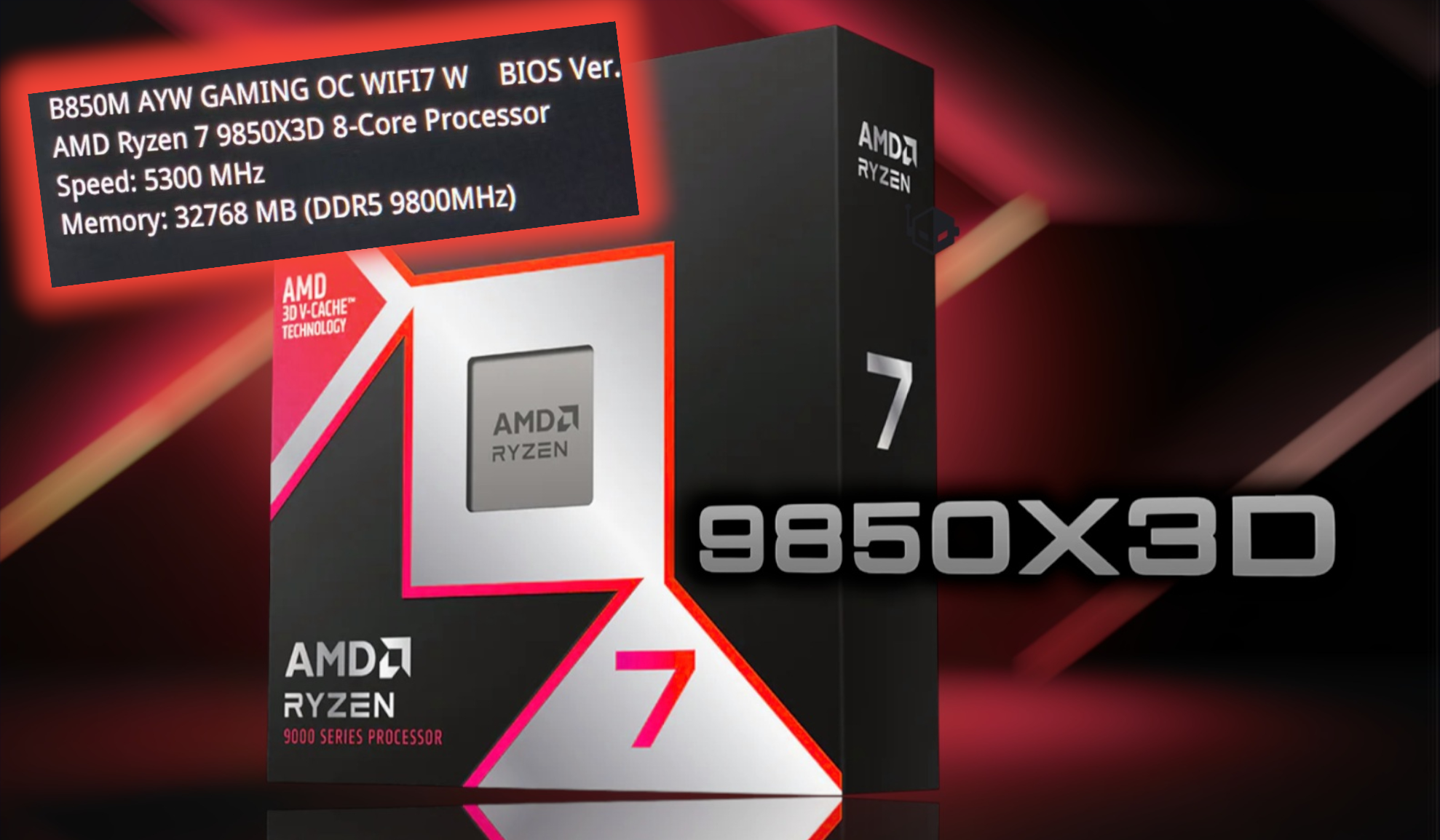
It confirms that firmware, microcode and platform support are already at a mature stage, and for PC gamers still on Ryzen 5000 or early 7000 series chips, it is our clearest hint yet of the next 8-core gaming king.
ASUS B850M AYW Gaming OC WIFI7 W: a B-series board built for high-end gaming
The choice of motherboard in this leak is just as interesting as the CPU itself. Despite its B-series branding, the ASUS B850M AYW Gaming OC WIFI7 W is clearly not a budget throwaway. It is a compact Micro-ATX gaming board designed for serious overclocking, with a power delivery system that would not look out of place on many X-series flagships. ASUS equips it with a 15-phase 80 A VRM configuration, more than enough to keep a 120 W-class CPU like the Ryzen 7 9850X3D comfortably fed under sustained boost clocks and heavy gaming workloads.
Memory support is equally aggressive. The board is rated for DDR5 speeds of up to 10,400 MT/s, opening the door for enthusiasts to pair next-generation Zen 5 X3D silicon with extremely fast RAM. For cache-heavy gaming CPUs, this combination is especially attractive: 3D V-Cache tends to shine when the rest of the system is tuned for low latency, and pushing DDR5 to the limit can help keep both the cores and the massive L3 cache consistently busy in demanding titles.
This also underlines an encouraging trend for the AM5 platform. You do not necessarily need the absolute top-end X870 or X870E motherboard to unlock serious performance from a premium CPU. A well-built B850 board like this ASUS design offers advanced power delivery, PCIe bandwidth, and memory tuning options in a more affordable package, which could make the Ryzen 7 9850X3D a particularly appealing choice for cost-conscious high-end builds.
Ryzen 7 9850X3D: Zen 5 cores with a mountain of cache
Under the heat spreader, the Ryzen 7 9850X3D follows AMD’s proven gaming formula: eight Zen 5 cores, sixteen threads and a large slab of stacked cache. The chip is expected to carry a 120 W TDP and to rely on a single X3D-enabled CCD with 96 MB of L3 cache, backed by 8 MB of L2 cache across its eight cores. This layout mirrors the approach that made earlier chips like the 7800X3D so dominant in gaming benchmarks, where cache capacity and latency often matter more than raw core count once you cross the eight-core mark.
The big generational twist is clock speed. Leaked specifications point to boost clocks of up to 5.6 GHz, which is roughly a 400 MHz bump over the Ryzen 7 9800X3D. For a 3D V-Cache part, that is a significant uplift. Historically, adding a large stack of cache on top of the compute die has constrained maximum frequency because of thermals and power density. If AMD is genuinely able to push an 8-core X3D chip to the mid-5 GHz range, it suggests that the new cache implementation and Zen 5’s efficiency improvements are working exactly as intended.
As a result, the 9850X3D is being positioned as the definitive 8-core gaming processor in AMD’s lineup: a chip designed not for workstation workloads or heavy rendering, but for the highest possible frame rates, smooth 1% lows and consistent performance at high refresh rates when paired with powerful GPUs.
Second-generation 3D V-Cache: cooler, faster and finally overclockable
One of the most intriguing parts of the story is AMD’s second-generation V-Cache technology, which is expected to be used across the Ryzen 9000X3D family, including the 9850X3D. AMD has indicated that this updated design runs cooler and more efficiently than the first wave of X3D parts, and that it also unlocks overclocking support for enthusiasts who want to push clocks and memory beyond stock settings.
That matters for several reasons. Cooler operation gives the CPU more thermal headroom to boost higher and stay there longer, particularly in sustained gaming sessions where the CPU and GPU are both under load. Overclocking support, meanwhile, means owners will not be restricted to fixed voltage and frequency curves: careful tuning of PBO, curve optimizer and memory timings can squeeze even more performance out of the already fast 3D cache architecture. It is also likely that this more mature cache implementation is what enables AMD to consider more complex designs such as dual X3D CCD configurations at the top of the product stack.
Early performance hints: ahead of 9800X3D and comfortably above 7800X3D
Although independent testing is still months away, early leaked figures suggest that the Ryzen 7 9850X3D could deliver around 5 percent higher gaming performance than the Ryzen 7 9800X3D and roughly 20 percent more than the still-popular 7800X3D. On paper those numbers may look modest, but at the cutting edge of CPU-limited gaming, a few percentage points at the top often translate into noticeably stronger minimum frame rates and better stability in complex scenes.
For players targeting 1080p and 1440p high-refresh monitors, where frame times are as important as averages, that improved consistency can be more valuable than big headline average FPS gains. And for anyone upgrading from older architectures such as Ryzen 5000, the combined benefits of Zen 5 cores, DDR5 memory, PCIe 5.0 connectivity and second-generation 3D V-Cache will likely feel like a generational leap in responsiveness across games, streaming and everyday desktop use.
Where the 9850X3D sits in the Ryzen 9000 and 9000X3D family
The Ryzen 7 9850X3D is not arriving alone. It is part of a wider Zen 5 desktop lineup that stretches from efficient 6-core chips up to 16-core powerhouses. At the very top, leaked spec sheets point to a Ryzen 9 9950X3D with 16 cores and a huge combined L3 cache pool, alongside non-X3D versions such as the Ryzen 9 9950X and 9900X for heavy multitasking and content creation. Below them, the Ryzen 9 9900X3D aims to blend 12 cores with extra cache for users who want both strong workstation performance and elite gaming numbers.
In the midrange, AMD appears to be covering almost every type of user: the Ryzen 7 9800X3D and 9700X for mixed use, the 9700F as a more affordable option without integrated graphics, and a series of Ryzen 5 models such as the 9600X and 9600X3D for gamers who prioritize value without giving up modern features. Across the stack, you see common themes: Zen 5 cores, integrated RDNA 2 graphics on most models, DDR5-5600 support and TDPs that range from modest 65 W parts for compact builds up to 170 W and even 200 W for the absolute flagships.
Within this lineup, the 9850X3D clearly occupies the role of the no-compromise 8-core gaming chip. It offers the huge 96 MB 3D V-Cache configuration that gamers care about most, but keeps power at 120 W and avoids the complexity and cost of a dual-CCD design. Pricing is still unconfirmed, but early whispers place it somewhere in the 400 to 500 US dollar range, which would position it directly against high-end GPUs and premium gaming monitors as the centerpiece of an enthusiast build.
Platform, pricing and what it all means for your next gaming PC
From a practical standpoint, the Ryzen 7 9850X3D looks like it could become the default recommendation for anyone building a high-end gaming rig around a powerful GPU. Eight cores and sixteen threads remain more than enough for modern games and simultaneous background tasks such as streaming or recording, while the massive L3 cache helps keep open-world titles, big multiplayer maps and CPU-heavy simulations smooth even as frame rates climb.
Pairing the chip with a capable B850 board such as the ASUS B850M AYW Gaming OC WIFI7 W, some fast DDR5-6000 or higher memory, and a strong graphics card should yield a compact but extremely capable system aimed squarely at 144 Hz and above gaming at 1440p, with enough headroom to stretch into high-FPS 4K in many titles. The fact that AMD is enabling this level of performance on B-series motherboards also means that more of the budget can be shifted toward the GPU, storage and cooling, which is exactly what many gamers want.
With engineering samples already running on retail-class hardware and leaks starting to line up, all that remains is for AMD to confirm clocks, pricing and launch dates. If the early information proves accurate, the Ryzen 7 9850X3D is on track to extend AMD’s dominance in cache-heavy gaming CPUs and give PC enthusiasts yet another compelling reason to stay on, or finally jump to, the AM5 platform.