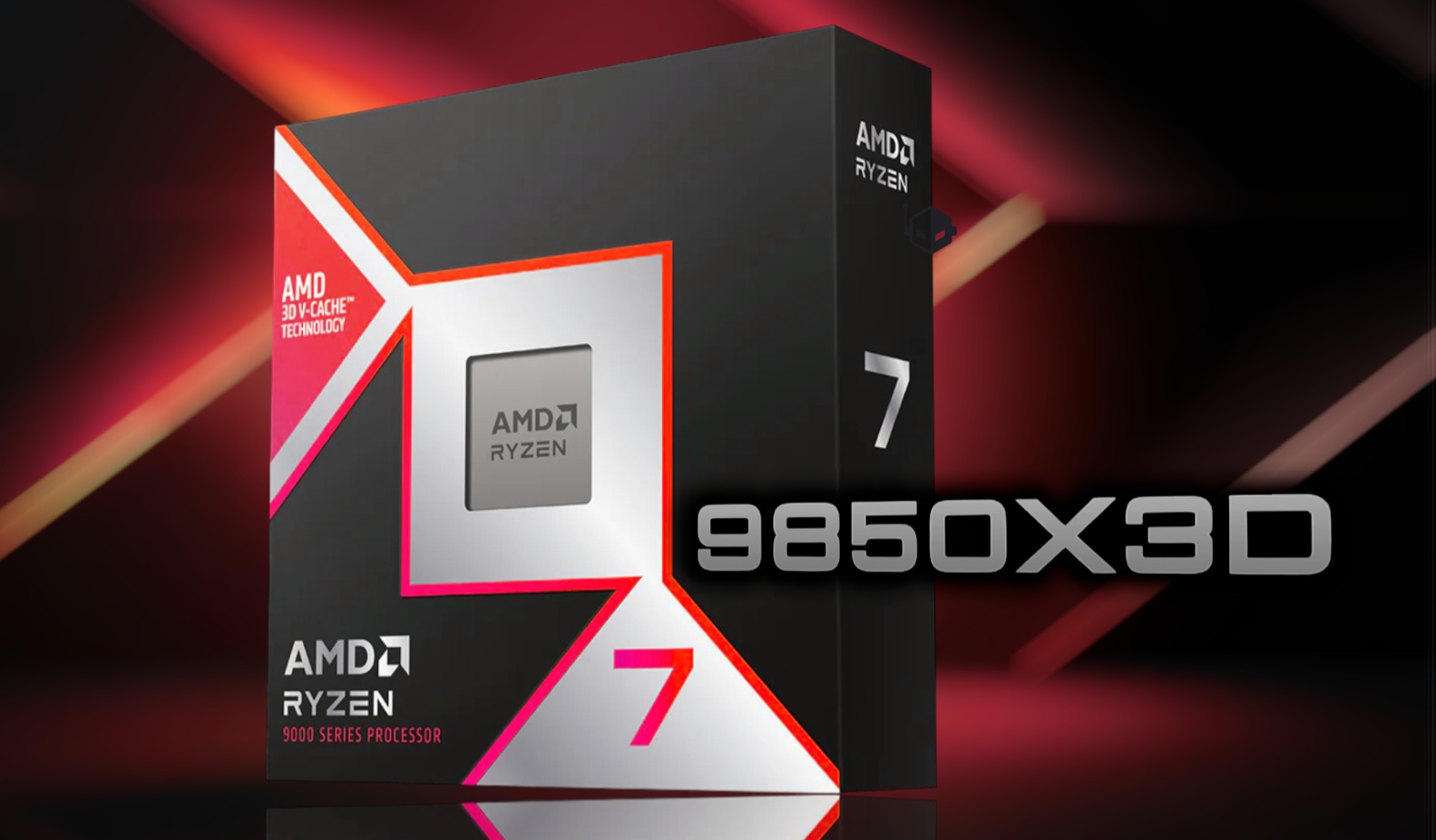
AMD Ryzen 7 9850X3D PassMark Leak: Small Generational Bump Or Big Step For Upgraders
AMD is not waiting for CES 2026 to let its next wave of 3D V-Cache chips quietly slip into the spotlight. The latest leak for the AMD Ryzen 7 9850X3D has surfaced in PassMark, giving us an early look at how this Zen 5 gaming workhorse stacks up against the hugely popular Ryzen 7 7800X3D, the existing Ryzen 7 9800X3D, and even the older AM4 legend, the Ryzen 7 5800X3D. On paper the generational uplift over the 9800X3D is only around five percent, and that has already sparked plenty of sarcasm and memes in enthusiast circles. But once you zoom out and look at the upgrade path from AM4 and older X3D chips, the 9850X3D starts to look a lot more interesting than the raw percentage suggests.
The Ryzen 7 9850X3D is built around eight Zen 5 cores and sixteen threads, aimed squarely at gamers and mainstream enthusiasts who want a fast, cache-heavy chip without jumping to a pricey sixteen core flagship. It carries a 120 watt TDP and pairs those cores with a massive 96 megabytes of L3 cache stacked using AMDs 3D V-Cache technology, plus the usual slice of L2. This is the same cache capacity we saw on the 7800X3D and 9800X3D, but the implementation is now powered by second generation V-Cache that is designed to run cooler, clock higher, and finally play nicely with overclocking. AMD is essentially refining a formula it already knows works extremely well for gaming.
Clock speeds are where the 9850X3D separates itself from the 9800X3D. The new chip reportedly boosts up to 5.6 gigahertz, a notable 400 megahertz jump over the 5.2 gigahertz boost clock of its direct predecessor. That is roughly a 7.5 percent frequency uplift at the top end, which lines up neatly with the modest single core performance gains we are seeing in PassMark. In other words, AMD seems to be cashing in almost all of its extra headroom on raw clocks while keeping the same eight core, single X3D CCD layout that so many gamers already love.
The leaked PassMark numbers, while still early, give us enough to sketch the performance landscape. In the CPU Mark aggregate, the Ryzen 7 9850X3D lands around four thousand six hundred plus points in single threaded performance and roughly eighteen thousand plus points in multi threaded. The Ryzen 7 9800X3D sits a little lower, in the neighborhood of four thousand four hundred in single core and just under eighteen thousand in multi. The older Ryzen 7 7800X3D trails further back, with roughly three thousand seven hundred single core and around seventeen thousand multi, while the venerable AM4 based Ryzen 7 5800X3D lags at roughly three thousand two hundred single core and sixteen thousand plus multi.
| CPU | Architecture | Cores / Threads | Approx ST Score | Approx MT Score |
|---|---|---|---|---|
| Ryzen 7 9850X3D | Zen 5 | 8 / 16 | 4630 | 18400 |
| Ryzen 7 9800X3D | Zen 5 | 8 / 16 | 4425 | 17900 |
| Ryzen 7 7800X3D | Zen 4 | 8 / 16 | 3760 | 17100 |
| Ryzen 7 5800X3D | Zen 3 | 8 / 16 | 3230 | 16200 |
From a purely numerical perspective, the 9850X3D is around five percent ahead of the 9800X3D in both single and multi core results. That is exactly the sort of incremental gain that Intel fans have spent years celebrating as a big generational win, which is why some AMD followers are already poking fun at the idea of calling this a revolution. In reality, this is precisely what you would expect when the architecture and cache configuration remain similar and only the frequency and V-Cache implementation get tuned. We are in the era of diminishing returns where five percent at the same core count and power envelope is more hard fought than it sounds.
The bigger story appears when you stop comparing it only against the 9800X3D and start looking at the upgrade path from older platforms. Versus the Ryzen 7 7800X3D, the leaked scores show more than twenty percent uplift, which is substantial for a chip that will almost certainly be marketed primarily at gamers. Compared to the AM4 based Ryzen 7 5800X3D, the gains swell to roughly forty three percent in single core and up to nearly fifty percent in multi core. For someone still on AM4, those numbers mean shorter render times, snappier everyday responsiveness, and a real chance to hit higher minimum frame rates in CPU bound titles once you pair the chip with fast DDR5 memory.
There is also the wider Zen 5 3D lineup looming in the background. Above the 9850X3D, AMD is expected to ship the Ryzen 9 9900X3D and the headline grabbing Ryzen 9 9950X3D2, a sixteen core flagship with 3D V-Cache on both CCDs. Enthusiast chatter has already dubbed that part the final nail in the coffin for Intels hybrid desktop chips, because every core gets access to stacked cache and the Windows scheduler no longer has to guess which CCD has the gaming friendly configuration. Where recent Intel designs sometimes stumble when the scheduler parks a game on the wrong set of cores, AMDs straightforward full fat core layout with huge cache looks like the easier road to consistently high performance.
That does not mean life is easy for AMD. On the other side of the fence, Arrow Lake and upcoming Intel generations will try to answer Zen 5 and these new X3D chips. Social media is already full of barbed jokes about Arrow flop and comparisons that cherry pick workloads where Intel still looks competitive. Until independent reviews land, any PassMark leak for the 9850X3D has to be taken as an early data point, not a final verdict in the ongoing AMD versus Intel slugfest.
Performance is only half of the equation though, and the community reactions around this leak highlight that clearly. One of the most common refrains from AM4 users is simple: they are not moving to AM5 any time soon, not because the CPUs are slow, but because memory pricing is painful. Stories of the first 32 gigabyte DDR5 kit on a local store listing at four hundred euros for a fairly modest 5600 megahertz kit are not rare, especially since many people picked up 6000 megahertz CL30 kits just a while ago for close to a hundred. Some builders are seriously considering launching new rigs with only 16 gigabytes of DDR5 just to avoid going broke, planning to add more later when pricing normalizes.
The irony is that a big part of the pressure on DRAM prices comes from the same AI boom that is also pushing demand for high performance CPUs and GPUs. Large data center deployments and AI labs are swallowing huge amounts of memory, and when giant buyers reserve large fractions of global DRAM supply, retail pricing stops being reasonable for a while. That is the backdrop against which the Ryzen 7 9850X3D will land: a chip that looks like a fantastic gaming upgrade from older platforms, but which demands a not so modest investment in DDR5 and an AM5 motherboard.
Another thread in the community reactions concerns the role of X3D chips going forward. Some enthusiasts are already joking that they are just waiting for Zen 6 and a Zen six percent meme uplift. Others are asking the more serious question of whether a future vanilla Zen 6 chip without stacked cache could catch or surpass the current X3D parts in gaming. The answer is that it is not a fair apples to apples comparison. 3D V-Cache gives AMD a very specific advantage in latency sensitive workloads like games, and that is hard to replicate with clocks and IPC alone. Vanilla Zen 6 will almost certainly beat vanilla Zen 5 on all fronts, but X3D chips exist specifically to push gaming performance beyond what standard desktop silicon can do at a given power budget.
There is also the question of priorities. A chunk of the audience seems frankly bored by another X3D leak and more excited about the eventual Ryzen 9000G desktop APUs with strong integrated graphics. For people building compact systems, living room PCs, or budget rigs that will rely on integrated GPU performance, another eight core 3D V-Cache chip is not the star of the show. AMD will have to juggle messaging carefully so that the 9850X3D lands as the obvious premium gaming chip without overshadowing the mainstream APU story that a lot of buyers are quietly waiting for.
Within AMDs own stack, the Ryzen 7 9850X3D slots in as the high end eight core option for gamers who do not need or want the power draw and price of a sixteen core flagship. Below it we have the Ryzen 7 9700X and 9700F with more modest cache and clocks, while above it sit the Ryzen 9 9900X3D and 9950X3D2 for heavy multitasking, content creation, and high end gaming. All of these chips share DDR5 support up to at least 5600 megahertz officially, integrated RDNA 2 graphics for basic display duties, and TDPs that range from 65 watts on the leaner parts up to 200 watts for the dual X3D flagship. For many buyers, the 9850X3D will look like the sweet spot where you get the full gaming benefit of 3D V-Cache without having to pay for extra cores you may never saturate.
So should you plan an upgrade around the Ryzen 7 9850X3D just because of this PassMark leak. If you are already on a Ryzen 7 9800X3D, the five percent bump is unlikely to justify a swap on its own, especially once you factor in resale value, cooler compatibility, and the usual hassle. For owners of the 7800X3D, the picture is a bit more nuanced: twenty plus percent across synthetic tests will translate into smoother performance in some demanding games and workloads, but probably not into night and day differences at high resolutions where the GPU becomes the bottleneck. The real winners, at least on paper, are those still running a 5800X3D or earlier AM4 CPU who were already tempted by AM5. For them, the combination of Zen 5 IPC, much higher clocks, second generation 3D V-Cache and the wider AM5 platform features make the 9850X3D a very compelling landing point.
Ultimately, PassMark is just one benchmark, and no seasoned buyer should make a final decision based solely on an early synthetic leak. What this data does tell us is that AMD is not ripping up the playbook for X3D in the Zen 5 era. Instead, it is applying a series of careful refinements: faster clocks, cooler and more robust stacked cache, and a more mature platform around it. The Ryzen 7 9850X3D looks set to deliver exactly what it promises: a polished evolution of one of the best gaming CPU formulas on the market. Whether that is enough for you personally will depend less on that five percent number and more on where you are coming from, how badly DDR5 pricing bites in your region, and how long you plan to stay on your next platform.
1 comment
From a 5800X3D this actually looks kinda sweet. Forty plus percent uplift in some tests plus all the AM5 goodies, thats finally an upgrade that feels like an upgrade, not just new socket tax