AMD has quietly turned one of the most hyped gaming processors of the year into a genuine price shock. The Ryzen 7 9800X3D, the Zen 5 chip built from the ground up for high refresh rate gaming, has slid to around 399 USD at Micro Center. That is not just a small promo, it is a full step down from the official launch price and from what most online retailers are still asking. 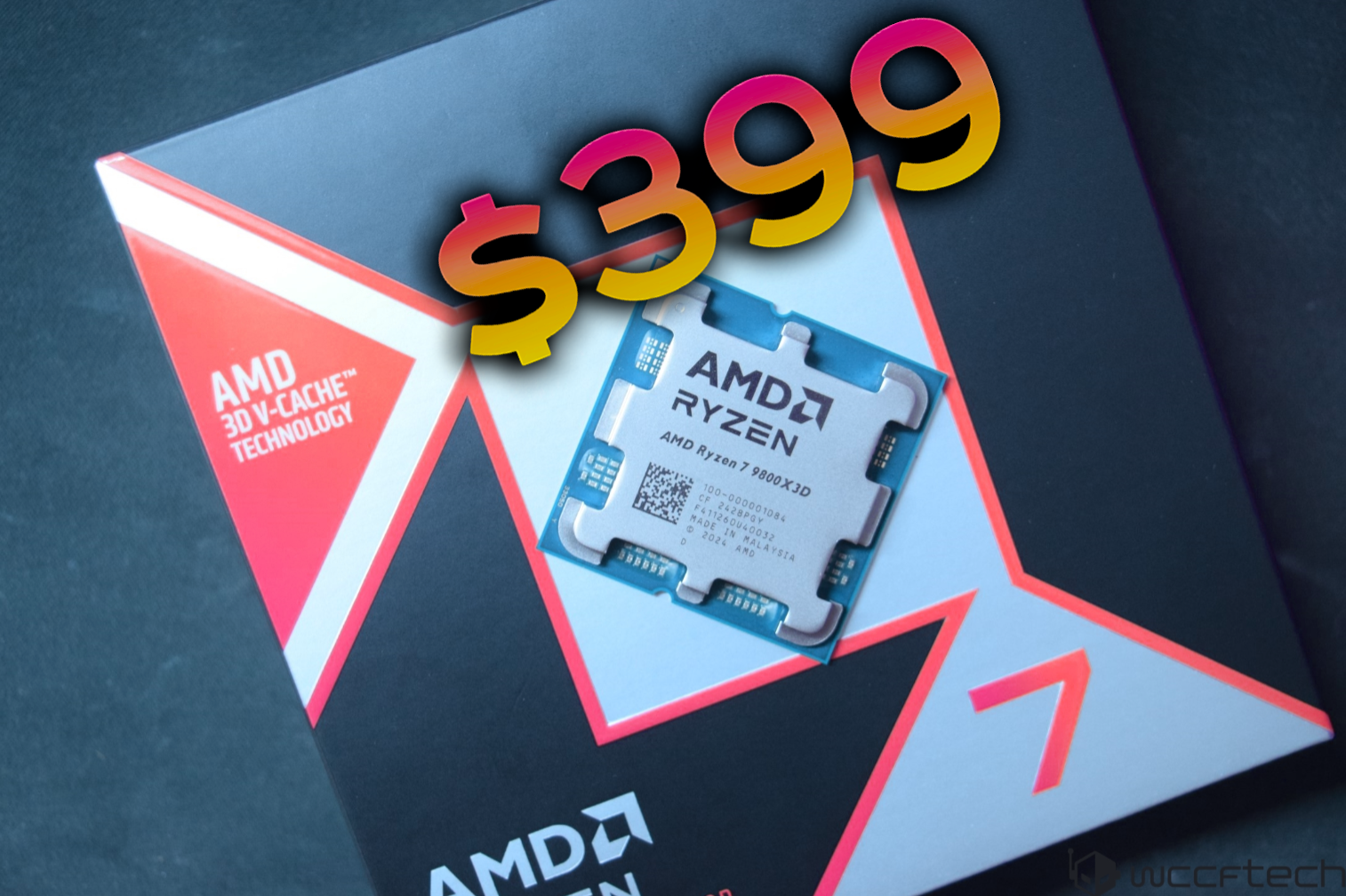
For anyone planning a new gaming rig or looking to retire an aging CPU that is struggling to keep up with modern titles, this is exactly the kind of deal that makes even long time Intel fans double check the benchmarks.
When it launched, AMD positioned the Ryzen 7 9800X3D as its flagship gaming CPU with an MSRP of 479 USD. Since then, we have seen a slow drip of discounts, with typical street prices hovering in the mid 400s at major online stores. Micro Center has now gone further, dropping it to roughly 399 USD and undercutting those listings by a wide margin. That is about 80 USD below the original MSRP, a price cut of roughly 16 to 17 percent. Once you factor in the usual motherboard and memory combo offers that Micro Center loves to run, the total platform cost can shrink dramatically, turning a high end wish list build into something much more realistic.
The reason this particular chip is stirring up so much conversation is simple. In many CPU limited scenarios, especially at 1080p or competitive settings where the graphics card is barely breaking a sweat, the Ryzen 7 9800X3D tends to sit right at the top of gaming charts. It brings 8 cores and 16 threads based on the Zen 5 architecture, with a base clock around 4.7 GHz and boost speeds that can climb to about 5.2 GHz. What truly separates it from regular Ryzen models is the huge slab of additional cache provided by AMDs 3D V Cache technology, which feeds the cores with far more game data than standard designs.
This second generation 3D V Cache implementation is more than a simple repeat of what AMD did on earlier chips like the 7800X3D. The Ryzen 7 9800X3D combines 32 MB of standard L3 cache on its single CCD with an extra 64 MB stacked vertically, for a massive total that many engines absolutely love. The cache stack now matches the footprint of the core complex die, which removes the need for filler silicon and gives the cooler more direct contact with the chip. In practice that means better heat transfer, less thermal bottlenecking, and the ability to hang closer to peak boost clocks for longer gaming sessions without sounding like a jet engine.
Despite the extra performance, AMD keeps the 9800X3D in a familiar envelope with a 120 W TDP. That makes it surprisingly easy to cool for the level of performance on offer. A solid tower air cooler or a modest 240 mm liquid loop is enough to keep temperatures under control and noise civilized. On top of that, the newer 3D V Cache chips are no longer as locked down as the very first wave. The 9800X3D supports the usual tuning tools, from memory overclocks and EXPO profiles to curve optimizers and fine grained voltage tweaks, giving enthusiasts room to squeeze out a little more performance without blowing through their power budgets.
Of course, as any comment thread will remind you, there is no such thing as a universally perfect CPU. Many gamers point out that the Ryzen 7 9800X3D is absolutely at its best when the game is CPU bound and you care about every single frame at 1080p or 1440p high refresh. Once you move up to 4K or crank visual settings until the GPU is the limiting factor, the advantage of all that extra cache naturally shrinks. Some people argue that a cheaper chip like the Ryzen 7 9700X can be the better play for more balanced builds, especially when paired with a strong graphics card and a 1440p monitor where frame rates are already sky high.
There is also the eternal waiting game. A familiar group of enthusiasts rolls their eyes at any claim of best gaming CPU on the planet and is already talking about the likely Ryzen 7 9850X3D or whatever comes next. If a future x3D part delivers another 5 to 10 percent uplift, they say, todays champion will suddenly look ordinary. That cycle never really ends, and it leads some buyers to delay upgrades indefinitely. But in the real world, most people hold on to a gaming PC for years, not months, and the difference between grabbing an extremely fast chip at a steep discount now and waiting for a slightly faster but more expensive successor is often more about psychology than about what you will actually notice in day to day play.
Where the Micro Center deal really changes the conversation is overall value. Many online retailers still list the Ryzen 7 9800X3D in the 440 to 470 USD range, which naturally makes people hesitate. Getting it for 399 USD, and then stacking a discounted AM5 motherboard and possibly even a free or heavily reduced DDR5 kit on top, is a different story. Combined with how affordable DDR5 has become compared to its launch era pricing, the total cost of jumping into the AM5 platform starts to look far more approachable, even if you are coming from an older Intel system or a beloved AM4 chip.
For pure gaming rigs, the end result is compelling. Pair the Ryzen 7 9800X3D with a strong midrange or high end GPU, 32 GB of decent DDR5, and a fast NVMe SSD, and you have a machine that can drive 1080p and 1440p titles at very high refresh rates for years. Competitive shooters, battle royales, and fast paced esport games benefit the most, with smoother frame times and fewer dips when matches get chaotic. Streamers and content creators who mostly focus on games and light editing or encoding work also get plenty of mileage out of the 8 core, 16 thread configuration, while the big cache often helps keep minimum frame rates high even when background tasks are running.
There is one more wrinkle sitting in the background. Reports have suggested that AMD may push pricing on some Ryzen 9000 series and older processors upward, depending on market conditions and inventory. Retailers are not shy about adjusting tags either, especially when exchange rates, stock levels, or competitor moves change. Put simply, the 399 USD price tag we are seeing today might not be a permanent fixture. If the rumored price pressure becomes reality, this wave of aggressive discounts on the Ryzen 7 9800X3D could easily go down as a short window rather than a new normal.
So while the forums continue to light up with AMD versus Intel banter, memes about stuck cats, and hot takes about which chip deserves the crown, ordinary gamers quietly benefit. Right now, the Ryzen 7 9800X3D sitting at 399 USD at Micro Center is one of those rare moments when a true top tier gaming CPU falls into upper midrange pricing territory. If what you care about most is pushing as many frames as possible in modern titles, especially at 1080p and 1440p, and doing it with a cool, efficient system that will sit happily on an AM5 board for years, this 3D V Cache powered Zen 5 chip deserves a serious look.