AMD has officially set the release date for its newest budget-oriented Zen 5 processor, the Ryzen 5 9500F, which will arrive on shelves on September 16th. Positioned as the most affordable entry in the Ryzen 9000 lineup, the chip aims to give gamers and mainstream PC users a taste of Zen 5 performance without breaking the bank. 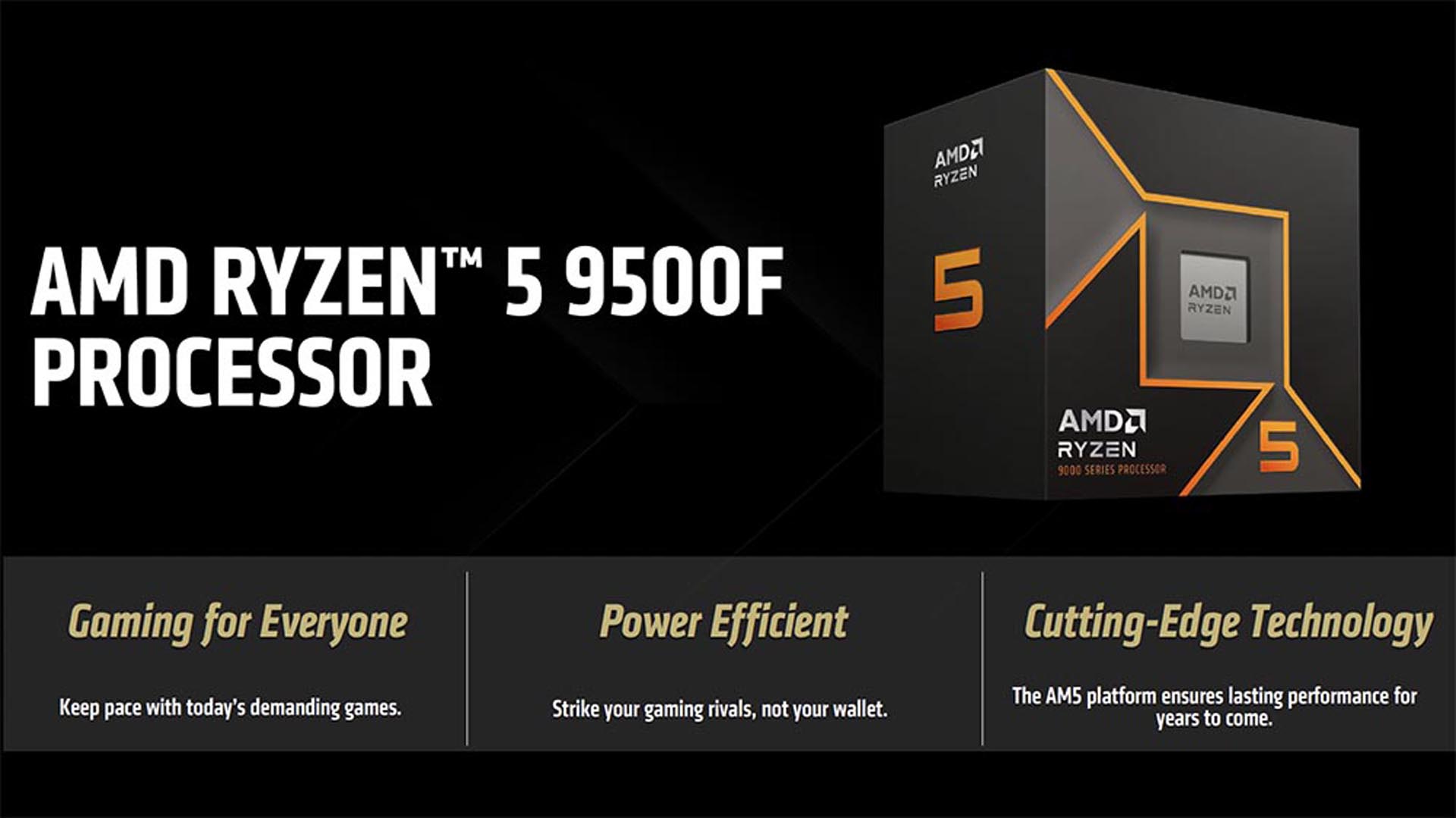
However, its launch comes with caveats that spark debate among enthusiasts.
At its core, the Ryzen 5 9500F offers a 6-core, 12-thread design, clocked at a 3.8 GHz base frequency and boosting up to 5.0 GHz. The similarities with its sibling, the Ryzen 5 9600X, are striking – same 65W TDP, same cache setup, same architectural foundation. The only notable difference lies in the boost clock, which is about 400 MHz lower. To keep costs down, AMD has also stripped the chip of integrated graphics, making it a better fit for users who already plan on pairing it with a discrete GPU.
According to AMD’s internal slides, the Ryzen 5 9500F shows a respectable generational uplift when compared to the previous Ryzen 5 7500F. In AAA gaming benchmarks like Baldur’s Gate 3, AMD claims gains of up to 24%, with an average of around 9% across a suite of ten major titles. In competitive multiplayer games, the chip reportedly offers an 11% average uplift, with certain titles showing even stronger boosts. AMD emphasizes these improvements were tested at 1080p high settings, a resolution where CPU bottlenecks are more apparent. Still, the company notes that performance can vary in real-world setups.
The story gets more complex when looking beyond AMD’s own data. Independent tests from Chinese platform Bilibili (via @9550pro) paint a more muted picture. When paired with NVIDIA’s GeForce RTX 5080, the Ryzen 5 9500F was only about 3.5% faster than the 7500F, and most of this advantage came from just two titles – DOTA 2 and Call of Duty: Black Ops 6. For the majority of other games, the gap was negligible, suggesting that while Zen 5 improvements exist, they may not always translate into visible gains for everyday gamers.
Pricing also complicates the equation. AMD has set the launch price at 1,299 Yuan, roughly $181 USD before taxes. That’s only $20 less than the Ryzen 5 9600X in China, which not only delivers slightly better performance but also includes an integrated GPU. For many buyers, the extra $20 could prove worthwhile, especially for those wanting a fallback option when no discrete graphics card is available.
In summary, the Ryzen 5 9500F is AMD’s attempt to capture budget-conscious buyers with a Zen 5 chip that delivers incremental but not groundbreaking gains. On paper, it’s an appealing upgrade from the 7500F, particularly for those focused on esports and competitive titles where small boosts matter. Yet, when judged against its sibling, the 9600X, the pricing difference makes its value proposition more questionable. Whether this CPU ends up being a hidden gem or just a stopgap option will depend heavily on real-world reviews and how AMD’s retail partners position it against fierce Intel competition.