AMD has officially unveiled its new “Helios” rack-scale platform at the Open Compute Project (OCP) event, signaling a bold step toward challenging NVIDIA’s long-standing dominance in the AI infrastructure space. The Helios platform marks AMD’s first large-scale, open-standard system designed to integrate its next-generation EPYC Venice CPUs and Instinct MI400 GPUs within a unified rack-scale architecture built on the Open Rack Wide (ORW) specification introduced by Meta. 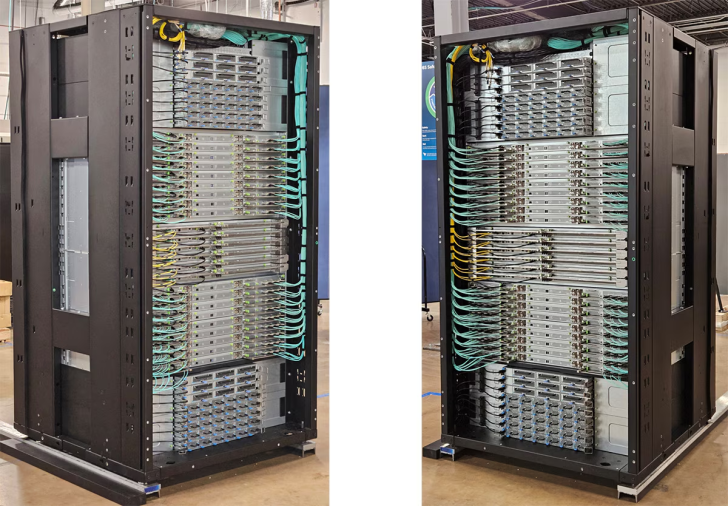
It’s an ambitious move that blends open design with powerful compute components and custom networking to create a foundation for future AI data centers.
At OCP, AMD didn’t just tease specs – it showcased a fully built Helios rack, offering a glimpse into what the company envisions as the next evolutionary step in AI hardware. The display highlighted a double-wide ORW chassis featuring horizontal compute sleds that occupy around 70–80% of the total rack space, surrounded by service bays for accessibility and maintenance. The platform’s clean internal layout, accentuated by two distinctive fiber lines – the blue ‘Aqua’ and yellow ‘Power’ runs – drew attention for its meticulous engineering and modular cooling solutions.
AMD’s Data Center EVP explained that Helios embodies the company’s commitment to open standards and flexibility: “With Helios, we’re turning open standards into real, deployable systems – combining AMD Instinct GPUs, EPYC CPUs, and open fabrics to create a scalable, high-performance platform for next-generation AI workloads.” This is more than marketing speak; the firm’s design approach shows clear intent to enable interoperability and customizability – two areas where closed, proprietary NVIDIA systems have long held sway.
Helios will use UALink for intra-rack (scale-up) communication and UEC Ethernet for inter-rack (scale-out) connectivity, providing an open alternative to NVIDIA’s NVLink and InfiniBand technologies. AMD also integrates Pensando DPUs for smart networking, giving Helios a distinct advantage in flexible, distributed AI deployments. Perhaps one of the most notable engineering decisions is its adoption of quick-disconnect liquid cooling, enabling high-density thermal management while simplifying maintenance – a clear nod to the increasing energy and heat demands of modern AI training clusters.
The industry reception to Helios has been a mix of intrigue and skepticism. Some argue AMD still needs to prove its ability to deliver large-scale AI solutions at the level of NVIDIA’s Rubin or Hopper ecosystems, while others view this as AMD’s strongest attempt yet to disrupt the data center status quo. The inclusion of open-source fabrics and Meta-backed ORW compliance might give AMD leverage with hyperscalers that have been pushing for modular and non-proprietary hardware for years.
In essence, Helios represents AMD’s coming-of-age moment in AI infrastructure – not just a component maker, but a full-solution provider ready to shape data center architecture for the AI era. If performance and scalability match expectations, NVIDIA could soon face real competition in a domain it has long dominated alone. The upcoming months, particularly as AMD rolls out full Helios configurations with Venice CPUs and MI400 accelerators, will determine whether Team Red can truly redefine the AI hardware landscape.
2 comments
this thing looks sick ngl, open racks + liquid cooling? damn that’s nice
bro these fanboys acting like nvidia invented ai itself 💀