AMD is pushing its Zen 5 strategy deeper into the edge with the launch of the EPYC Embedded 2005 series, a family of compact processors designed for systems that never get to power down. 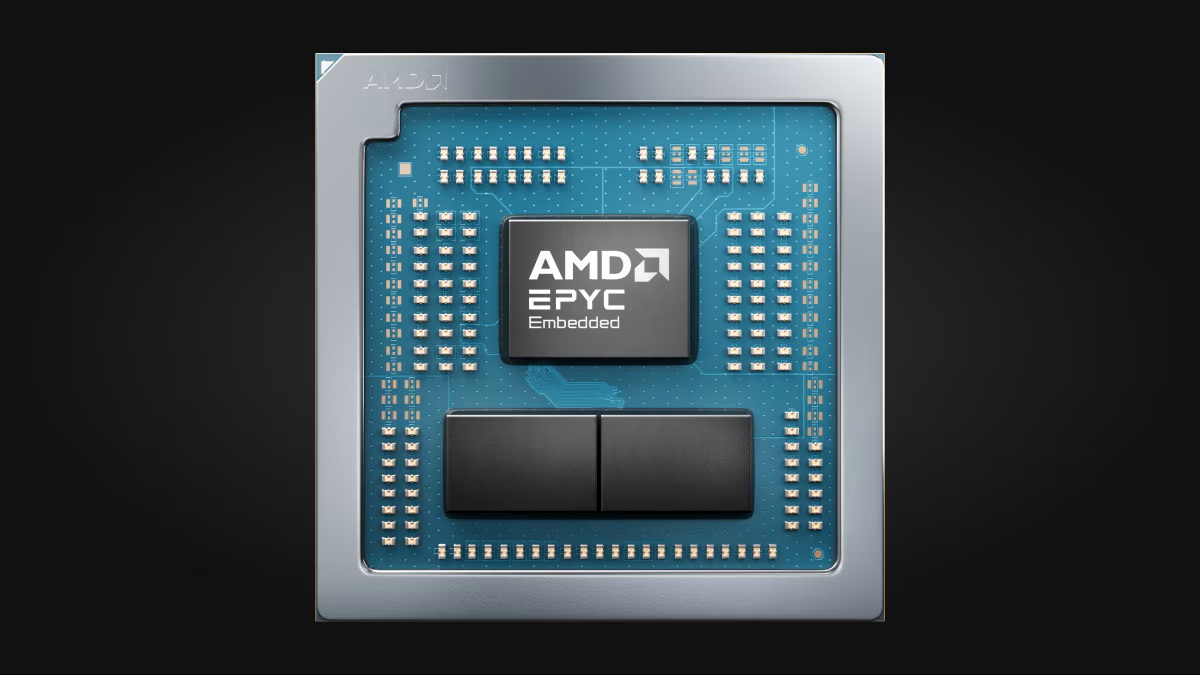
From top-of-rack switches and storage controllers to industrial robots and aerospace platforms, these chips are built for the unglamorous but critical layer of infrastructure that has to run 24/7, quietly and efficiently, somewhere far away from air-conditioned data centers.
The backdrop is simple: AI-driven workloads are no longer confined to big cloud clusters. Inference, data filtering, network telemetry, security analytics and control-plane logic are increasingly being pushed closer to where data is generated. That shift puts pressure on embedded system designers to deliver more compute per watt, more I/O in less space, and server-class reliability in boxes that might be bolted to a factory wall or a telecom pole. This is exactly the niche AMD is targeting with EPYC Embedded 2005.
Small BGA package, big Zen 5 core count
At the heart of the lineup is a 40 mm × 40 mm BGA package that AMD says is around 2.4 times smaller than comparable Intel Xeon 6500P-B solutions. That footprint matters: a soldered BGA design allows board vendors to squeeze more compute into tight, power- and space-constrained form factors, while shortening electrical paths for better signal integrity and simpler thermal design.
Despite the small package, EPYC Embedded 2005 scales up to 16 x86 cores based on AMD’s latest Zen 5 microarchitecture, backed by up to 64 MB of shared L3 cache. The configurable TDP spans 45 W to 75 W, giving OEMs room to tune the silicon to their airflow, chassis and power-budget realities. In other words, you can dial these parts down for fanless networking gear or allow a higher envelope for dense edge servers that need all the clocks they can get.
Under the hood, the silicon looks very similar to the high-end mobile dies that power AMD’s flagship notebook chips, now repurposed and hardened for embedded and server-style duty. Commenters are already joking that AMD basically took something in the class of a Ryzen 9 9955HX, locked it into a BGA socket and turned it into an always-on control-plane engine. In a laptop, the idle power might look chunky; in an embedded box that was never going to sleep anyway, it suddenly makes a lot more sense.
Performance density vs Intel Xeon
AMD is particularly keen to highlight how EPYC Embedded 2005 stacks up against Intel’s Xeon 6503P-B. According to AMD’s own figures, the new parts can offer up to 28% higher boost CPU frequency and 35% higher base CPU frequency while operating at roughly half the TDP of the Xeon competitor. For embedded designers, that translates directly into performance density: more work per watt, more headroom for additional accelerators, or simply smaller power supplies and quieter cooling solutions.
There is, of course, plenty of noise in the comment sections whenever AMD and Intel show up in the same chart. The usual memes about “Shintel” vs “AMDead” resurface, along with cherry-picked benchmark screenshots and out-of-context percentages. Strip away the fanboy arguments, though, and the real story is about platform efficiency. If a 45–75 W Zen 5 part can match or beat a higher-TDP Xeon in the kinds of mixed control, security and light AI workloads common at the edge, that is exactly the kind of incremental but meaningful win OEMs care about.
PCIe Gen5, DDR5 and I/O for the AI edge
Raw CPU performance is only part of the package. EPYC Embedded 2005 exposes 28 lanes of PCIe Gen5, giving designers a flexible toolbox for building modular systems. Up to 16 of those lanes can be aggregated to hang high-speed Ethernet NICs, FPGAs, SmartNICs or custom networking ASICs directly off the CPU. The remaining lanes can be used for NVMe storage, additional accelerators or out-of-band management controllers, depending on the appliance class.
On the memory side, support for DDR5 delivers more bandwidth and better scaling for AI-adjacent tasks such as packet inspection, encryption, compression and telemetry aggregation. Just as importantly, DDR5 support offers a clean migration path as DDR4 enters end-of-life. For customers building platforms with 10- to 15-year lifecycles – think telecom, industrial and aerospace – that long-term viability is as crucial as any single benchmark number.
Reliability, security and software ecosystem
Embedded infrastructure systems are not enthusiast gaming rigs; they are expected to run continuously, often in harsh environments, with tight SLAs for uptime. AMD positions the EPYC Embedded 2005 family with the usual suite of RAS (reliability, availability and serviceability) features, hardware-level security capabilities and the long-term availability commitments that OEMs need to lock in a platform.
The software side is just as important. These are x86 Zen 5 cores, which means they plug directly into existing Linux distributions, container platforms and virtualization stacks. From a DevOps perspective, running an EPYC Embedded 2005 appliance at the edge should feel very similar to managing a standard EPYC system in the data center, making it easier to extend CI/CD, observability and security tooling out to the network’s edge.
From telecom racks to homelabs
Officially, AMD is aiming these processors at networking gear, storage controllers, aerospace, industrial control and robotics. Unofficially, the specs are already making homelab enthusiasts salivate. A 16-core Zen 5 CPU with DDR5 and PCIe Gen5 in a 45–75 W envelope is exactly the kind of silicon that could power dense 1U or shoebox-sized edge servers, NAS appliances or all-in-one home lab machines – if, of course, any vendor decides to sell boards and systems to regular consumers.
The sweet spot is obvious: enough cores and I/O for serious virtualization, container clusters or small-scale AI inference, but still frugal enough to run 24/7 without blowing up the power bill. As one observer noted, idle power that feels high for a thin-and-light laptop looks perfectly acceptable in a rack that was never meant to sleep anyway.
Noise, memes and the bigger picture
Whenever AMD moves the needle in servers or embedded, the wider ecosystem reacts. Some commenters fantasize about a world where Jensen, as a major shareholder of every x86 player, could simply demand an x86 license for Nvidia and sweep the market. Others nitpick benchmarks or compare desktop GPUs to embedded CPUs, mixing apples, oranges and the occasional pineapple for good measure.
The reality on the ground is less dramatic but more consequential. EPYC Embedded 2005 is a steady, well-targeted step in AMD’s roadmap: bringing Zen 5 into compact, power-constrained infrastructure designs with competitive performance, modern I/O and long-term availability. In a market where reliability and efficiency beat marketing slogans, that kind of quiet evolution is exactly what keeps networks humming, factories running and data flowing – often in places most of us will never see.
2 comments
Someone in the thread said Jensen should just buy half of Intel and AMD and ask for an x86 license for Nvidia, I legit choked on my coffee 🤣
Not an Intel fan, not an AMD fan either, but comparing desktop GPUs to embedded CPUs to prove a point is peak internet clownery lol