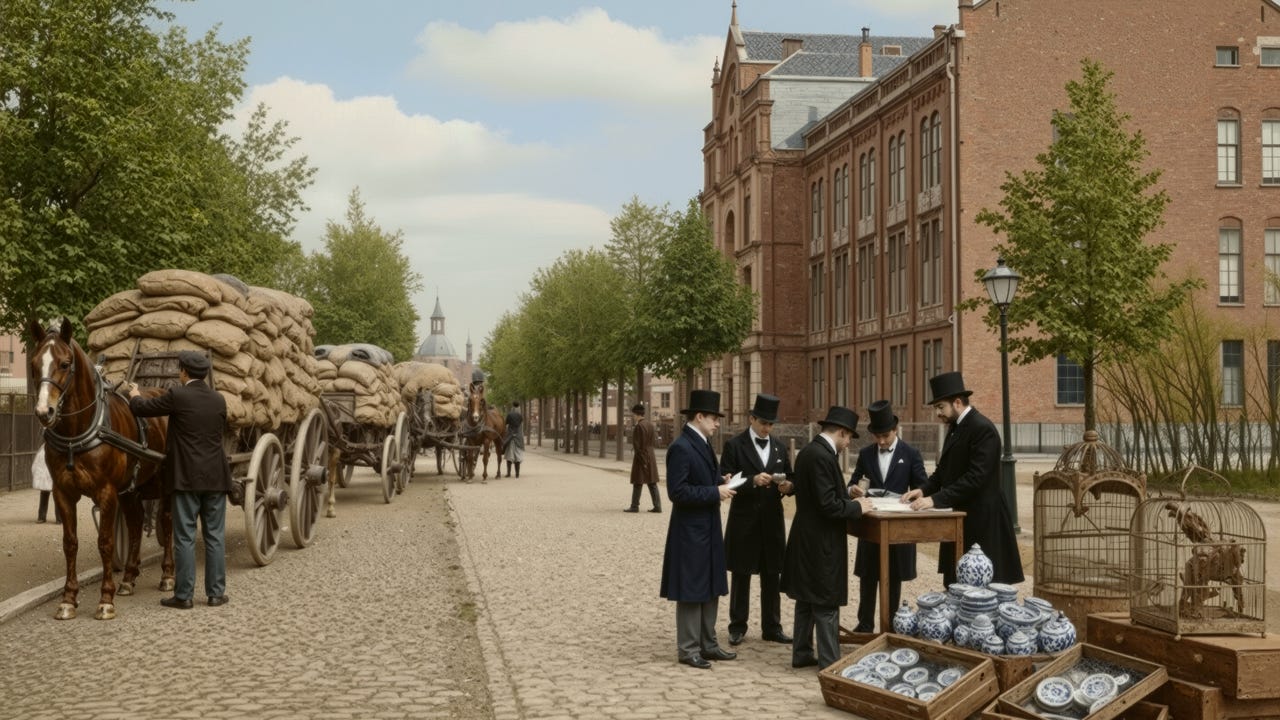
AI History Series ‘Straten van Toen’ Reimagines Dutch Streets on The History Channel
When the AI performer Tilly Norwood first appeared online, she instantly became a flashpoint in the argument over whether synthetic faces should ever stand in for human actors. Now her creator, Dutch filmmaker and entrepreneur Eline van der Velden, is back with a very different experiment. Instead of pushing an AI “actress” to the foreground, she is using artificial intelligence as a kind of time machine for a new shortform series on the Netherlands arm of The History Channel.
The project, produced by Van der Velden’s company Particle6 in partnership with Hearst Networks, is called Straten van Toen – “Streets of the Past.” Across ten bite-sized episodes, Dutch historical investigator and reality personality Corjan Mol wanders through some of the country’s most iconic streets, squares and canal sides. Viewers see the familiar paving stones, shopfronts and bicycles of today, but AI-generated sequences peel back the layers of time to reveal how those same locations looked in previous centuries.
From viral AI actor to historical storyteller
Tilly Norwood turned Van der Velden into a lightning rod. Many performers saw the hyper-real AI character as a direct threat to their livelihoods, arriving at a moment when worries about deepfakes and automated casting were already high. Even Ryan Reynolds weighed in by turning Tilly into a joke, cementing her meme status and the sense that AI actors might be more unsettling than exciting. Against that backdrop, Straten van Toen feels like an attempt to redirect the conversation: what if AI does not replace actors, but helps them – and presenters like Mol – tell richer, more visual stories about the world we actually live in?
Particle6 has used AI behind the scenes for years, quietly applying it to research, workflow and post-production. This series is the first time the company is putting the technology so boldly on screen. Yet Van der Velden insists it is still human-led: writers, historians, designers and Mol himself shape the narratives, while the algorithms are treated as powerful tools rather than creative overlords.
How AI rebuilds the streets of the past
Instead of inventing history from thin air, the production leans on archival materials: paintings of canal houses by Dutch masters, sepia-toned photographs, city maps, engravings and prints. These sources feed AI models that construct immersive scenes matching the exact locations where Mol is standing. The aim is accuracy first, spectacle second. Rooflines, window styles, signage and even the way light falls on the facades are checked against historical references before the shots are approved.
Within those reconstructed streets, Particle6 populates the world with a mix of real and imagined figures: merchants and sailors based on documented residents, alongside composite characters who can speak the exposition that history books leave between the lines. Mol appears as a kind of time traveller, stepping into these AI-built tableaux in cameo roles. One moment he is a modern presenter in jeans and a jacket; the next, he is dressed like a seventeenth-century shopkeeper, reacting to events as though he has truly slipped through a crack in time.
Visually, the result sits somewhere between classic television re-enactments and a richly modded historical video game. Live-action plates of the present-day Netherlands are blended with AI scenes of the same street in another era, allowing the camera to glide from now to then without obvious seams. Done well, it could give viewers that strange, almost physical jolt of realising that under every sneaker print lies centuries of other lives.
Excitement, scepticism and the AI bubble question
Not everyone is thrilled, of course. Some viewers argue that if you want a funny, irreverent take on the past, you can still get it from formats like “Drunk History,” where very human storytellers slur their way through real events. Others say they would happily rewind culture back to the 1990s – when TV relied on physical sets, practical effects and a healthier balance between analog and digital – rather than watching yet another experiment in automation.
There is also the question of timing. The entertainment industry is chasing AI projects at high speed while investors whisper about an eventual bubble. To sceptics, a niche AI history show on a cable network feels like a last-minute scramble to claim relevance before the hype curve dips. The History Channel itself divides opinion: fans welcome the chance to see a serious historical format again, while critics dismiss the brand as “slop” that long ago traded rigorous documentaries for eye-catching gimmicks.
Still, even among critics, there is grudging respect for the way Straten van Toen uses the technology. Instead of swapping out human performers with synthetic ones, AI is focusing on environments, textures and crowds – areas where computers genuinely shine and where traditional visual-effects artists have always needed heavy resources. In an ideal world, projects like this would sit alongside skilled CG teams rather than quietly replacing them, but as a proof of concept it at least points toward a collaboration model rather than a full-scale takeover.
A blueprint for future history formats?
If the experiment works, it could become a template for how other broadcasters approach history. Imagine local versions in different countries, where presenters walk through familiar neighbourhoods and AI rebuilds lost theatres, demolished factories or pre-war apartment blocks. There is huge educational potential in letting audiences “stand” on their own street corner and watch it morph through time in front of their eyes, instead of staring at a static black-and-white photo in a textbook.
At the same time, the risks are real. AI can just as easily fabricate as it can reconstruct, and visual shortcuts taken for pacing or drama might blur the line between documented fact and plausible invention. That is why Van der Velden’s repeated insistence on human oversight matters. For Straten van Toen to win trust, the series will need to be transparent about its sources and honest about which details are drawn from records and which are educated guesswork.
In the end, the show lands right on the fault line of our relationship with technology. Many people quietly miss a slower, less automated media world; others are curious to see how far generative tools can stretch television grammar. Whether Straten van Toen becomes a beloved format or a forgotten experiment, it tells us something revealing about this moment: we are not content simply to walk down today’s streets. We want, with a little help from code, to feel all the other centuries pressing in around us.
4 comments
tbh this is probably the least-worst use of AI so far, but it’s stuck on a channel nobody I know actually watches anymore
not a terrible idea, better than replacing actors, but maybe pay real CG/VFX artists instead of letting the machine do it all??
Sometimes I legit wish we could roll tech back to like 1997, nice mix of analog + digital and zero AI everything 😅
ngl I’d rather just binge Drunk History with real drunk storytellers than stare at another uncanny AI face lol