Desktop PCs are about to borrow another trick from the server world. ADATA, in cooperation with MSI, has unveiled what it calls the world's first 4-rank DDR5 CUDIMM module for mainstream platforms, pushing capacity to a massive 128 GB per stick. 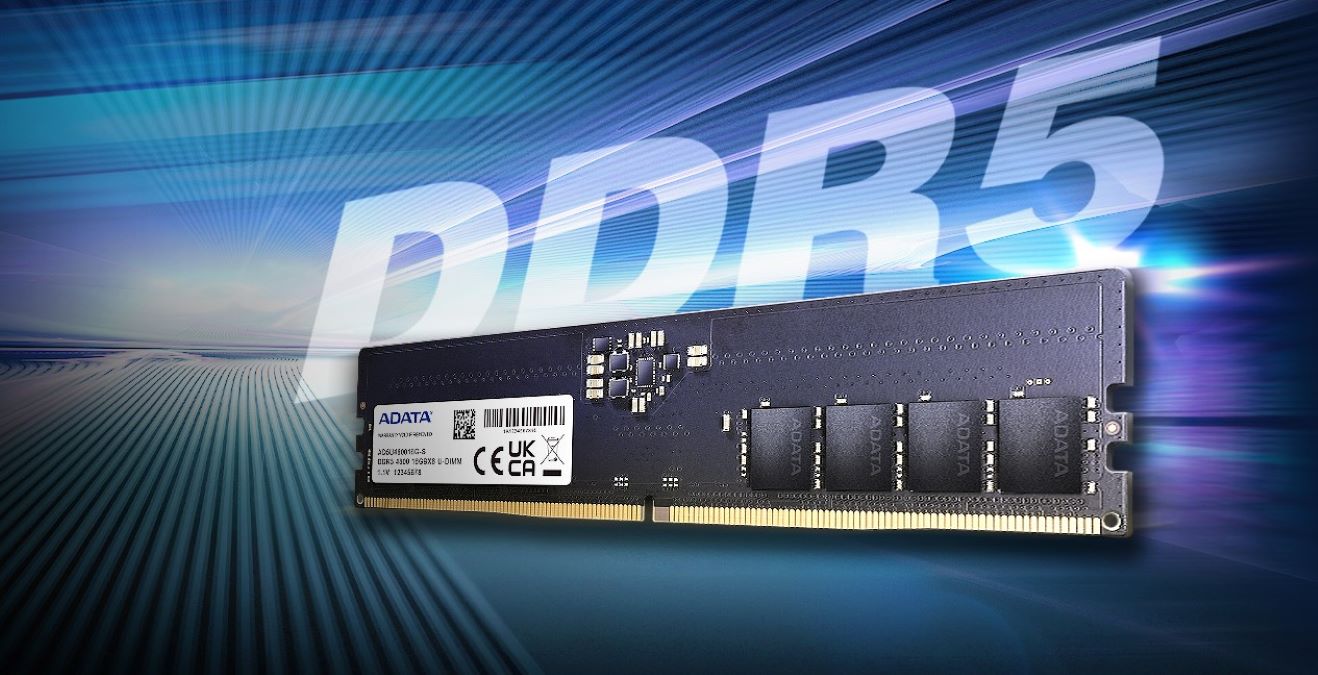
For years, enthusiasts have been stuck at 64 GB per DIMM on consumer boards, even as workloads like AI, 8K video editing, and huge codebases have exploded. This new 4-rank design effectively doubles what a single DDR5 module can hold, opening the door to 256 GB of RAM on a simple two-slot motherboard.
To understand why this is a big deal, it helps to look at what "ranks" actually are. In today's typical DDR5 modules, you get single-rank or dual-rank configurations: one or two groups of chips that the memory controller can address. ADATA's new 4-rank CUDIMM essentially stacks four of these groups on a single PCB. That means far more memory chips are hanging off the same memory channel, allowing the leap from 64 GB to 128 GB without changing the physical slot or breaking compatibility with standard desktop motherboards.
Of course, this doesn't come for free. Packing four ranks on one module increases the electrical load on the memory bus. That can make ultra-high frequencies harder to hit and may require more careful tuning from motherboard vendors. ADATA's early sample is rated at 5600 MT/s, which is not the fastest number in the DDR5 ecosystem, but that's beside the point: these modules are clearly aimed at users who care more about raw capacity and stability than about squeezing out the last couple of percentage points in gaming benchmarks.
ADATA validated its 4-rank 128 GB CUDIMM on MSI's in-development Z890 motherboards, confirming that the platform can boot, run, and stress-test these monster sticks without drama. This matters especially for compact and workstation-style builds. Mini-ITX or small ATX systems often have only two DIMM slots, which historically limited them to 64 GB or 128 GB total. With 128 GB per module, the same boards could now handle 256 GB, turning a small-form-factor PC into a serious workstation for creators, engineers, and AI enthusiasts.
That extra headroom directly benefits memory-hungry workloads. Local AI inference with large language models, fine-tuning custom models, massive Blender scenes, Unreal Engine projects, and multi-stream 4K or 8K video timelines can all chew through 64 GB surprisingly fast. With 128 GB per DIMM, creators can keep more assets resident in memory, avoid constant swapping to SSD, and maintain smoother performance in offline environments where cloud-based compute is not an option. For developers experimenting with multi-GPU or NVL-style AI builds, such high-capacity RAM also makes it easier to manage huge datasets, caches, and preprocessed assets directly on the workstation.
ADATA hints that the combination of dense CUDIMM modules and MSI's next-gen Z890 platform will enable highly efficient, fully local compute setups. Think of small but powerful boxes that run AI assistants, data analysis pipelines, or production workloads entirely on-prem, without shipping sensitive information to external servers. With greater memory capacity, these systems can juggle multiple VMs, containers, and complex pipelines in parallel while still leaving room for everyday tasks like browsing and communication.
There are still plenty of question marks. ADATA hasn't published detailed timings, voltages, or SKUs for the 4-rank DDR5 CUDIMM line, and there is no firm retail launch date yet. MSI, meanwhile, is still finalizing its Z890 motherboard stack, so the first wave of boards compatible with these modules is also "coming soon" rather than here today. And then there is the elephant in the room: pricing. With the DRAM market still volatile and 128 GB modules sitting at the bleeding edge of consumer tech, nobody should expect these sticks to be cheap in the short term.
Still, this first step is important. For years, PC enthusiasts dreaming about high-capacity builds have had to resort to HEDT platforms or repurposed server hardware to get past 128 GB of RAM. ADATA and MSI are signaling that mainstream platforms are now ready to catch up. If the ecosystem matures, we're likely to see a wave of 4-rank DDR5 options and motherboards tuned specifically for high-capacity configurations. That means more room for wild NVL-inspired builds, compact AI workstations, and future-proof desktop rigs that won't hit a memory ceiling anytime soon.
1 comment
Nice to see ADATA and MSI pushing capacity instead of just another pointless +200 MT/s marketing bump