Apple is quietly turning its in-house training hub into one of the most interesting education stories in American manufacturing. The Apple Manufacturing Academy, created to upskill workers for advanced production lines, has taken a major step forward by bringing its curriculum online. 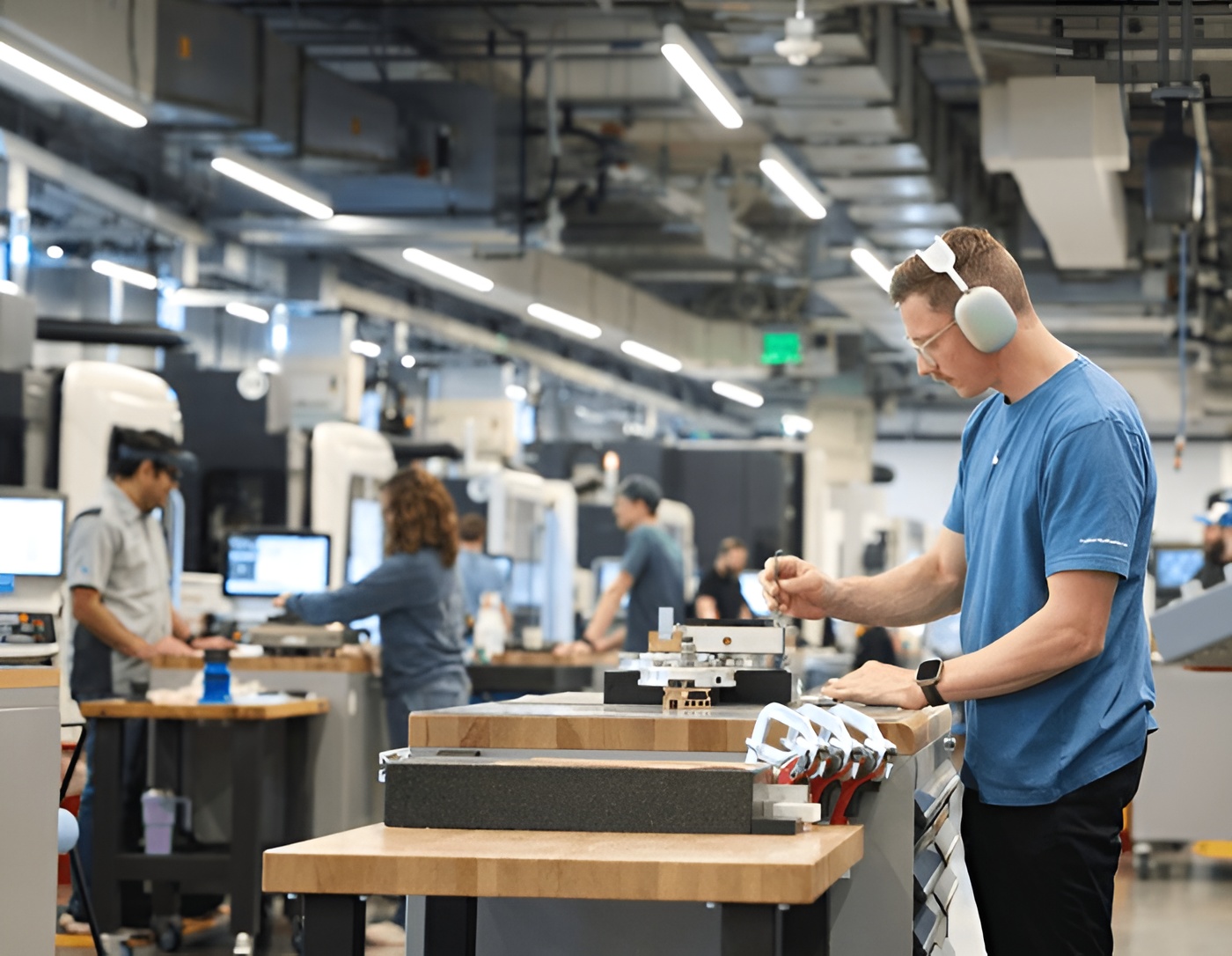
What began as a physical academy in Detroit is now evolving into a virtual classroom designed to reach suppliers, partners and small manufacturers across the United States, dramatically lowering the barrier to high-end technical training.
This move does not exist in isolation. It sits inside a far bigger industrial commitment from Apple: a pledge to invest 600 billion dollars in the United States over the next four years. That massive figure is tied to a strategy that intertwines advanced manufacturing, supply chain security and political realities such as tariff exemptions. By opening up its know-how, Apple is effectively telling partners that it is not just buying components, it is helping build the ecosystem needed to produce them competitively at home.
Part of a 600 billion dollar made in the US strategy
At the heart of this strategy is an effort to create a domestic end to end silicon supply chain. Apple is working with a roster of key partners across each stage of chip design and production, including GlobalWafers America, Texas Instruments, Samsung and Amkor. Instead of treating semiconductor manufacturing as a black box handled offshore, the company wants more of that value and expertise within US borders, supported by a workforce that understands the latest tools, standards and reliability requirements.
Display technology is another crucial piece. Through expanded partnerships with Corning, Apple plans to source more display glass from domestic facilities, tightening quality control and shortening logistics routes. The strategy extends further into infrastructure: a new AI server manufacturing facility in Houston dedicated to the next wave of artificial intelligence workloads, and rapid expansion of datacenter capacity in North Carolina, Iowa, Oregon, Arizona and Nevada. Together, these investments build a physical backbone for the software and services Apple expects to deliver in the coming decade.
From Detroit pilot to national classroom
The Apple Manufacturing Academy was launched in Detroit in partnership with Michigan State University as a way to prepare workers for these new kinds of plants and processes. For its first phase, all training was delivered on site in Detroit. That was valuable for companies close enough to send teams in person, but it left a gap for smaller firms and remote suppliers who simply could not afford the travel, time away from production or relocation costs.
Moving the academy online directly tackles that limitation. By turning the curriculum into virtual courses, Apple can reach a much broader slice of the manufacturing landscape, including family owned factories, regional repair centers and specialist component makers that may have never had structured access to this type of advanced instruction. It also lets staff learn in shorter blocks, revisit modules and integrate training into shift based work, instead of squeezing everything into a single intensive trip.
What the new virtual curriculum actually teaches
The first wave of online courses focuses on some of the most important capabilities for modern factories. Automation modules help workers understand how to design, monitor and improve automated production lines rather than simply reacting when something breaks. Predictive maintenance training shows teams how to use data from sensors and machines to anticipate failures, schedule repairs in advance and avoid costly downtime.
Quality control optimisation goes beyond old style inspection to cover data driven approaches, statistical thinking and process design that reduce waste and defects before they appear. A dedicated track on machine learning with vision introduces participants to how cameras and AI models can be used to spot anomalies, verify parts, guide robots and make inspections more consistent. Finally, professional development training focuses on soft skills that often determine whether new technology is successfully adopted: project management, communication between engineering and operations, and building a culture that values continuous improvement.
Apple describes this initial virtual catalogue as only the first phase of the academy. The plan is to keep expanding the curriculum as new technologies, tools and factory needs emerge, turning the platform into a living library rather than a static set of videos.
Early impact and national competitiveness
Even before the online launch, the program had already begun to show its reach. Since its debut in August 2025, the Apple Manufacturing Academy has worked with more than 80 businesses spread across states such as Florida, Indiana, Michigan, Missouri and Utah. Those early cohorts operated under the constraints of in person training. With virtual access, the number and diversity of participants is likely to increase sharply, especially from regions that are trying to rebuild or modernise their industrial base.
Apple chief operating officer Sabih Khan has framed the initiative as a way to deepen expertise across the entire supply chain, not just inside Apple facilities. Bringing the curriculum online, he argues, opens the door for many more businesses and workers to build cutting edge skills that will help keep US manufacturing competitive in fields like silicon, AI hardware and precision assembly. In practical terms, the academy becomes a force multiplier for Apple’s 600 billion dollar investment promise, ensuring there are enough trained people to operate the plants, data centres and server lines the company is funding.
For policymakers and industry watchers, the virtualisation of the Apple Manufacturing Academy is an important signal. It implies that the future of advanced manufacturing in the US will not be secured only through tax breaks and industrial incentives, but also through systematic investment in people and knowledge sharing. By combining massive capital spending with scalable training, Apple is trying to align its own business interests with a broader national push toward resilient, AI ready manufacturing.
1 comment
finally some tech news that isnt just layoffs and AI doom, skill building for workers is the good timeline 😂