AMD’s next 8 core gaming special, the Ryzen 7 9850X3D, has quietly surfaced in fresh Geekbench 6 entries, and the numbers are already stirring up the never ending AMD versus Intel debate. While the chip is still unannounced and all information should be treated as early and provisional, the leak paints a picture of a Zen 5 based 3D V Cache processor that pushes clocks higher than any X3D desktop part before it, while keeping the familiar 8 core, 16 thread configuration that made previous X3D chips so popular with gamers.
According to the database listings, the Ryzen 7 9850X3D sticks to the formula that works: 8 Zen 5 cores with simultaneous multithreading, a 120 W TDP and a gigantic slab of L3 cache stacked on top of the compute die. In total you still get 96 MB of L3 cache on a single X3D CCD, combined with the usual 8 MB of L2, but the headline change is frequency. 
The base clock is listed at 4.7 GHz, while boost is recorded at up to 5.6 GHz, a bump of about 400 MHz over the Ryzen 7 9800X3D. For a latency sensitive, cache heavy design like this, even a few hundred extra megahertz can make the difference in high refresh rate gaming.
On paper, then, the 9850X3D looks like a refinement rather than a radical redesign. AMD is leveraging its second generation 3D V Cache implementation across the wider Ryzen 9000 family, and the company has previously hinted that the new stacking process improves thermals, raises achievable clocks and behaves far better with voltage tweaks than the first batch of X3D chips. If those claims translate into retail silicon, that would explain how an 8 core X3D part is now flirting with 5.6 GHz while staying inside a 120 W envelope.
The Geekbench entries themselves list two different motherboards based on AMD’s new B850 platform. One run uses a Colorful CVN B850M Gaming Frozen 14A, where the chip appears to hit its advertised 5.6 GHz boost under load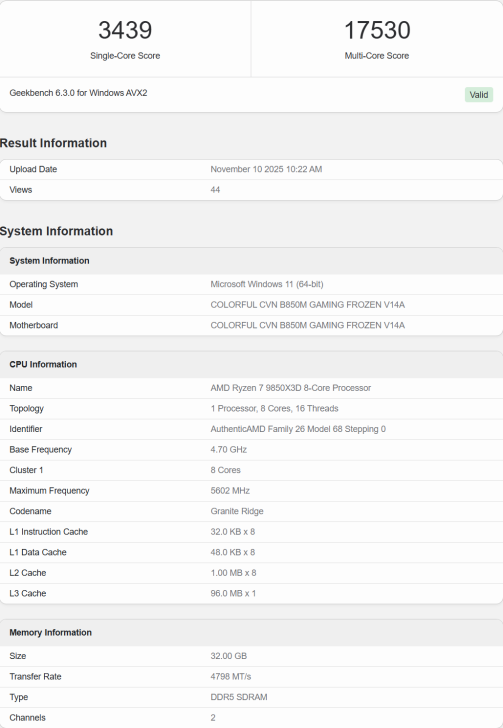
. The other run sits on a compact Maxsun B850 ITX board, and there the boost tops out closer to the 5.3 to 5.4 GHz range. That kind of variation is not unusual this early in a platform’s life, when BIOS versions are still immature, but it also reminds us why it is dangerous to declare winners and losers off a couple of pre launch benchmarks.
There are other red flags that seasoned benchmark watchers have already pointed out. The CPU name string in the listing still reads along the lines of an 8 core processor label that does not quite match how AMD tends to brand retail chips, and the scores themselves come in slightly behind a well tuned Ryzen 7 9800X3D in similar tests. Memory configuration is also far from optimal: both entries are using 32 GB of DDR5 locked at 4800 MT s, which is painfully slow compared to the DDR5 5600 and above speeds that Zen 5 is designed for. On a cache heavy gaming chip, memory latency and frequency can change scores by several percentage points, especially in mixed workloads like Geekbench.
In other words, anyone rushing into the comments to declare that this leak proves AMD has fumbled Zen 5, or that the new X3D is barely faster than its predecessor, is doing what internet comment sections always do: reacting before the full story is known. Several enthusiasts have already joked that this looks like the classic situation where you get a 5 to 10 percent bump in ideal scenarios and maybe three percent at 4K once the GPU is the main bottleneck. Others counter that high cache Zen chips tend to shine in 1080p esports titles and minimum frame rate metrics, where small average gains can hide much larger improvements to frame time consistency. Until reviewers get retail hardware on mature boards with fast memory, both camps are mostly arguing from instinct.
Placed in the wider Ryzen 9000 line up, the Ryzen 7 9850X3D has a clear job. At the top of the stack sit the 16 core Ryzen 9 9950X and its hypothetical X3D sibling, monster chips with up to 192 MB of L3 cache that target creators and extreme enthusiasts. Below them the 12 core Ryzen 9 9900X and 9900X3D cover heavy multitasking and mixed gaming plus productivity builds. The 8 core tier is where mainstream high end gaming rigs live, and here AMD now has three distinct flavors: the straightforward Ryzen 7 9700X, the cache boosted 9800X3D, and this new 9850X3D that appears to pair the giant cache with the highest clocks of the group. Further down, the six core Ryzen 5 9600X and incoming 9600X3D are set to chase value oriented gamers.
If provisional pricing rumors hold, the Ryzen 7 9850X3D could land somewhere in the 400 to 500 US dollar bracket, bracketing or slightly overlapping the Ryzen 7 9800X3D. 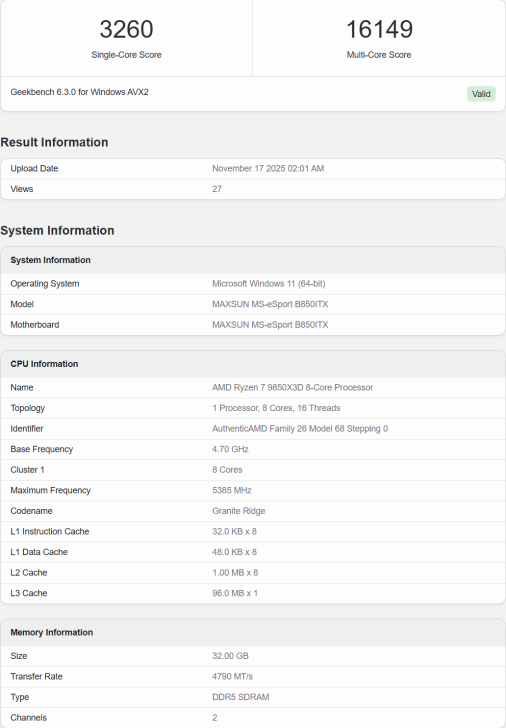
That would put it head to head with future Intel Arrow Lake Core i7 offerings, as well as any special gaming focused models Intel may cook up. It is no surprise, then, that a big slice of the community discourse around this leak is framed in the language of a boxing match. Some commenters are already memeing that Zen 5 will give Intel nightmares for years, pointing to previous X3D chips like the 5800X3D that punched far above their weight in games. Others fire back with jokes about AMDead, insisting Arrow Lake will land a strong counterpunch once it arrives.
The reality, as usual, is likely to be more nuanced than either side of the fan war wants to admit. If the 9850X3D delivers a solid double digit uplift in the most CPU bound titles at 1080p, tightens one percent lows and keeps power draw reasonable, it will be an attractive drop in upgrade for existing AM5 owners and a compelling heart for new high refresh builds. If, on the other hand, the gains are only five to seven percent at best, some buyers will reasonably decide that a cheaper 9800X3D, or even an overclocked non X3D Zen 5 chip paired with fast DDR5, offers better value. That tension between absolute performance and bang for buck is exactly what keeps the market interesting.
There is also the question of platform maturity. Early B850 boards, as seen in these benchmarks, may not yet expose the full memory and boost behavior AMD intends. AGESA updates have historically moved performance by noticeable margins, particularly on new architectures. Enthusiasts still remember how first generation Ryzen improved substantially with later BIOS revisions. It would not be surprising to see similar story lines with early Zen 5 X3D parts as board vendors tune voltages, SOC limits and curve optimizer defaults specifically for stacked cache models.
Another angle that has caught the community’s imagination is overclocking. The second generation 3D V Cache design, used across all these Ryzen 9000 desktop parts, is supposed to be less fragile and more tolerant of tinkering than the earliest attempts. That raises hopes for safe per core curve optimization, memory overclocking and even modest frequency overclocks without running straight into thermal ceilings. Memes about releasing the 270K Kraken and chasing leaderboard scores are already circulating, and it is easy to imagine a wave of guides focused on squeezing every last frame out of an 8 core Zen 5 X3D system once the chips are actually on shelves.
Until then, the sensible stance is cautious optimism. The leaked Geekbench entries do suggest that AMD is confident enough in its second generation cache stacking to push clocks significantly higher while keeping the beloved 8 core plus huge cache recipe intact. At the same time, the unfinished memory configuration, odd naming strings and slightly underwhelming early scores are strong reminders that this is not final silicon running in a polished environment. With CES 2026 looming as the most likely stage for a proper announcement, gamers and hardware enthusiasts have just enough information to start theory crafting builds, but not nearly enough to declare the next champion.
For now, the Ryzen 7 9850X3D sits in that familiar pre launch limbo: part rumor, part leak, part wish list. If AMD delivers on the promise of a cooler running, higher clocked X3D design that preserves AM5 compatibility and lands at a sensible price, it will give anyone shopping for a top tier 8 core gaming processor a very difficult decision to make. And judging by the loud, chaotic comment threads already forming around these benchmarks, that is exactly the kind of headache the PC community secretly enjoys.
2 comments
Can you be more specific about the content of your article? After reading it, I still have some doubts. Hope you can help me.
Your point of view caught my eye and was very interesting. Thanks. I have a question for you.