Every few years a single smartphone comes along that does more than just top sales charts – it drags the entire industry in its wake. In 2025 that role clearly belongs to Apple’s iPhone 17. What looked like a solid upgrade on paper has turned into a runaway commercial hit that is forcing analysts to redraw their forecasts for the whole global smartphone market.
Fresh numbers from IDC suggest Apple is on track to ship about 247.4 million iPhones in 2025, a record for the company and a hefty 6.1% increase in unit shipments year over year. 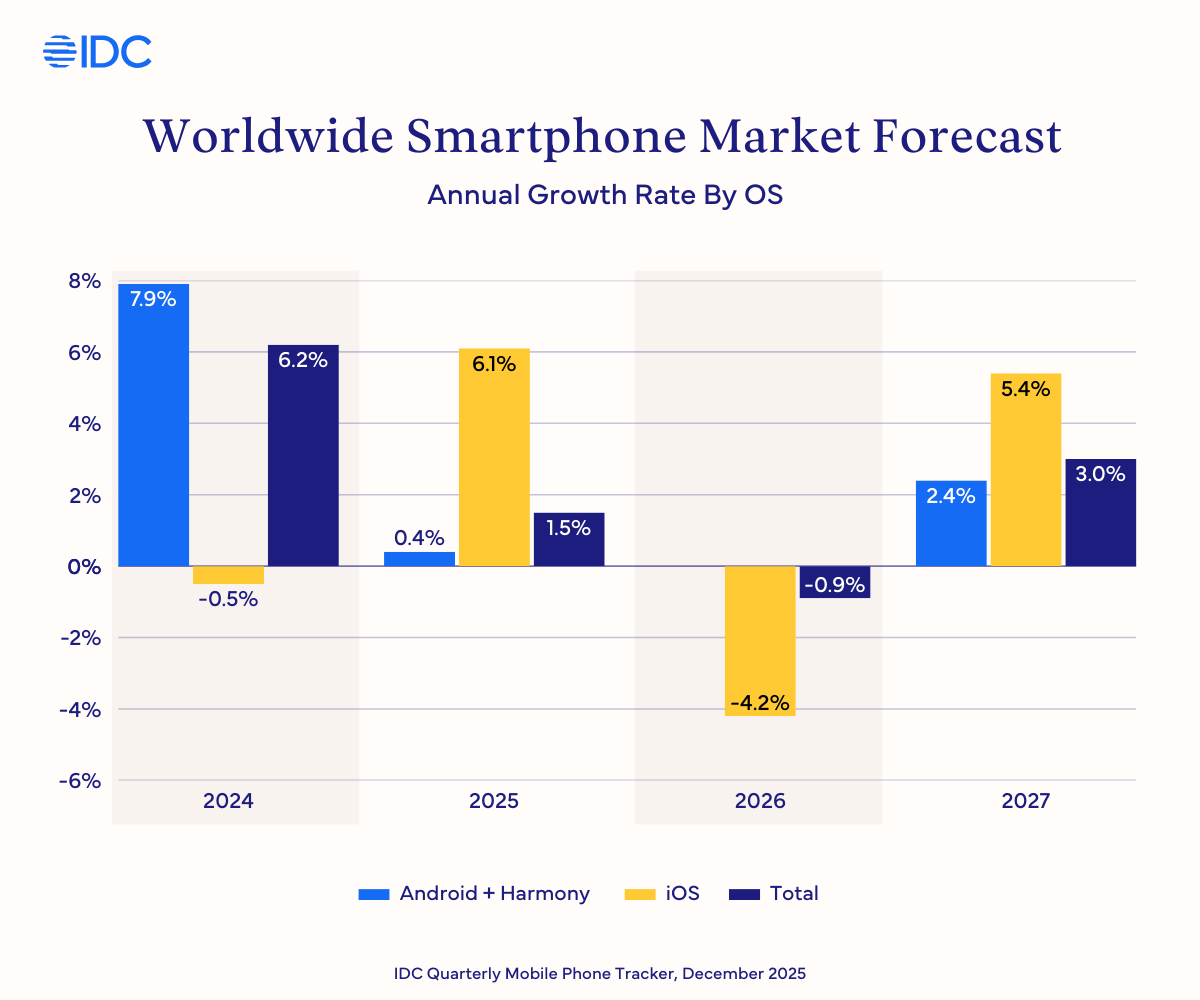
On its own that would already be impressive for such a mature product line, but the iPhone 17’s momentum is so strong that IDC has had to nudge its entire smartphone market outlook higher. Instead of the previously expected 1% growth, total shipments are now projected to rise by 1.5% to around 1.25 billion devices – with Apple effectively shouldering most of that upside.
The most striking story is playing out in China, a market where Apple has faced intense competitive and political pressure, and where online commentators love to proclaim that local brands have already left the iPhone in the dust. Reality looks very different once you move away from comment sections and look at the data. According to IDC’s monthly sales tracking, the iPhone 17 grabbed more than 20% share in China during October and November, comfortably ranking first and leaving domestic rivals scrambling. That surge was so strong that IDC had to revise its Q4 iPhone forecast for China from 9% growth to 17% growth year over year.
In other words, the country that is often held up as proof that Apple is "finished" is currently one of the main reasons why its latest iPhone is breaking records. Chinese buyers, who have no shortage of aggressively priced and technically ambitious Android options, are still voting with their wallets for Apple’s ecosystem, hardware reliability, resale value, and the prestige that comes with the brand. For all the noise about supposedly superior local alternatives, consumers in one of the most competitive markets on Earth are signaling something very different.
The same pattern repeats in other key regions. In the United States and Western Europe, the iPhone 17 has reversed what many expected to be a stagnation phase. Instead of the modest decline analysts forecasted a few months ago – including a projected 1% drop in China for 2025 – Apple is now expected to squeeze out growth of about 3% across its iPhone business. It is a rare case of a single product family single-handedly pulling the global market curve upward.
All of this is happening against a noisy backdrop where critics and some tech YouTubers insist Apple is falling behind in artificial intelligence because it is not shipping as many flashy AI-branded features as certain Android competitors. Yet the most damning rebuttal to that narrative is sales performance. While AI-heavy Android flagships struggle to convert hype into real demand, the iPhone 17’s combination of tight hardware–software integration, long-term updates, and quiet on-device intelligence seems to be exactly what mainstream buyers want. The industry can celebrate benchmarks and buzzwords; the market quietly keeps rewarding execution.
However, the story does not stay this rosy if you fast forward to 2026. Apple is preparing a major shake-up of its iPhone roadmap with the iPhone 18 generation. The company is widely expected to launch the iPhone 18 Pro models and its long-rumored iPhone Fold in September 2026, while the standard iPhone 18 may slide to spring 2027. That staggered schedule, combined with a global memory shortage that could constrain supply and drive component prices higher, is already baked into analyst forecasts.
IDC now anticipates that iOS shipments will fall by about 4.2% in 2026 as a result of the gap between major launches, and that overall smartphone shipments will dip by roughly 0.9% in the same year. On paper it looks like a sudden loss of momentum after a record 2025. In practice it is more like a deliberate pause in the release cycle plus an industry-wide component crunch – the kind of temporary turbulence a dominant player can afford.
Looking beyond that speed bump, both Apple and the broader smartphone market are expected to return to growth in 2027 once the full iPhone 18 lineup is on shelves and memory supply catches up. If anything, 2026 serves as a reminder of how unusual Apple’s current position is. When one company with a relatively small number of models can move global shipment curves simply by shifting launch dates, it is hard to argue that it is "falling behind" anyone.
The iPhone 17 may not have introduced a wild new form factor, and it certainly did not arrive draped in AI buzzwords, but it has done something much harder: it has convinced hundreds of millions of people to upgrade in a lukewarm market and, in doing so, has effectively kept the smartphone industry growing. That is the kind of dominance you cannot fake with marketing slides – and the rest of the market, from Chinese champions to Android’s AI darlings, will have to respond on Apple’s terms.