White themed gaming rigs are no longer a quirky niche, they are the showpieces of many modern setups, and hardware vendors have finally caught up with that reality. Asus is leaning hard into this trend with the ROG STRIX B850-I Gaming WIFI7 W, a Mini ITX AM5 motherboard that combines a bright white aesthetic with the kind of power delivery and feature set you would normally expect from a much larger board. 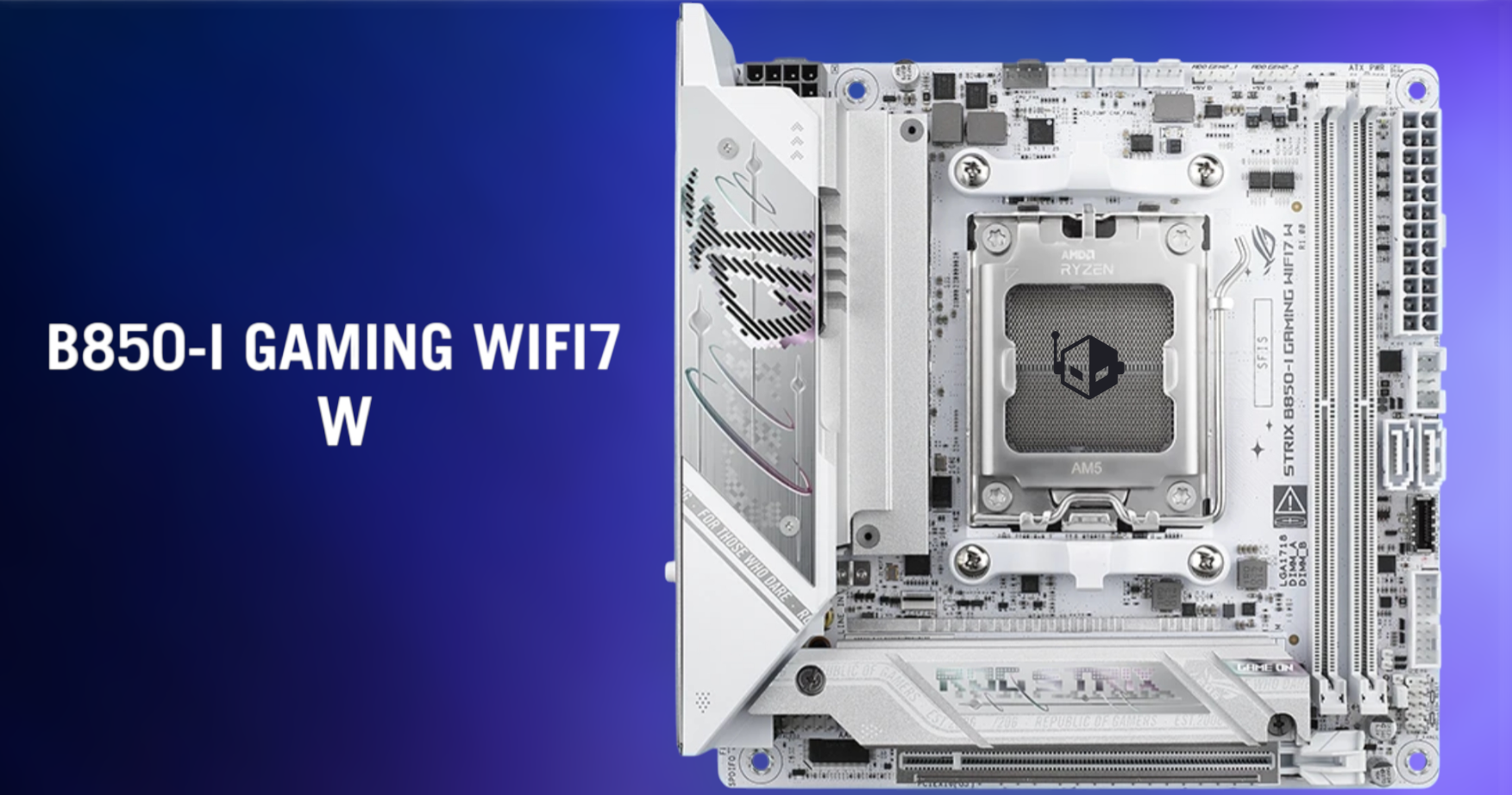
It is designed for builders who want a compact machine that looks curated on a desk or in a living room, without giving up high end Ryzen performance or cutting edge connectivity.
This model is essentially a refreshed, white coated take on the existing ROG STRIX B850-I Gaming WIFI variant. Rather than reinventing the platform, Asus keeps the proven hardware foundation and reworks the styling so that it drops neatly into all white or silver themed builds. Under the paint it still carries the AM5 socket and is prepared for current and upcoming Ryzen generations, including Zen 5 based apu chips and future Zen 6 processors, which makes it a board you can drop into a build today and keep upgrading around for several product cycles.
Power delivery is where many small form factor boards compromise, but that is not the case here. The ROG STRIX B850-I Gaming WIFI7 W is equipped with a 13 phase vrm that uses 90 amp power stages and draws from a single 8 pin eps connector. In practice that means the board is perfectly comfortable running high core count Ryzen parts at stock and with aggressive boost behaviour, and it has the electrical headroom for manual tuning as long as your cpu cooler and case airflow are up to the job. For a board this small, that level of vrm muscle is one of its standout selling points.
The memory configuration is simple but potent. You get two ddr5 dimm slots supporting a total of up to 128 gigabytes of ram, which is more than enough for a combined gaming, streaming and content creation setup. Rated support goes well beyond 8400 mega transfers per second when overclocked, and Asus backs that up with its usual memory tuning tools. In a dense Mini ITX layout where signal integrity matters, having vendor tuned profiles and training logic can be the difference between a plug and play high speed kit and an unstable system that needs endless trial and error.
On the storage and expansion front the board is thoroughly modern. A full length pci express 5 point 0 x16 slot anchors the bottom edge, ready for the latest and next wave of high end graphics cards. Asus adds its q release slim mechanism so that you can actually get a finger on the latch and remove a gpu in tight cases without dismantling half the build. For solid state storage there are two m point 2 slots capable of running at pci express 5 point 0 x4 speeds, ideal for ultra fast nvme drives, plus two sata three ports for more traditional drives. For a compact gaming or creator system, that combination is a very balanced mix of speed and capacity.
Cooling is always a challenge in a mini itx chassis and Asus clearly designs this board with that in mind. A substantial vrm heatsink wraps around the power stages and hides a small integrated fan that actively pushes air across the area most likely to heat soak under sustained loads. The m point 2 and chipset region is covered by a solid metal heatsink assembly as well, helping to keep nvme drives from throttling when you are loading large games, copying project files or working with heavy media. With sensibly positioned fan headers, the board gives you good control over case and cpu fans so that thermals stay in check without turning the whole system into a tiny jet engine.
Where this ROG STRIX platform really separates itself from basic Mini ITX boards is the suite of tuning and overclocking tools. Dynamic oc switcher, core flex and pbo enhancement work together to balance multi core and single core behaviour on Ryzen chips, trying to keep clocks high in lightly threaded tasks without sacrificing sustained performance in long renders or heavy games. On the memory side, Asus offers aemp support and dimm fit style guidance to help users find stable high speed settings for ddr5, which is particularly valuable when pushing large capacity kits in only two slots. It is the kind of feature set that makes this board interesting even to experienced overclockers despite its small footprint.
Asus also loads the board with quality of life extras aimed at people who like to build and rebuild their rigs. M point 2 q slide and q latch make installing and swapping nvme drives much less fiddly, since you no longer have to juggle tiny screws in awkward positions. Q antenna streamlines the process of attaching the wireless antenna. On the rear panel you get hardware buttons for clear cmos and bios flashback, so recovering from an unstable overclock or dropping in new firmware does not require disassembling the system. A flexkey header on the front panel lets you remap the classic reset button to perform functions such as turning on safe mode or triggering other handy shortcuts.
The rear input and output layout is dense for such a small board. There is a single usb 20 gigabit port for high speed external drives or docks, backed up by five usb 10 gigabit ports, four of which are type a and one a type c that also carries displayport alt mode for users running an apu. Two additional usb 2 point 0 ports cover low bandwidth peripherals. For display there is an hdmi port tied to the integrated graphics on capable Ryzen chips. Networking is handled by an intel 2 point 5 gigabit ethernet port and an onboard wifi 7 module, giving both wired and wireless options that match modern fiber internet and fast home mesh networks. Audio output is covered by three analog jacks and an optical spdif port so you can hook up anything from basic speakers to a surround receiver.
All of this hardware sits under a visual design that leans heavily into white while still feeling like part of the rog family. The vrm and chipset heatsinks, m point 2 covers and rear shroud are finished in white and light grey tones, accented by subtle patterns and restrained rgb lighting. On a desk, especially in a glass fronted or open side panel case, it pairs naturally with white graphics cards, power supplies and cooling hardware, letting you build a rig that looks coordinated rather than like a random pile of components.
Price wise, the ROG STRIX B850-I Gaming WIFI7 W is expected to land close to the existing black version, which typically sells around the 270 dollar mark. That places it firmly in the premium Mini ITX zone, but the value proposition makes sense once you factor in the robust 13 phase vrm, pci express 5 point 0 support, dual high speed m point 2 slots, wifi 7 connectivity and extensive overclocking and diy friendly features. For builders planning a compact AM5 gaming or creator system that needs to look as sharp as it performs, this white ROG STRIX board is likely to sit very high on the shortlist.
1 comment
price is kinda spicy for a mini board but i guess wifi 7 tax is real lol