China’s domestic GPU race has just gained a serious new contender. Xiang Dixian has officially pulled the curtain back on its Fuxi A0 graphics card, a 5 nm Chinese GPU built around Imagination’s latest DXD architecture. 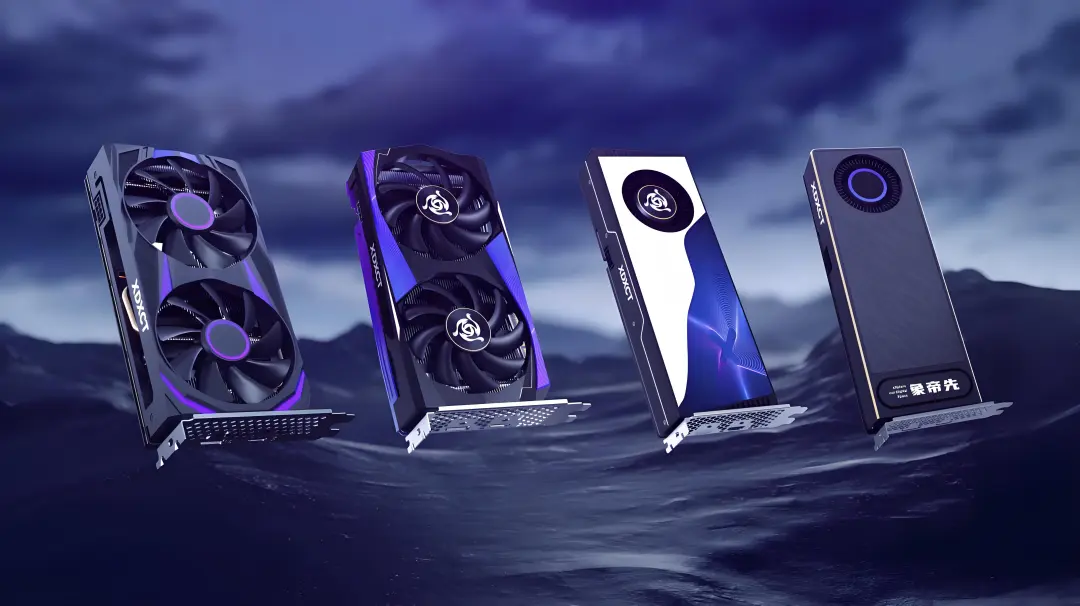
Shown publicly at the ICCAD Expo in Chengdu, the Fuxi A0 is not a lab curiosity but a working board that already runs modern games with ray tracing and showcases super resolution upscaling, positioning itself as a real alternative to established Western brands in the mid to high performance segment.
Imagination Technologies made a strong appearance at the same event, underlining how important the DXD GPU IP is to its roadmap. For years the company has licensed graphics designs for mobile and embedded systems, but DXD is its push into full desktop class performance. Xiang Dixian’s Fuxi A0 is currently the only mass produced product based on this DXD architecture, and the firm claims more than double the overall rendering performance compared to its previous generation solutions. At the booth, the card was used to drive large 3D applications and complex digital twin scenes, demonstrating that this is not just a tech demo core but a GPU ready for serious visualization workloads.
Under the shroud, the Fuxi A0 combines a 5 nm GPU die with 12 GB of onboard memory. Earlier reports suggest the chip can hit up to 160 TFLOPs of compute power in specific workloads, a figure that, while marketing friendly, gives a sense of the scale Xiang Dixian is targeting. The physical card uses a dual slot, dual fan cooler, and photos from the show floor reveal four visible DRAM packages around the GPU. That layout strongly hints at a 192 bit or 256 bit data bus, but the exact configuration and memory speeds have yet to be disclosed. Enthusiasts are already debating whether the 12 GB uses HBM class memory or more conventional GDDR, with most observers leaning toward high clocked GDDR as the practical option for a first generation desktop card.
Xiang Dixian is not only planning a single chip. The company’s roadmap splits the lineup into two families, the Fuxi A0 and Fuxi B0. The A0 version, which was shown at ICCAD, is the gaming and rendering focused SKU that targets players, content creators, and visualization pros who need strong raster performance plus modern extras like ray tracing and super resolution. The B0 variant, by contrast, is designed as a hybrid processor that marries the DXD GPU with a dedicated NPU block offering FP8 capabilities for AI workloads. That combination could allow the Fuxi B0 to accelerate neural rendering, denoising, upscaling, and general purpose inference on a single board once it ships.
On the show floor, the Fuxi A0 was used to power several eye catching demos. Imagination and Xiang Dixian ran large scale 3D graphics applications and so called digital twin scenarios, where real world environments are mirrored in detailed simulated spaces. Beyond raw polygon pushing, the key message was that the card can handle next generation effects: hardware accelerated ray tracing for more realistic lighting and reflections, and super resolution upscaling to recover frame rates while keeping sharp images. In one of the most talked about demos, the company ran the demanding action RPG Black Myth Wukong with ray traced effects enabled, reporting around 35 frames per second on average. That is not a final benchmark result, but for early silicon and beta drivers, it signals that Fuxi A0 is already within usable territory for real gaming.
Ray tracing and super resolution are quickly becoming table stakes in the GPU market, and Xiang Dixian clearly knows it. The Fuxi A0’s ray tracing units aim to bring physically inspired lighting to Chinese made engines and global titles alike, reducing the visual gap to Nvidia and AMD cards. Meanwhile, the card’s super resolution technology, conceptually similar to the upscaling techniques seen on other modern platforms, reconstructs higher resolution images from lower resolution renders. For gamers, that means the chance to run at high resolutions or with heavy effects while keeping playable frame rates; for professionals, it opens the door to smoother design visualization, simulation previews, and real time digital twin dashboards.
As always with a new GPU ecosystem, the hardware is only half the story. Driver maturity and API support will decide how attractive the Fuxi A0 really is outside carefully prepared demos. One early concern echoed by enthusiasts is whether the card will fully support modern graphics APIs such as DirectX 12 on Windows. Some users already joke that the only real issue is the lack of robust DX12 support, which would effectively lock the card out of many Western PC titles if not resolved. Vulkan and proprietary domestic APIs may help fill the gap, but to win over gamers globally, Xiang Dixian will need stable, feature complete drivers, frequent updates, and strong relationships with engine developers.
Market wise, the emergence of the Fuxi A0 could be more important than its exact frame rate numbers today. A third player with a 5 nm, ray tracing capable Chinese GPU based on Imagination’s DXD IP brings competitive pressure to a space that has long been dominated by Nvidia and AMD. For China, it is also a strategic step toward greater independence in graphics and compute hardware, giving local OEMs and system builders an option that is less exposed to export controls and supply chain shocks. As one sentiment commonly seen in community reactions puts it, competition is simply good for everyone, even if early drivers are quirky and performance per watt is still being tuned.
Xiang Dixian is not an unknown startup arriving out of nowhere. The company has shipped multiple generations of cards based on older Imagination IP, including models like the XDX 121 and XDX 151 for desktops, the XDX R1900 for workstations, and the XDX X1900 for servers. Those products helped it gain experience in board design, cooling, and driver delivery, even if they never challenged the global gaming elite. The Fuxi family, however, looks like a break from that modest history, with far more ambitious performance targets and much more modern features.
Mass production of the Fuxi A0 and its sibling B0 is expected to ramp up in the near future, with a commercial launch tentatively aimed for next year. Critical questions remain unanswered, including exact clock speeds, final memory configurations, power consumption, regional availability, and of course pricing. Independent benchmarks will be essential to see whether the claimed doubling of performance over previous generations holds up across real games and pro workloads. Yet even at this early stage, Xiang Dixian’s Fuxi A0 5 nm GPU based on Imagination DXD has moved the conversation from whether China can build a modern desktop GPU to how fast it can iterate and improve one that already runs demanding, ray traced games in public.
2 comments
35 fps in Black Myth with ray tracing on early silicon is actually not bad, my poor old card crawls with RT on 😂
more competition in gpus is always good, even if drivers kinda suck at launch, prices only go one way when there are just 2 big players