Art and engineering rarely collide as dramatically as they do in the Glashutte Original Senator Chronometer Tourbillon Premiere. At first glance it looks like a piece of sculpture in platinum, a miniature architectural model for the wrist. Look closer and you discover a patented flyback tourbillon mechanism that pushes two centuries of horological thinking into new territory, all while staying rooted in the rigorous, slightly obsessive culture of German precision watchmaking. 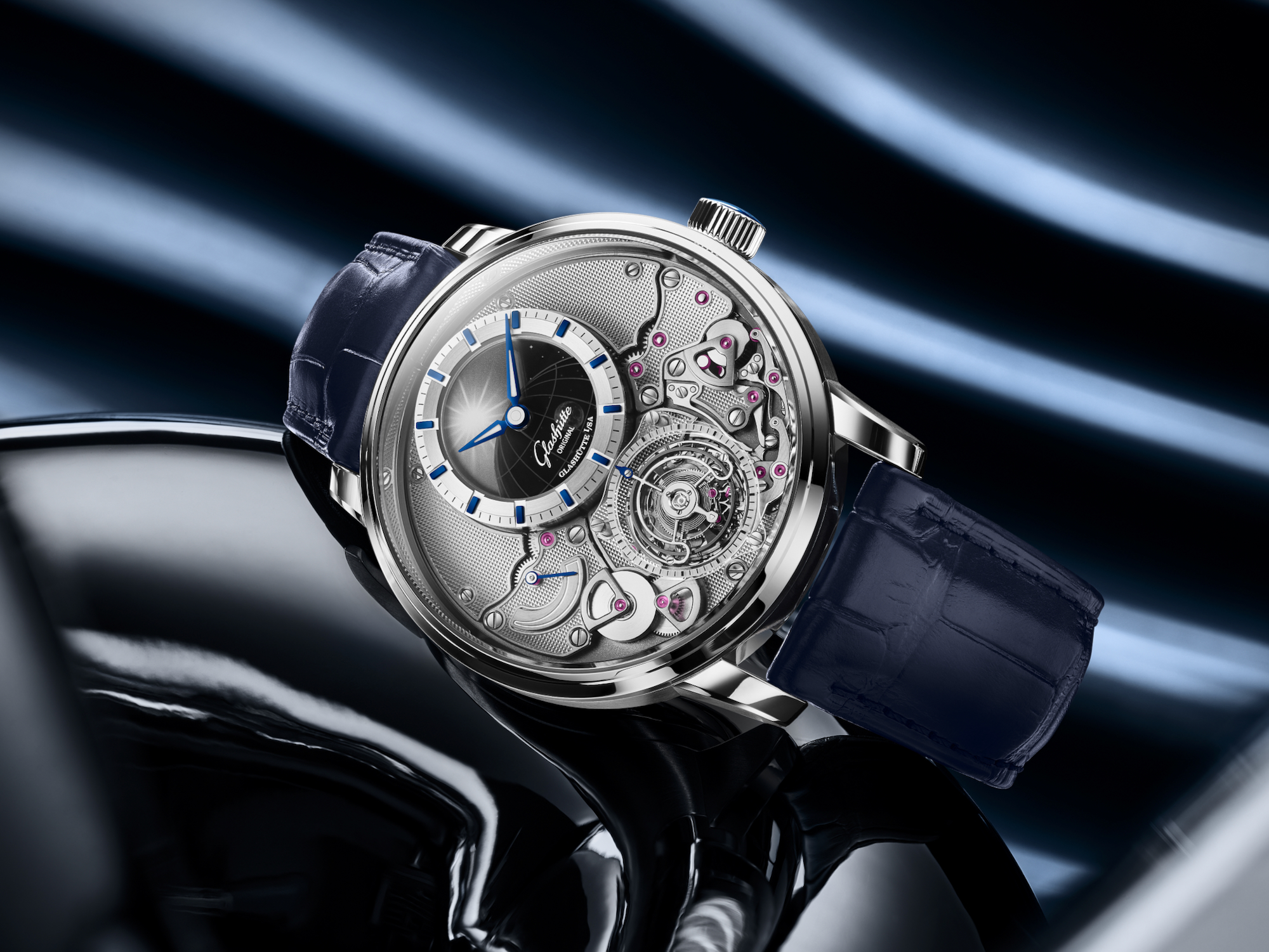
This is not just another complicated watch; it is Glashutte Original making a very public statement about what high horology can be in the twenty first century.
To understand why this watch is important, you have to start with the tourbillon itself. At the turn of the nineteenth century, John Arnold and Abraham Louis Breguet were wrestling with an age old problem: gravity. In a pocket watch that lived mostly in a vertical position, the force of gravity could pull on the balance and escapement in a way that introduced consistent timing errors. The solution was as elegant as it was complex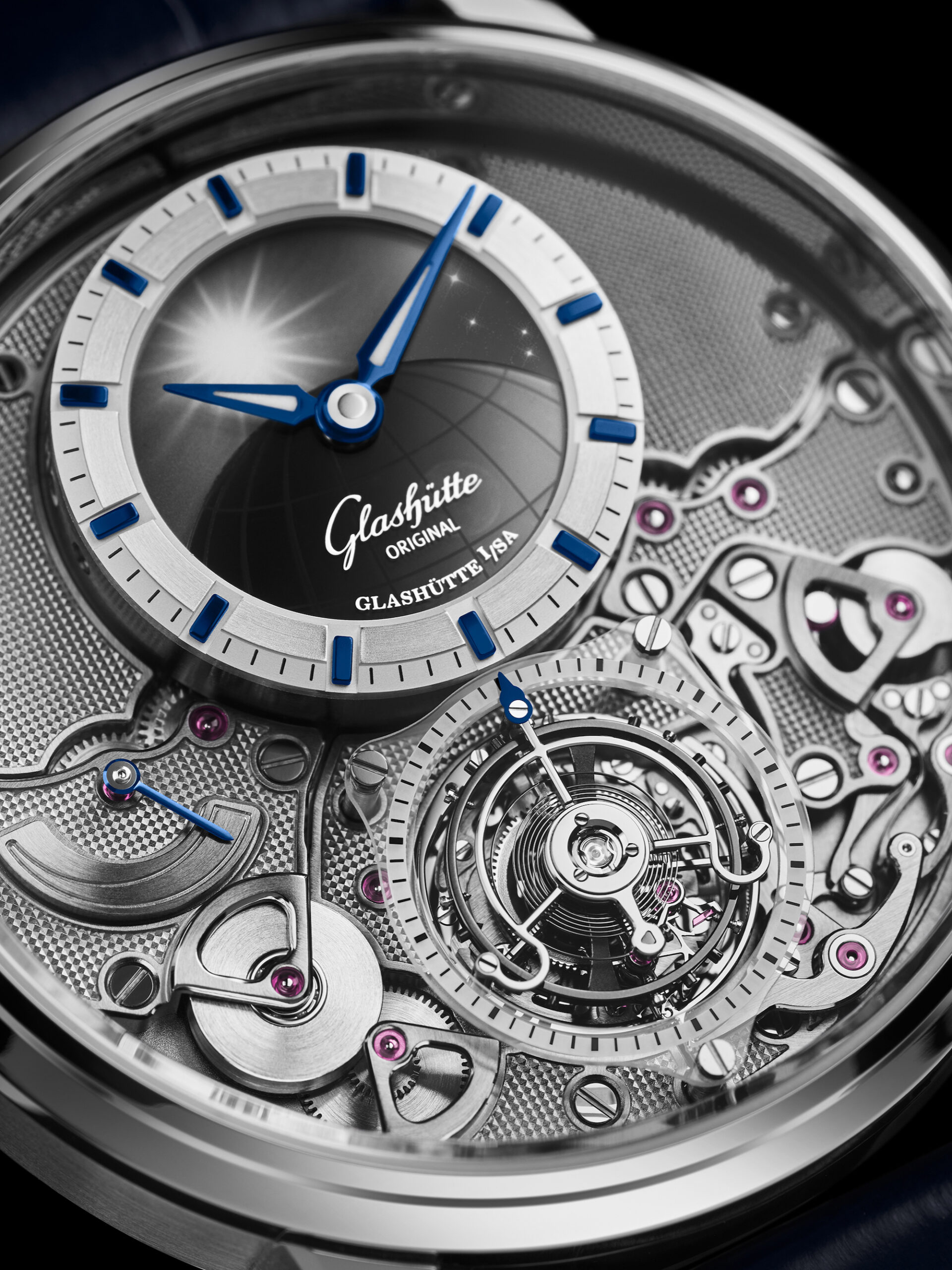
. By placing the regulating organ inside a rotating cage, the positional errors were averaged out over time, delivering more stable timekeeping and giving birth to the tourbillon, one of watchmaking’s most mythical inventions.
Fast forward to the early twentieth century and the story moves to Saxony. In 1920, Alfred Helwig, a master watchmaker in Glashutte, imagined a tourbillon that appeared to float in space. Instead of being supported on both sides, his flying tourbillon was anchored only from below, with no visible bridge at the top. The effect was almost magical, giving a lightness and visual drama that still captivates collectors. That invention is part of Glashutte Original’s spiritual DNA, and the Senator Chronometer Tourbillon Premiere is very clearly conceived as a modern chapter in that narrative.
For all their beauty, classic tourbillons have a very practical flaw. They are notoriously difficult to set with true precision. Stopping and restarting a delicate rotating cage without upsetting the balance, and aligning the seconds indication with the minute hand, is a delicate dance. 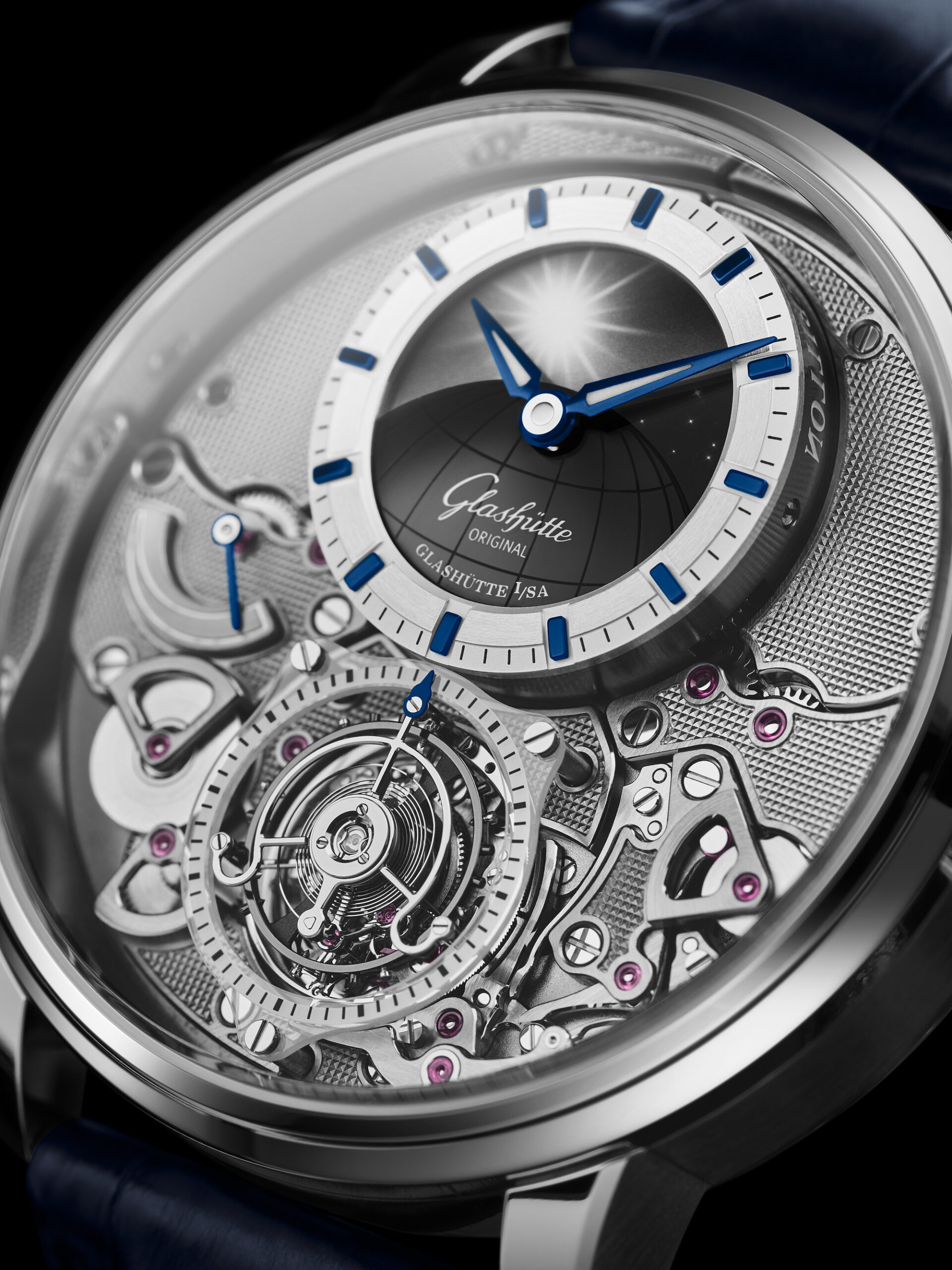
Many tourbillon watches can be set approximately, but synchronizing them perfectly to a reference time is more art than science. Glashutte Original decided to attack that problem head on, using the same relentless, almost laboratory minded approach that defines German chronometer building.
The result is the patented flyback tourbillon mechanism at the heart of this watch. When the crown is pulled out to the first setting position, a vertical clutch comes into play, halting the balance and locking the tourbillon cage in place. This alone is already a serious technical feat, as it freezes an entire rotating assembly without shock or stutter. Pull the crown to the next position and the real magic happens. The cage begins to travel in a smooth arc, gliding upwards until the seconds hand riding on its tip lands precisely at the zero marker. At that exact moment, the minute hand jumps cleanly to the next minute index. In one fluid motion you have a stopped seconds display at zero and a correctly aligned minute hand, ready to be synchronized to a time signal with a level of accuracy that most tourbillon owners have only dreamed about.
Underneath this choreography is the calibre 58 06, a hand wound movement developed specifically for this application. It beats at 21,600 vibrations per hour, a traditional frequency that suits a high end chronometer and gives the escapement enough time to breathe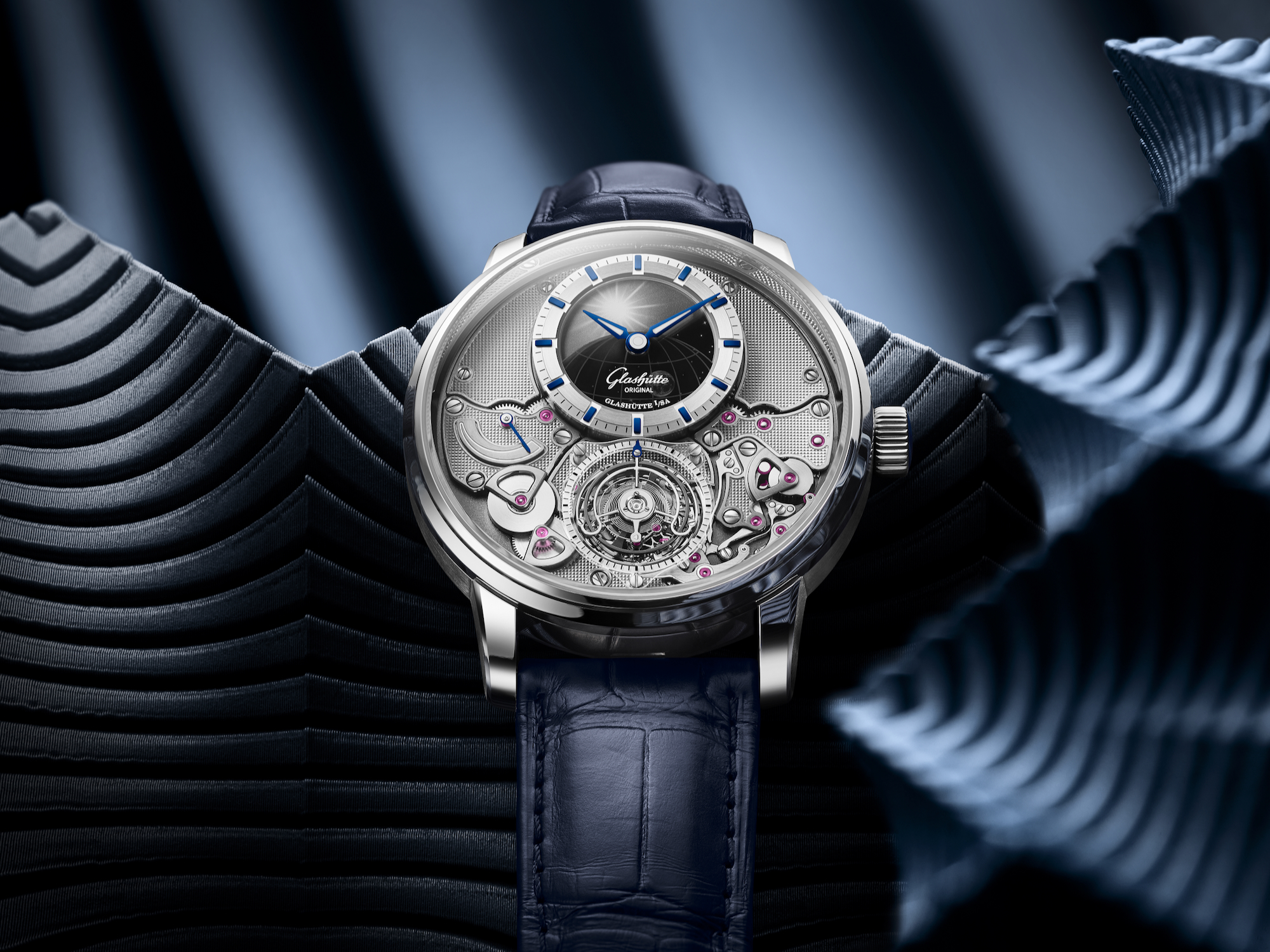
. A silicon balance spring, almost obligatory in a serious modern chronometer, brings strong resistance to magnetic fields and temperature changes, both sworn enemies of precision. Energy is stored in a barrel that delivers roughly seventy hours of power reserve, monitored by a clear indicator at nine o’clock on the dial side. Nothing here is left to chance. Each calibre is submitted to an independent testing regime according to the DIN 8319 chronometer standard, carried out by the Thuringian Weights and Measures Office. Over fifteen days the movement is evaluated in five positions and at three different temperatures, a process that echoes the old observatory trials and reassures collectors that the flyback theatrics are backed by serious timekeeping credentials.
All of this engineering could easily have been hidden away, but Glashutte Original has chosen instead to celebrate it. The Premier is housed in a 42 millimetre platinum case with a reassuring heft, yet the proportions are carefully judged so that it feels like a compact piece of architecture rather than a heavy ingot. The time display is shifted upward toward twelve o’clock, freeing up the lower part of the dial for the tourbillon and its control mechanism. 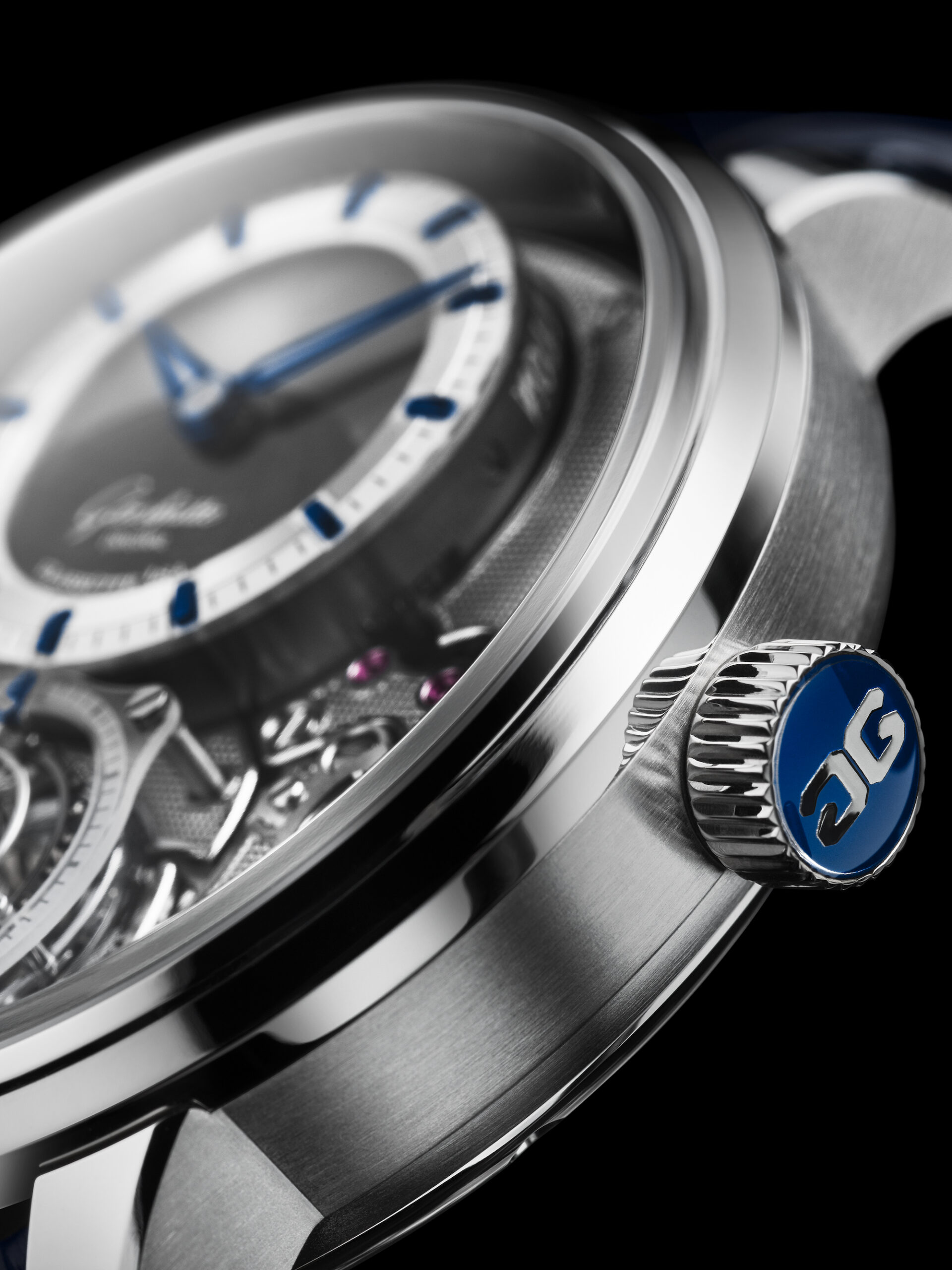
Bridges, levers and wheels are revealed in a way that feels technical but never chaotic. The upper plate is laser engraved in a refined Clous de Paris pattern, a field of tiny pyramids that catch the light and create a visual contrast with the polished and brushed steel of the functional components. Collectors who know the brand’s earlier hand engraved creations may instinctively assume that traditional engraving is the more prestigious approach, yet many enthusiasts quietly admit that this sharply rendered laser pattern suits the watch better. It feels more contemporary, more industrial, and underlines the fact that this is a laboratory grade instrument as well as an object of art.
The sense of depth is heightened by the way the time display and the flying tourbillon are raised above the decorated plate, almost like two stages in a miniature amphitheatre. On the off centred dial you will find a stylised globe, a nod to the knowledge and craft accumulated over roughly one hundred and eighty years of watchmaking in Glashutte and to the global audience that now follows the brand. Above this globe, a day night indicator slowly rotates, cycling from a warm rising sun to a moon and starry sky. It is a poetic detail, but also a useful visual cue when setting the time. Taken together with the applied markers, the fine printing and the neatly framed power reserve display, the result is a dial that manages to be both dramatic and highly legible.
On the wrist the Senator Chronometer Tourbillon Premiere offers an experience that blends spectacle with real world usability. The smooth travel of the tourbillon cage during the flyback sequence is remarkably satisfying to watch, a slow sweep rather than a jerky snap, underscoring how much energy control and mechanical damping is happening behind the scenes. The click and feel of the minute hand jumping precisely into place has an almost addictive quality if you are the sort of person who enjoys the sound of a finely made movement. Glashutte Original offers the watch on a range of straps, but many collectors gravitate toward the high quality synthetic options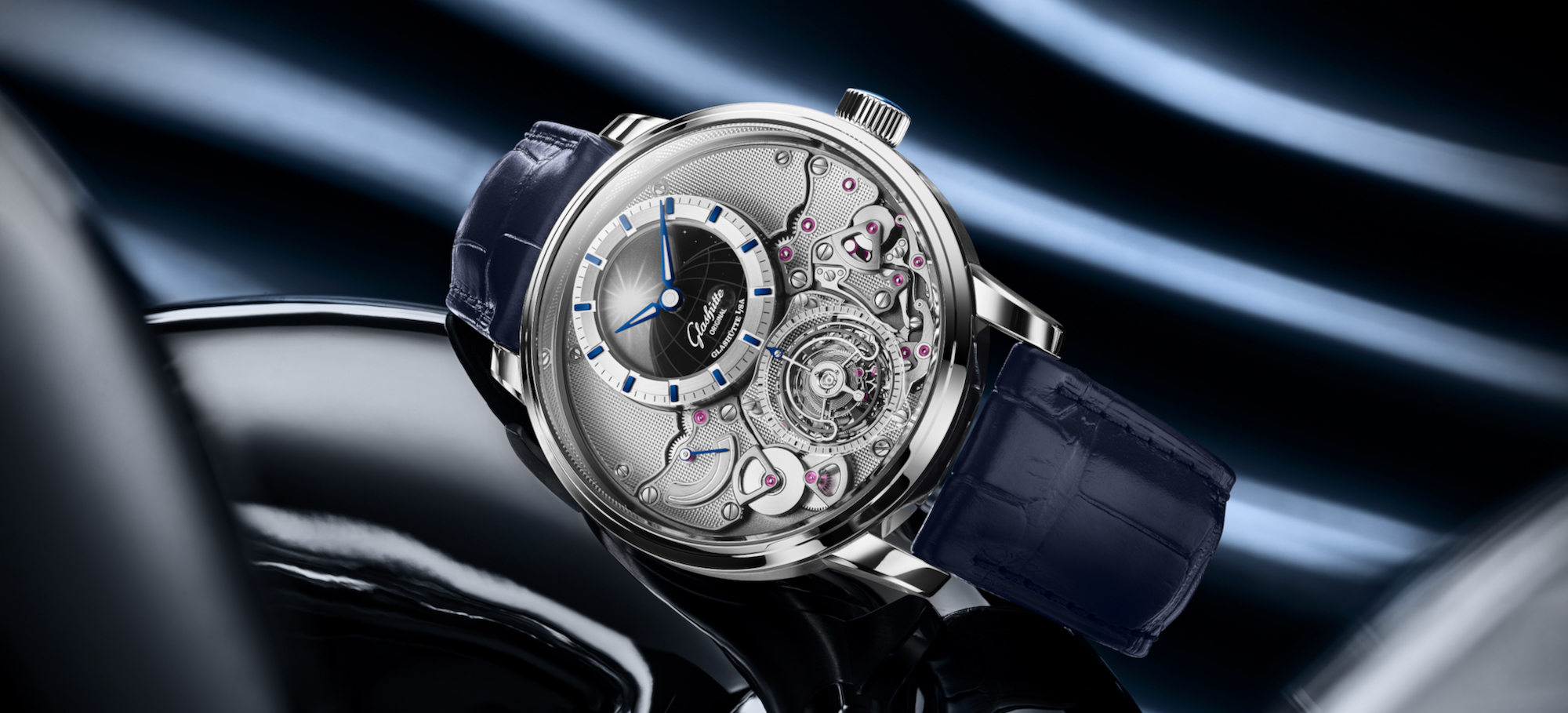
. They give the platinum case and technical dial a slightly more relaxed, sporty character and make the whole package feel less museum piece and more future daily wearer, assuming your life can reasonably accommodate a platinum flying tourbillon as a regular companion.
Among enthusiasts, the watch has quickly developed the reputation of being both a serious reference piece and an unexpectedly playful one. At collector gatherings, it is the sort of watch that pulls people across the room. Even hardened hobbyists who are used to rare independent pieces tend to crack a smile when the owner demonstrates the flyback sequence and the zero reset of the tourbillon. The consensus is that this is technical genius executed with a flourish, and that whatever the eventual price, the level of invention and finishing goes a long way toward justifying it. Some see it as a perfect expression of Glashutte Original’s current direction: a brand deeply rooted in Saxon tradition that is unafraid to embrace laser engraving, silicon technology and novel mechanisms if they truly improve performance rather than merely adding visual fireworks.
The Senator Chronometer Tourbillon Premiere is limited to just fifty pieces worldwide, available through Glashutte Original boutiques and selected partners. That scarcity, combined with the platinum case and the original flyback mechanism, practically guarantees that the watch will remain a talking point in high end collecting circles for years to come. But the deeper achievement lies beyond rarity. By uniting the historic ideas of Arnold, Breguet and Helwig with modern materials, independent chronometer testing and a patented way to set a tourbillon to the second, Glashutte Original has created a watch that feels genuinely new without discarding the emotional warmth that makes mechanical timekeeping so compelling. It is a reminder that in haute horlogerie, the most satisfying pieces are the ones where engineering precision and artistic coherence are so tightly woven together that you can no longer see the seam.