Handheld gaming has gone through wild phases over the last two decades. We started with dedicated cartridges, moved into the age of optical discs with systems like PlayStation Portable and PlayStation 2, and then jumped to powerful Windows based portable PCs that can genuinely push modern triple A titles. 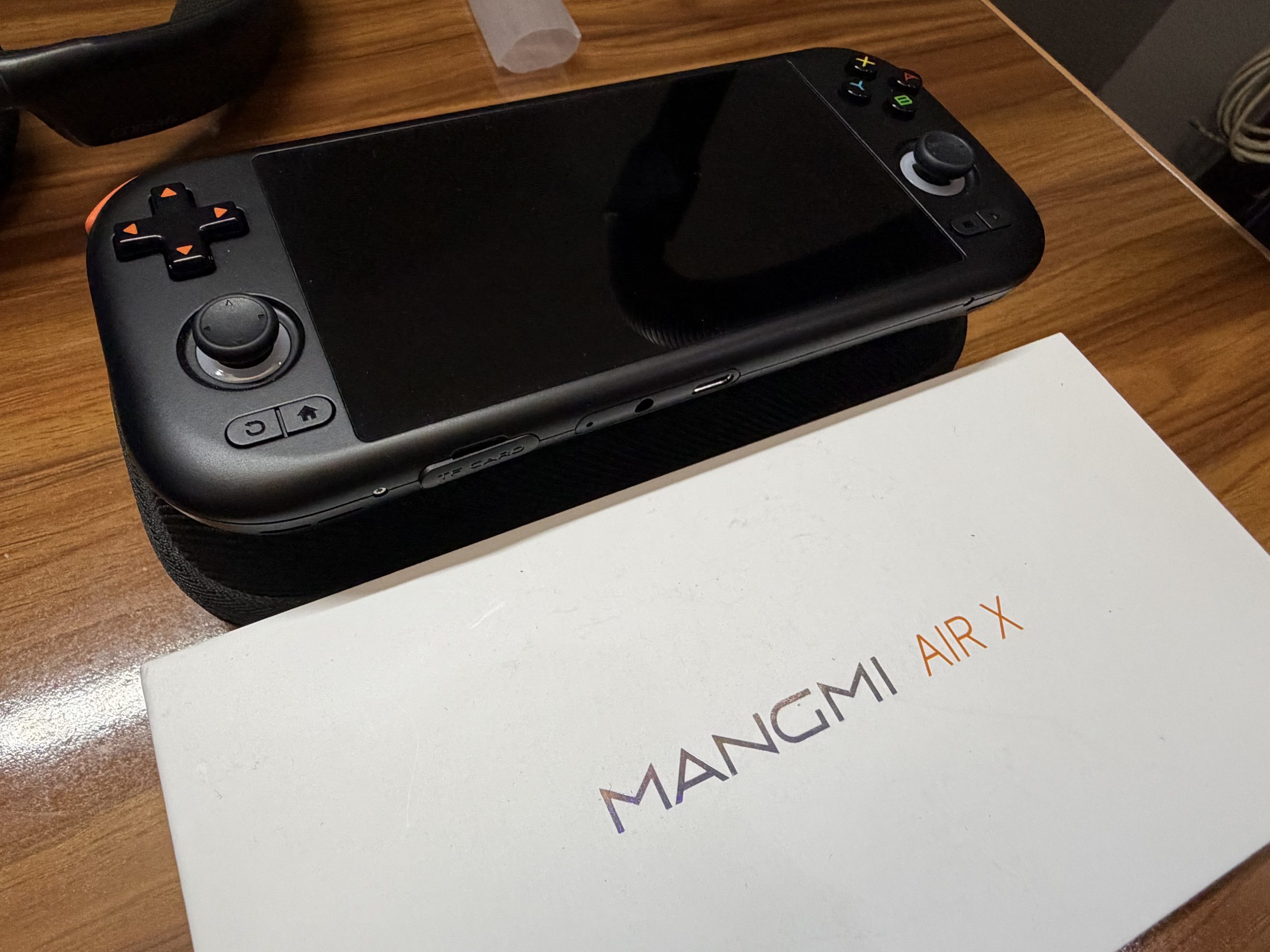
Somewhere between those extremes sits the MANGMI Air X, a budget friendly Android handheld that does not pretend to be a pocket gaming PC. Instead, it aims to bottle the feeling of firing up a beloved old console and taking a trip back to the era of memory cards, long loading screens and legendary action adventures.
At a glance, the MANGMI Air X looks like yet another inexpensive Android handheld. The asking price of 89.99 USD instantly sets expectations: this is not trying to compete with premium devices such as ROG Ally X or Steam Deck. Rather, the goal is to give you an easy way to play older console titles through emulation, along with lighter Android games, in a form factor that feels like a modern spin on the classics. Think of it as a hybrid of retro handheld, Android media device and emulator machine, all wrapped in a compact shell with surprising attention to nostalgia.
Design, unboxing and first impressions
My story with the MANGMI Air X starts in a slightly chaotic way. Before I even saw the handheld, local customs had already opened the parcel, which meant the first unboxing experience was technically not mine. Once I finally got my hands on the retail package, though, it felt more premium than the price suggests. Inside the box you will find the console itself, a USB A to USB C cable for charging, a pre applied or included screen protector depending on configuration, and the option of a dedicated pouch case if you choose that bundle. The pouch and protector are not completely free extras; if you tick every accessory box you will nudge the total price upwards, but it still remains firmly in budget territory.
Lifting the MANGMI Air X out of the box, the first impression is pure nostalgia. If you ever spent evenings glued to PlayStation 2 or long bus rides with a portable system, the shape and layout will instantly trigger old memories. The device follows a classic handheld blueprint with four main face buttons on the right, a directional pad on the left, shoulder triggers along the top edge and two thumbsticks that are illuminated with subtle RGB lighting. The sticks are an especially nice touch, giving the handheld a bit of modern flair that contrasts nicely with its retro ambitions.
Build quality lands somewhere between toy like and enthusiast grade. The plastic shell is light and feels sturdy enough, without creaking or bending under normal use. It is not the kind of device you would want to abuse or toss loosely into a bag with keys, though. The finish does not seem highly scratch resistant, so treating it with basic care is wise. The included pouch suddenly feels less like a nice perk and more like a necessity if you plan to carry the Air X with you every day. In the hand, the contours are comfortable, the triggers are easy to reach and the overall weight is friendly for long sessions.
Screen quality and visual experience
Front and center on the MANGMI Air X is a 5.5 inch IPS display, and it plays a huge role in why this handheld feels so pleasant to use. An IPS panel might sound ordinary on paper, yet the implementation here is surprisingly solid. Colors look vivid without being oversaturated, and viewing angles allow you to tilt the console quite a bit without losing clarity. For retro titles that often rely on bold color palettes and stylized art rather than modern visual effects, this kind of screen is a great match.
The size also hits a sweet spot. It is large enough to comfortably read small in game text and appreciate environmental details, yet small enough to keep the console portable and lightweight. Classic console games that were originally designed for televisions translate well to this panel, and many of them even benefit from being shrunk down; aliasing and lower resolution assets are less distracting when compressed onto a 5.5 inch canvas. Whether you are exploring mythic landscapes in a famous action adventure or cruising through an open world crime sandbox, the IPS display of the Air X does the job and then some for its price.
Speaker placement and audio character
Audio is where the MANGMI Air X reminds you that it is a budget first device. The handheld uses a single speaker with a circular cutout positioned on the back shell. This design choice has one obvious consequence: when you naturally grip the console, your palms tend to partially block the opening. As a result, sound can become muffled, particularly if you are pressing the device tightly while focusing on an intense boss fight. Front firing speakers would have been ideal, or at least side firing ones, but at this price point the compromise is understandable even if it is not ideal.
In terms of pure sound quality, the speaker is serviceable but not standout. Effects and music tracks are clear enough to be enjoyable, yet you will not mistake them for the richer audio output of a flagship smartphone or premium handheld. Volume levels can fill a small room but lack depth in the low end. For many retro titles, especially older role playing games, platformers and action adventures, this is tolerable. Anyone who truly cares about audio immersion will almost certainly plug in headphones or connect a wireless audio solution where possible. Given the overall focus of the MANGMI Air X, the speaker experience is acceptable, but definitely one of the weaker points of the package.
Under the hood: Snapdragon 662 and core specifications
The beating heart of the MANGMI Air X is the Qualcomm Snapdragon 662, paired with 4 gigabytes of LPDDR4X memory and 64 gigabytes of eMMC storage. On paper, that is hardly cutting edge silicon. The Snapdragon 662 is known more for power efficiency than raw performance and usually appears in mid range or budget smartphones. However, context is everything. The Air X is not marketed as a portable PC killer or a device meant to push the latest graphically heavy Android blockbusters at max settings. Its mission is to deliver smooth experiences for retro console emulation and moderate Android gaming, and the chosen hardware is surprisingly well aligned with that goal.
Storage may look modest at 64 gigabytes, but the console supports expansion through a TF card slot. This is particularly useful for emulation, where users often store multiple game images. Pair the internal storage with a decent capacity TF card and you can easily build a library of classic titles without constantly deleting and reshuffling. On the software side, the MANGMI Air X ships with Android and a custom Game Launcher utility from the manufacturer. The launcher helps organize your collection, provides quick access to installed emulators and games, and makes the handheld feel less like a generic Android device and more like a dedicated console.
Expectations: what this handheld is and is not
Because the MANGMI Air X runs Android, it would be easy to assume it should behave like a standard smartphone in disguise, capable of running the latest and heaviest games with ease. That is not really the case. The Snapdragon 662 and 4 gigabytes of RAM are sufficient for day to day Android tasks and many mainstream games, but they are not tuned for graphically demanding workloads at very high settings. If you go in expecting a budget handheld capable of running the most advanced Android titles on maximum graphics, you will be disappointed. If, however, you view the hardware as a power efficient engine tailored for emulation up to PlayStation 2 era and comfortable performance in optimized Android games, you will find it much more impressive.
The device shines brightest when used as an emulation focused console. The combination of physical controls, compact form factor and Android flexibility makes it ideal for loading up classics from the sixth generation of home consoles and earlier. The goal is not to chase benchmark numbers or synthetic performance charts. Instead, the goal is to recreate that iconic feeling of starting a legendary title, seeing the old boot screen and realizing you can carry that entire library in your bag.
PlayStation 2 emulation: how the classics run
To properly understand what the MANGMI Air X can do, it is far more revealing to test real games than to rely on synthetic benchmarks. Rather than running tools such as Geekbench or heavy CPU renderers, I turned to NetherSX2 to emulate several iconic PlayStation 2 titles. The lineup included God of War, Grand Theft Auto San Andreas, Tekken 5 and Resident Evil 4, all of which are demanding in different ways. Over multiple sessions spread across roughly two hours of focused testing, the handheld produced results that were frankly more impressive than the raw specifications had led me to expect.
In many scenes, the games ran smoothly enough that it was easy to forget they were being emulated on a budget handheld. Action sequences in God of War felt responsive, driving and exploration in San Andreas held up well and even the tension filled combat of Resident Evil 4 remained playable. There were occasional moments where the frame rate dipped or the experience felt a little constrained, but they never rendered the games unplayable. What did present a more consistent annoyance was controller mapping. With NetherSX2, some button assignments were not correctly recognized out of the box, forcing me to frequently call up the virtual on screen controls to navigate menus or rebind specific actions. Once configured, gameplay itself was excellent for a device in this price class, reinforcing the idea that the Air X is built first and foremost with emulation in mind.
Android games: PUBG, Genshin Impact and beyond
Because the MANGMI Air X is still an Android device at its core, it would have been incomplete to test only classic console titles. I also installed and played popular modern mobile games such as PUBG Battlegrounds and Genshin Impact to see how far the Snapdragon 662 could stretch. As expected, neither title could be pushed at ultra presets, but with sensible graphical settings the experience was surprisingly enjoyable. PUBG runs best at moderate configurations, where frame rate remains stable and the controls benefit from the physical sticks and triggers. Genshin Impact is more demanding and benefits from dialing visuals down further, but the core exploration and combat loop remains intact.
It is worth stressing again that the Air X does not aspire to be the ultimate device for visually intensive Android software. Yet for players who want a machine that can switch between an evening of retro nostalgia and a few rounds of online multiplayer shooters, it delivers enough flexibility to feel versatile. Casual games, platformers and many popular titles from the Play Store run comfortably, and the Android interface itself feels smooth and responsive thanks to the efficient chipset and clean software setup.
PSP and other emulation potential
Although my focus was primarily on PlayStation 2 emulation, it is nearly impossible to pick up the MANGMI Air X and not think about PSP era gaming. The hardware, screen size and physical layout are a near perfect match for portable console titles from that generation. While I did not exhaustively benchmark PSP games during this round of testing, the combination of Snapdragon 662, 4 gigabytes of RAM and Android based emulators suggests that the handheld is exceptionally well suited for that workload. For anyone whose personal nostalgia leans more toward portable adventures than living room consoles, PSP emulation is likely to be the crown jewel use case for this device.
Beyond Sony platforms, the Air X has ample headroom for emulating systems from earlier generations. Classic 16 bit and 32 bit consoles, handheld systems and arcade boards generally run with minimal strain, turning the console into a compact archive of gaming history. In many ways, that is the true charm of the MANGMI Air X; it is not limited to a single platform but instead becomes a flexible gateway into multiple eras of interactive entertainment.
Software, interface and everyday usability
Living with the MANGMI Air X day to day is shaped heavily by its Android foundation. The interface will be familiar to anyone who has used an Android smartphone, which makes setup straightforward. You can sign in with your usual account, download apps from the Play Store, install emulators from trusted sources and customize the home screen. On top of this, the manufacturer includes a Game Launcher that scans your internal storage and TF card, presenting your catalog in a console like grid that makes it easy to jump into a session without digging through folders.
Performance in menus and system navigation is smooth, thanks to the efficient processor and relatively light software loadout. Swapping between emulators, tweaking graphics settings and mapping buttons is not instantaneous, but it never feels sluggish either. For a device whose core identity is a retro gaming portal, that level of responsiveness is more than adequate. Combined with the sturdy build and comfortable controls, the software experience helps the MANGMI Air X feel like a coherent product rather than a random Android shell with sticks bolted on.
Value and who should buy the MANGMI Air X
At 89.99 USD, the MANGMI Air X lands in a sweet spot that makes it particularly appealing as a second device. It is not meant to replace a high end gaming PC, a console under your television or even your primary smartphone. Instead, it slots neatly into the role of side gadget for people who want a dedicated machine solely for games, especially older ones. When compared to more powerful handhelds that cost several times more, the Air X trades high end performance for simplicity, nostalgia and affordability. Add in the optional case and screen protector and the total still remains competitive, though it is worth remembering that these accessories do increase the overall spend slightly.
If you are the type of player who grew up with legendary titles on PSP or PlayStation 2 and you want a compact way to revisit them without diving deep into complex emulation setups on PC, this handheld makes a compelling case for itself. It also makes sense as a gift for younger gamers who might not have their own powerful hardware yet but are curious about the history of console gaming. For commuters, travelers or anyone who enjoys dipping into classic adventures during short breaks, the MANGMI Air X offers an appealing blend of convenience and old school charm.
Final verdict: a retro specialist with modern touches
Judged by premium handheld standards, the MANGMI Air X is clearly limited. The speakers are only average and hampered by their rear placement, the shell is not especially resistant to scratches and the Snapdragon 662 is nowhere near the cutting edge. Yet to evaluate it on that basis is to miss the point entirely. This is a handheld that embraces its identity as a retro specialist. It focuses on delivering a faithful, enjoyable experience for classic console and portable games, wraps it in an attractive form factor with RGB sticks and a crisp IPS display, and does all of that at a price that undercuts many competitors.
For its target audience, the MANGMI Air X comes remarkably close to hitting a peak retro gaming sweet spot, earning a score around 9 out of 10 in that niche. The strengths are clear: excellent price to fun ratio, smooth Android based user interface, sturdy and lightweight build, and emulation performance that far exceeds what its humble specifications might imply. The main drawbacks are equally obvious: subpar speakers, a finish that benefits from careful handling and occasional controller mapping quirks in certain emulators. If you can live with those compromises, the MANGMI Air X is a delightful little machine that proves you do not need cutting edge power to deliver genuinely memorable gaming sessions.
3 comments
for 90 bucks and some emus this is way better than handing my kid an expensive phone to game on
honestly this is exactly what I want, just give me old school games and decent controls, no need for 120fps graphics
did not expect a cheap handheld to run ps2 stuff that well tbh, kinda tempted now lol