The first Corsair Void Wireless V2 quickly became one of those rare gaming headsets you stop thinking about and simply use. It was light, easy to set up on every platform in the house, and rarely begged for tweaking. Now Corsair has introduced the Void V2 Max, a slightly more premium spin on the same idea, and after several weeks of swapping between the two it is clear that this is not a flashy redesign, but a careful refinement of a formula that already worked.
At around $149 at full price – and frequently dipping closer to $119.99 during sales – the Void V2 Max sits in a fiercely competitive mid-range where every extra feature has to justify its existence. 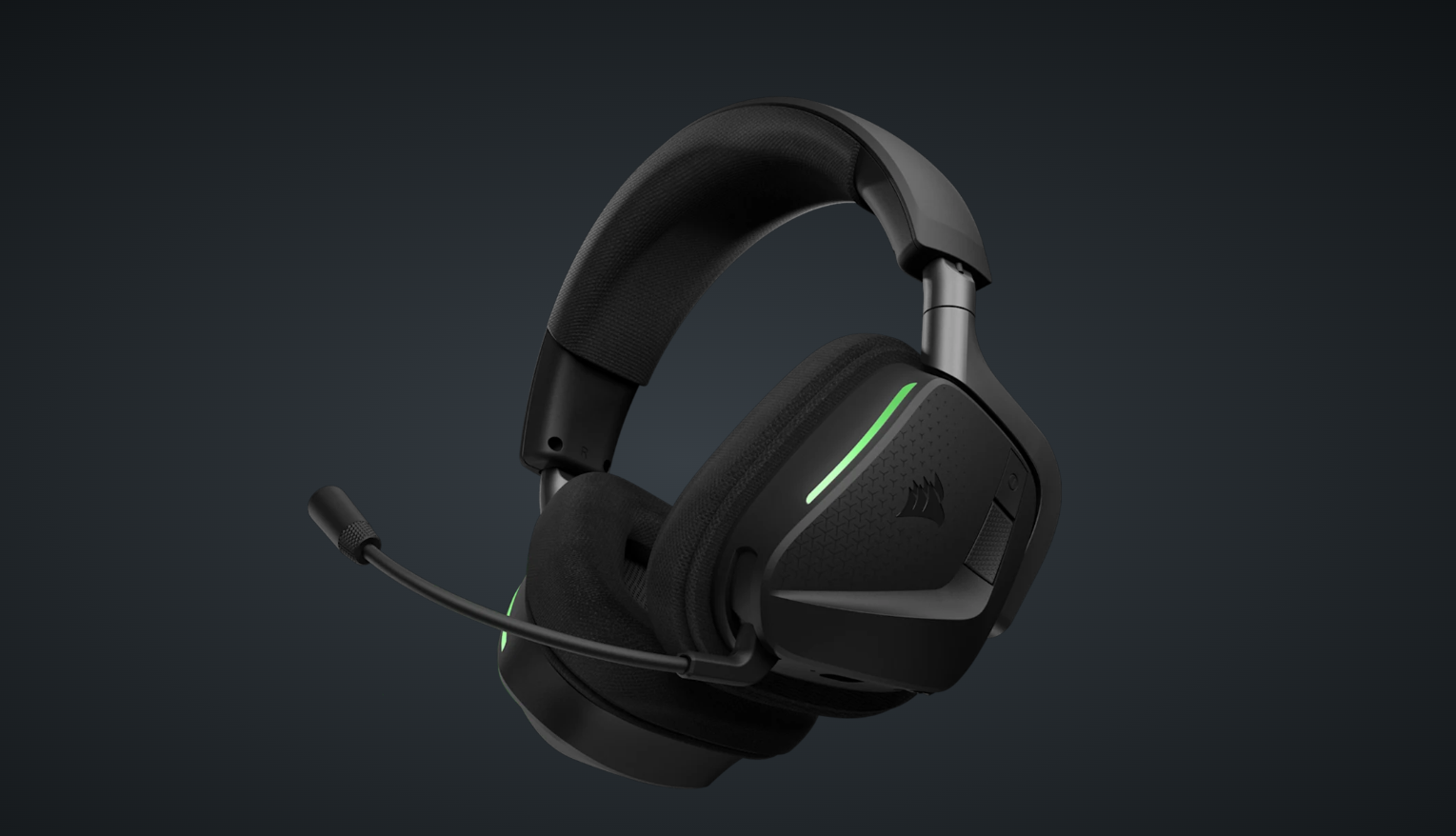
Corsair is not trying to reinvent the wheel here. Instead, the company focuses on three areas that affect everyday use more than spec sheets: comfort over long sessions, more deliberate audio tuning with Dolby Atmos and SoundID, and the same brilliant, no-drama multi-platform wireless support that made the original V2 such an easy recommendation.
Design, Build Quality and Comfort
Put the two headsets side by side and you would struggle to tell which one is the Max without looking closely. Both weigh 303 grams, share the same angular Void silhouette, and use breathable mesh ear cushions that fully surround the ear without clamping too aggressively. The familiar 90-degree swivel in the ear cups is still here, useful when you want the headset to sit flat on your chest between matches, and the flip-to-mute microphone arm retains the same smooth resistance and reassuring click when you push it up.
The real changes live underneath the fabric. Corsair has subtly reworked the foam inside the ear pads and around the drivers. The padding is slightly denser and extends a bit further toward where the cups meet your head. That extra material does not change the basic feel of the headset – if you love how the V2 fits, the Max will immediately feel like home – but it does improve passive isolation. Low-level background noises, like a PC fan or street hum, fade more into the distance, and quiet story moments in single-player games benefit most from this extra isolation.
Everything else about comfort is reassuringly familiar. Clamping force is moderate and glasses-friendly, the mesh fabric keeps heat buildup under control even in long sessions, and the headband never created hot spots in my testing. This is still a headset you can wear through an entire workday of calls and an evening raid without needing to take a break.
Audio Performance and Dolby Atmos Tuning
On paper, the Void V2 Max uses the same 50 mm drivers as the standard V2, which might lead you to expect the same sound. In practice, the Max benefits from more deliberate tuning. Corsair has partnered Dolby Atmos processing with a proper profile for this particular headset, and throws in a Sonarworks SoundID license so you can build a personalised EQ curve through a quick listening test.
The effect is immediately noticeable in games that make heavy use of positional audio. Footsteps and distant reloads sit more precisely in the stereo field, and the virtual surround stage feels wider and less congested. Mids have been cleaned up a little compared to the default V2 profile, which helps dialogue cut through chaotic firefights and keeps orchestral game soundtracks from turning into a blur.
SoundID ends up being the secret weapon. After a short sequence of A/B comparisons, it locks in an EQ that better matches your own perception. For some, that means lifting the low end for more cinematic impact; for others it might emphasize clarity in the upper mids. The important thing is that you reach a sound that feels intentional rather than endlessly tweaking sliders in software and hoping for the best. The original Void V2 could also tap into Atmos on Windows or via the dedicated Dolby app, but it never felt quite as tailored to the hardware as it does here.
Microphone performance remains essentially unchanged. The flip-up boom delivers clear voice chat with enough body for team comms and daily calls, but it is not going to replace a dedicated streaming microphone. For competitive matches, Discord, or work meetings, however, it does the job without calling attention to itself.
Battery Life, Charging and Effortless Platform Switching
Battery life was already a strong point for the Void line, and that has not changed. Both the original V2 and the V2 Max offer around 70 hours of use over the low-latency 2.4 GHz wireless connection, and it is easy to stretch beyond 120 hours when running purely over Bluetooth for lighter tasks like music, podcasts, or laptop calls. In everyday practice you only reach for the USB-C cable every few days, not every night.
The Max does introduce one meaningful quality-of-life upgrade: proper fast charging. Plug it in for roughly 15 minutes and you get around six hours of additional listening time, which is enough to rescue a spontaneous gaming session when you realise the battery is low. It is the sort of small convenience that you quickly take for granted.
Where Corsair continues to outclass many rivals is in how effortlessly the Void V2 family hops between platforms. A single USB dongle handles PC, PlayStation 5, and, in the case of the Xbox-specific Max variant, Xbox Series X|S as well. There are no physical mode switches or tiny hidden buttons on the dongle. You simply move it to the device you want to use, power on the headset, and connection happens automatically.
If you need to jump to your phone, tablet, or Nintendo Switch, a two-second hold on the power button hands things over to Bluetooth. When you are done, turning the headset back on instantly re-establishes the 2.4 GHz link with the dongle, usually in under a second. The pairings stay remembered, and the transition is so smooth that you stop thinking about which device is paired to what. Crucially, this behaviour has always been excellent on the regular V2, and the Max only tightens the reconnect speed slightly.
Value, Pricing and Which One You Should Buy
With the original Void V2 now commonly available around $110–$120, and the V2 Max coming in at $149 before discounts, the question naturally becomes whether the extra features justify the price gap. In short, you are paying for three tangible improvements and one strategic addition. First, there is the more thoughtful Dolby Atmos tuning paired with SoundID personalisation, which meaningfully enhances spatial precision and overall balance. Second, the denser ear pad foam delivers a modest but welcome bump in passive noise isolation. Third, fast charging turns a quarter-hour top-up into an entire evening of play.
The last piece of the puzzle is platform coverage. The Void V2 line already offered one of the cleanest, least frustrating multi-platform wireless experiences in this price range. With the arrival of the Xbox-specific V2 Max variant, Corsair extends that simplicity to the last major console platform without sacrificing anything on PC or PlayStation. One headset, one dongle, or Bluetooth when you are mobile – no profiles to micro-manage and no need to lock yourself into a single ecosystem.
If you already own and enjoy the standard Void V2, there is no urgent need to upgrade. You are getting roughly ninety-five percent of the Max experience, especially if you are not desperate for fast charging or the very best Atmos implementation. For new buyers, or for those who split their time between multiple platforms and want a wireless headset that genuinely keeps up, the Max is the smarter choice. It preserves everything that made the original so easy to recommend, then quietly upgrades the parts that affect daily use the most.
In the end, the Corsair Void V2 Max feels like a textbook example of what a “Max” badge should represent: not a loud redesign for marketing slides, but a solid, common-sense evolution of a winning design. If you are hunting for a versatile wireless gaming headset that behaves like a single, reliable companion for PC, Xbox, PlayStation and mobile without drowning you in settings, this one deserves a serious look.