Assassin’s Creed Shadows is not just coming to PC, PlayStation 5, and Xbox Series X|S. Ubisoft is also bringing the sprawling open-world adventure to Nintendo Switch 2 on December 2, turning the handheld-hybrid into the smallest device yet to run a fully fledged next-gen Assassin’s Creed. 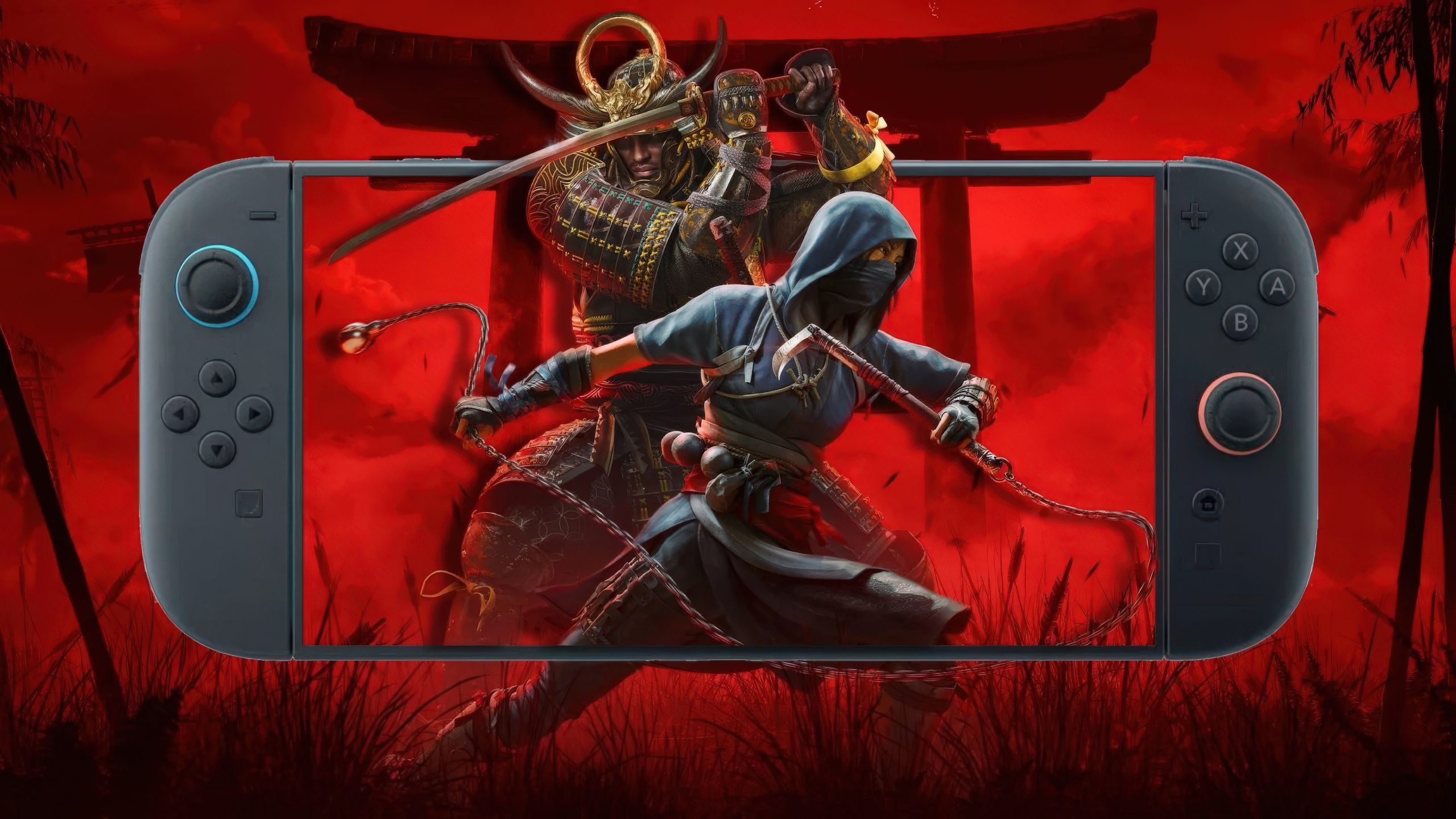
That sounds ambitious for a portable console, and it is: the team had to completely rethink how the game is rendered and how its systems talk to each other in order to deliver a stable 30 frames per second experience on the go.
Next-gen Anvil engine squeezed onto a handheld
At the heart of Shadows sits the latest evolution of the Anvil engine, which Ubisoft has been refining for more than a decade. In its full-fat form on high-end hardware, this version of Anvil leans heavily on modern rendering techniques. Global illumination and reflections are handled through extensive ray tracing, painting Kyoto streets and rural villages with convincing indirect light, reflections in puddles, and subtle bounce lighting. Weather is no longer just a layer of particles: wind and rain are driven by fluid simulation that bends trees, whips cloth, and even changes the direction of falling raindrops.
Clouds, too, are simulated rather than painted on a skybox. A physics-based, procedural cloud system continually evolves cloudscapes as time passes, making each sunrise subtly different from the last. On top of that, Anvil now incorporates a Nanite-style micropolygon system that virtualizes geometry. Instead of manually authoring multiple levels of detail for every rock and roof tile, artists can push extremely dense meshes, while the engine dynamically adjusts triangle density with distance. Destruction physics, cloth behaviour, and material responses have all been upgraded to make combat and stealth movement feel more physical and reactive.
Streaming, geometry and next-gen scale
Behind the scenes, Ubisoft rebuilt terrain and asset streaming around this virtualized geometry. Dense villages, rice fields, and mountainous passes can stay loaded without hammering the CPU or flooding storage bandwidth. Deeper GPU instancing and mesh shader integration let the engine throw countless small props – lanterns, foliage clusters, roof tiles – onto the screen without drowning the CPU in draw calls. All of this defines Assassin’s Creed Shadows as a thoroughly next-generation production on powerful machines.
Redesigning the world for Nintendo Switch 2
None of that changes the reality that Nintendo Switch 2 is significantly less powerful than a gaming PC or the current crop of home consoles. Project Lead Programmer Bruno explains that the team effectively had to re-author the way the world is drawn for Nintendo’s hardware. Fundamental simulation systems such as clouds and cloth remain present, but they are aggressively optimized and, in some cases, scaled back to ease GPU load. For global illumination, the Switch 2 version uses a baked solution – the same one already targeting low-spec PCs and Xbox Series S – rather than leaning on the console’s hardware ray tracing capabilities. This approach saves precious RAM and cuts the cost of lighting every alley and forest path in real time.
Ubisoft did not simply flip a single ‘low’ preset. The studio tuned almost every visual parameter on a per-scenario basis. Level of detail thresholds, draw distances, texture resolutions, and object streaming budgets are all adjusted region by region to keep performance in check. In the busiest hubs, NPC density is reduced only where it is strictly necessary, preserving the sense of life in markets and castles while avoiding CPU or bandwidth spikes that might cause stutter. The result is a game that still feels bustling, even if it is subtly leaner than its counterparts on more powerful devices.
DLSS, frame rate targets and visual trade-offs
To make this all work, Ubisoft leans on one of Nintendo Switch 2’s most important features: hardware support for NVIDIA DLSS. Instead of rendering every frame at native resolution, the game draws a lower-resolution image, which DLSS then reconstructs into a sharper final frame using temporal data and machine learning. This substantially improves performance and allows the engine to target a stable 30 frames per second in both handheld and docked modes. Ubisoft ultimately chose consistency over chasing 40 or 60FPS targets, prioritizing a smooth, predictable frame time over fluctuating performance.
The main difference between the two modes is visual fidelity. Docked, Assassin’s Creed Shadows on Switch 2 benefits from higher internal resolutions, increased draw distance, and more generous LOD settings, lending cities and countryside vistas a cleaner, more detailed look on a TV. Handheld mode pares things back further, with more aggressive LOD transitions and slightly softer reconstruction, but compensates with a couple of neat tricks: support for HDR on compatible screens and a tweaked implementation of Variable Refresh Rate.
Typically, VRR systems disable themselves below roughly 40FPS, but Shadows is capped at 30FPS on Nintendo’s hardware. According to Bruno, the team created a dedicated algorithm that keeps VRR active even at that lower frame rate window. The aim is to minimize micro-stutter and input latency, making camera movement and parries feel as fluid as possible despite the 30FPS cap.
Platform-specific features and future support
The Switch 2 version also embraces platform-specific features beyond visuals. Touchscreen support allows players to pinch-zoom and drag around the world map, interact with menus, and manage elements of their hideout directly with their fingers in handheld mode. Ubisoft is also planning to add mouse and keyboard compatibility in docked mode in a post-launch update, an unusual but welcome option for players who prefer a more PC-like control scheme while the console is in its cradle.
Post-launch plans: one focused expansion
One area where Ubisoft is keeping expectations in check is post-launch expansion. Players on Nintendo’s new console will eventually gain access to the Claws of Awaji expansion, scheduled to arrive on Switch 2 sometime in 2026. That will be the only major expansion for Assassin’s Creed Shadows across all platforms, in contrast to Assassin’s Creed Valhalla, which received three substantial expansions: Wrath of the Druids, The Siege of Paris, and Dawn of Ragnarök. In other words, the focus this time is on delivering a single, densely packed add-on rather than a multi-year season pass.
A next-gen Assassin’s Creed you can carry around
For Nintendo fans, though, the headline is clear: a full-scale, next-generation Assassin’s Creed is coming to a portable device, but it does so with carefully chosen compromises. Baked global illumination, aggressive optimization, DLSS reconstruction, and a 30FPS cap work together to balance ambition with practicality. If Ubisoft’s engineering holds up in the final release, Assassin’s Creed Shadows on Nintendo Switch 2 could become a showcase not just for the Anvil engine, but for how big open-world games can be reshaped to fit into your hands without losing their identity.
1 comment
if they nail DLSS this might be the best looking portable game yet, no joke