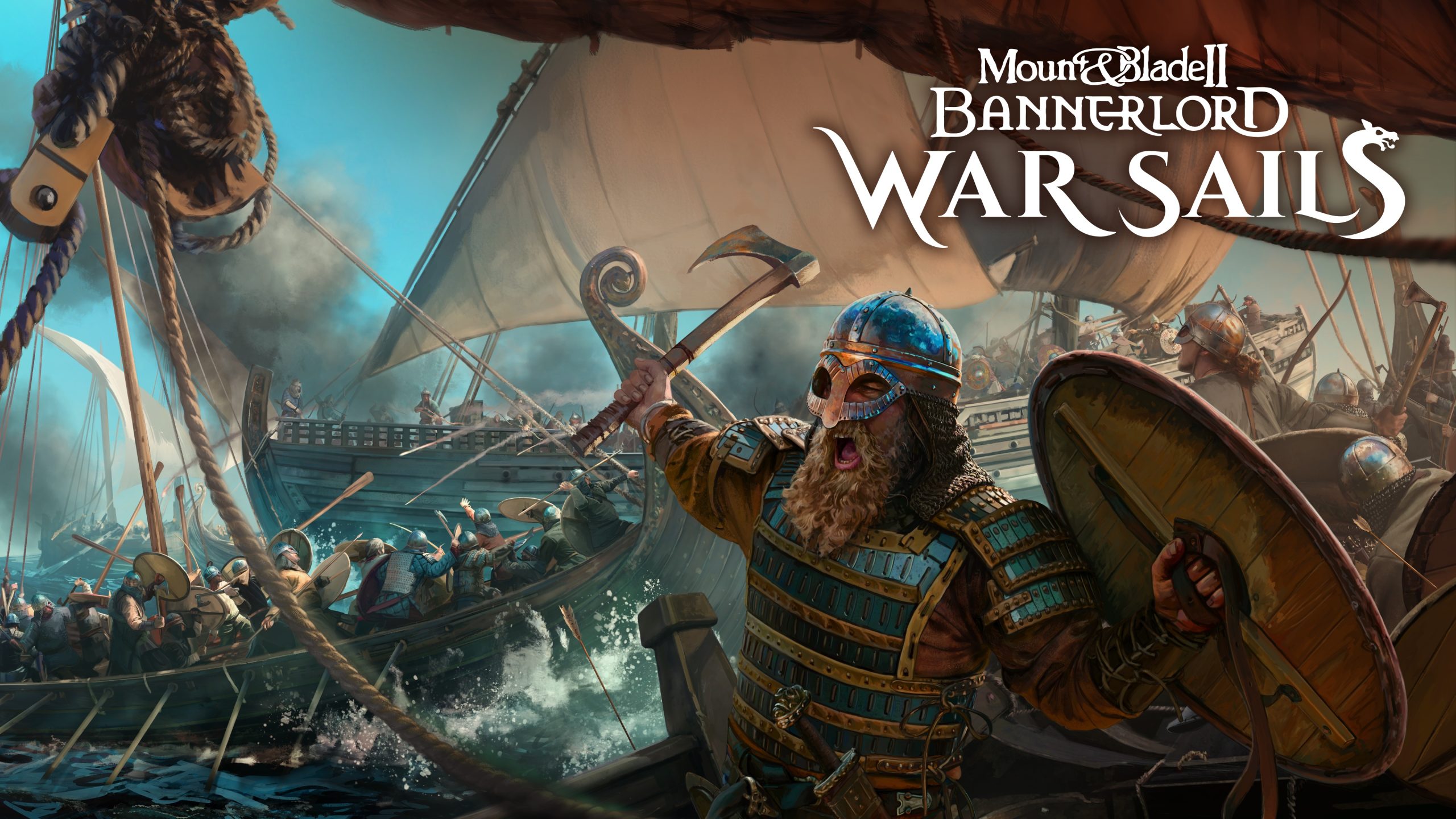
Mount & Blade II: Bannerlord – War Sails Brings Nords, Navies and New Politics to Calradia
Mount & Blade II: Bannerlord has already lived a long life since its 1.0 release in October 2022, evolving steadily from the early access days into a sprawling medieval sandbox. Now, more than three years on from launch, TaleWorlds Entertainment is preparing to make the biggest single change to Calradia since the game first hit PCs and consoles. The War Sails expansion drags the conflict off the dusty roads and open fields and throws it into crashing waves, burning decks and storm-lashed coastlines, while a massive free update reshapes politics, AI behavior and modding right alongside it.
War Sails is not just a new questline or a themed DLC pack: it is a foundational systems expansion. It introduces fully fledged naval combat, a new coastal biome to explore, and a returning culture beloved by veterans of the original Mount & Blade – the fearsome seafaring Nords. On top of that, players gain new naval-focused skills, ship upgrades, and mechanical tweaks that ripple back into the core campaign. Senior producer Falk Engel and design team lead Gökçen Karaağaç describe a project that aims to make the sea feel as important a strategic space as any fort-studded frontier, without abandoning the grounded simulation and emergent storytelling that define Bannerlord.
From Horse Lords to Sea Wolves: Why War Sails Matters
Bannerlord has always thrived on its grounded blend of tactical battles and grand strategy. You march across a living map, build reputations with nobles, juggle clan finances and loyalty, and lead weary bands of soldiers into desperate last stands. Until now, however, Calradia has been dominated by land warfare. The sea was visually present but mechanically absent, a pretty blue border with little influence on campaign planning. War Sails changes that in a way that alters how you think about logistics, movement, trade and war goals.
By opening up the coasts and islands as fully navigable spaces, TaleWorlds effectively carves new fronts into the campaign. Sea lanes become flanking routes, choke points and ambush grounds. Naval supremacy can determine whether coastal towns are safe trading hubs or eternally besieged war zones. A lord with ships can outmaneuver enemies that rely only on roads, and a player who invests in fleets gains fresh tools to raid, blockade and strike deep behind enemy lines. War Sails, in other words, is less a self-contained DLC and more a layer that rebalances the entire sandbox.
Naval Combat Built on Fire, Ramming and Positioning
At the heart of War Sails is ship-to-ship combat that blends Bannerlord’s familiar directional melee fighting with naval maneuvering and ranged warfare. According to Gökçen Karaağaç, the headline additions are the ability to ram with your vessel and the use of ship-mounted ballistas. Ramming lets you attempt brutal charges that crumple enemy hulls, while ballistas provide heavy, deliberate ranged fire that can punch through key sections of a target ship. These tools immediately create new tactical decisions: do you set up a deadly approach angle, try to cripple enemy mobility, or stay at range and whittle them down?
Despite those flashy mechanics, the developers emphasize that the primary way ships die at sea is not splintered wood, but fire. In Bannerlord’s naval warfare, flames are the great equalizer. Once fire takes hold on a deck or burns through hull sections, chaos erupts. Crews panic, morale can plummet, and carefully drilled formations turn into scrambling knots of soldiers. Players are encouraged to think about how they spread or contain fire, how they use it to deny sections of a ship, and how they time boarding attempts when the enemy is busy trying to save their vessel from becoming a floating pyre.
That focus on fire also integrates neatly into Bannerlord’s grounded approach to damage and attrition. You are not just watching health bars disappear; you are watching your carefully maintained, expensive ship suffer lasting harm. A reckless captain who charges into every engagement and lets their deck burn down to the waterline will quickly discover that the sea is far less forgiving than the open steppe.
Ship Upgrades, Sea Burtons and Purpose-Built Vessels
Beyond the adrenaline of combat, War Sails deepens the campaign layer through substantial ship customization and progression. Players can invest in a range of upgrades that alter how their fleet performs on the world map and in battles. Some improvements let you carry more troops, turning your flagship into a floating war camp capable of landing overwhelming forces along enemy shores. Others raise crew morale, which becomes crucial during long voyages and intense engagements. Another set of upgrades increases what the developers refer to as the ship’s sea burton – essentially its resistance to storms and rough seas – allowing you to weather violent weather where lesser captains would sink or be forced to turn back.
Engel notes that you can also expand cargo holds, steering your ship more toward trade and exploration instead of pure warfare. This creates an interesting tension: a captain who pours resources into cargo space can dominate coastal commerce, running profitable trade routes and supplying remote settlements, but might find their ship less specialized for brutal frontline engagements. Players can choose to tilt their builds toward swift raiders, resilient warships or long-haul merchant vessels, each suited to a different fantasy.
Crucially, not every ship offers the same degree of customization. Some hulls are all-rounders with broad upgrade options, ideal for jacks-of-all-trades. Others are highly specialized vessels with limited upgrade slots but extreme strengths in specific roles. A dedicated war galley, for example, might lack the flexibility to become a top-tier trader, yet it can outclass more generalist ships when it comes to ramming, boarding or absorbing damage. This design ensures that fleet composition matters as much as individual upgrades; a smart lord will think in terms of complementary roles rather than simply buying the biggest boat.
Sea Power and the Art of Coastal Warfare
One of the most important clarifications TaleWorlds makes about War Sails is what it does not do: it does not introduce fully blended battles where troops are simultaneously fighting in a single instance both on land and at sea under one unified control scheme. There is no scenario where you manually split forces between ship and shoreline within the same encounter and micromanage them together. Instead, the design focuses on a more structured but still dynamic interplay between naval engagements and land battles, especially around coastal towns and castles.
When you lay siege to a coastal settlement, you now have to think in layers. Defenders can challenge you both on the walls and from the sea. You might win a naval engagement to secure control of the harbor, only to be forced into a punishing land assault against fortified walls. Conversely, a strong garrison might attempt to sally forth with ships to break a blockade, even if they cannot meet you on equal terms on the field. These linked operations make coastal sieges less predictable and more cinematic, forcing you to plan ahead with the knowledge that danger can come from more than one direction.
On the campaign map, you still cannot give precise real-time joint orders to other armies – there is no button to instruct a friendly lord to attack a port at a specific moment while you lead a land assault. Instead, the open sandbox remains driven by observation, timing and opportunism. As Engel explains, you monitor what other parties are doing, read their movements, and choose when to align your actions with theirs. That could mean rushing your fleet into position when you see an allied army marching on a coastal city, or striking from the sea when you notice an enemy force has left its ports lightly defended. Coordination emerges from situational awareness rather than rigid scripting, preserving the series’ trademark improvisational feel.
New Naval Skills: Mariner, Boatswain and Shipmaster
To support this new layer of warfare, War Sails introduces three dedicated naval skills: Mariner, Boatswain and Shipmaster. Rather than simply bolting generic sea bonuses onto existing trees, TaleWorlds has tried to define archetypes that capture different facets of life at sea. Mariner leans into the idea of the seasoned sailor, someone who knows how to move, fight and survive on a rolling deck. Boatswain embodies the logistics-focused officer, the figure who keeps the crew disciplined and the ship functional under pressure. Shipmaster evokes the strategist-captain archetype, the leader who understands navigation, positioning and command decisions that can decide entire engagements before blades even clash.
These skills come with an important twist. They do not bring new attribute points with them; instead, each naval skill draws from two existing attributes, rather than the single attribute linkage used by most traditional skills. For example, Karaağaç mentions that Mariner connects to both Vigor and Control. In practice, that means a character who is already a capable fighter and competent ranged combatant will naturally find it easier to become a good seafarer. The design rewards well-rounded builds, tying your naval effectiveness to broader character development rather than isolating it in a completely separate system.
This dual-attribute structure also encourages role-playing. A high-intelligence, high-cunning noble might excel as a Shipmaster who outmaneuvers enemies on the campaign map, while a rugged, strong warrior with decent Control will feel like a proper Mariner who thrives amid boarding actions and shipboard skirmishes. It is a subtle shift, but one that ensures War Sails deepens existing characters instead of forcing you to rebuild them from scratch.
Captains, Crews and the Limits of Troop Influence
One of the first questions players raised about naval combat was whether an entire crew’s experience would affect ship performance, or if things would be pinned mainly to the captain. TaleWorlds’ answer is clear: the ship’s core statistics and capabilities are determined by the captain’s abilities, while regular troops continue to use their own personal skills only when they fight. There is no hidden calculation where a boat full of elite troops magically handles better than a ship full of recruits.
That does not mean crew composition is irrelevant. A key distinction introduced in War Sails is whether a soldier is considered a Mariner. If they are not, they suffer penalties to their combat capabilities while fighting at sea. The difference between a hardened, sea-trained warband and a hastily loaded land army becomes immediately obvious once arrows start flying and waves begin to heave underfoot. Inexperienced fighters might fumble their footing, react poorly to chaotic conditions and generally underperform when compared to dedicated sailors. Players are therefore incentivized to gradually build up a roster of troops comfortable with naval warfare instead of treating ships as simple troop transports.
This approach keeps the focus on leadership without erasing the flavor of specialized crews. Your captain determines how the ship turns, accelerates and withstands storms, but the unit mix you bring on board still matters when it is time to board an enemy vessel, repel attackers or fight through a fire-swept deck. It strikes a balance between Bannerlord’s emphasis on the significance of the party leader and the fantasy of commanding a real naval force rather than a faceless statistic.
The Nords Return: Nostalgia with a New Edge
For long-time Mount & Blade fans, one of the most exciting parts of War Sails is the return of the Nord culture, reimagined for Bannerlord’s timeline and systems. In the original Mount & Blade and its expansions, the Nords became iconic: axe-wielding warriors with a reputation for fearless infantry assaults and ruthless raiding. Karaağaç acknowledges that nostalgia played a major role in bringing them back. Lore-wise, the explanation is disarmingly simple and effective: the Nords were always out there in the northern reaches, and now, as the age of sails and longships accelerates, they have begun to push back into Calradia in force.
This narrative justification neatly aligns with the DLC’s mechanical focus. A culture that lives and dies by the sea is a perfect partner for an expansion centered on naval warfare. Yet TaleWorlds did not just transplant the old Nords wholesale. Their identity has been sharpened around two pillars: elite infantry and superior seamanship. On land, they field some of the heaviest, highest-tier foot troops in the entire game, infantry designed to chew through opposing lines and trade effectively even when outnumbered. If you want to see shield walls collide with brutal finality, Nord warbands are built to deliver that fantasy.
At sea, the Nords enjoy broad advantages over other factions in almost every naval-related dimension. Where other cultures might have solid navies or respectable coastal forces, the Nords strive to do it all better: sturdier crews, more naturally at home on ships, and doctrines tuned to aggressive boarding and relentless pursuit over open water. The one area where they are merely average rather than dominant is trade. Nords are competent merchants but not masters of commerce; their economies are skewed toward supporting war rather than building vast fortunes. That trade-off reinforces their identity as hardened raiders and warriors first, businessmen second.
Nord Lands, New Biomes and a Castle-Focused Economy
War Sails does not just add Nords as troop trees and culture tags; it physically reshapes the northern reaches of the world map. Their main power base, Nordvik, anchors a sweeping coastal region that interfaces tightly with Sturgia. Further out, across rougher waters, lies Vineland, an island area hosting another Nord town and surrounding settlements. This layout creates natural naval routes filled with strategic tension: island strongholds, vulnerable shipping lanes, and rugged coastlines ripe for ambushes.
The Nord homeland also introduces a fresh biome. Expect harsh, wind-blasted shores, dense forests crowding in from the interior and settlements whose architecture is visibly informed by shipbuilding traditions. Engel describes towns where houses seem inspired by inverted hulls, long halls that evoke massive upturned ships, and street layouts that reflect the logic of coastal communities built around harbors and docks rather than inland roads. Just wandering through these environments reinforces the feeling that you are dealing with a people who belong on the water.
Economically, the Nords break from some of Bannerlord’s existing patterns. They do not sprawl across the map with a web of wealthy cities. Instead, they field a relatively small set of well-supplied, important towns backed by a dense network of castles. Many Nord lords rule from fortresses rather than urban centers, which gives the culture a more militarized, resilient economy. They may never match the sheer commercial might of a faction like the Aserai, but they also avoid the fragility that can come with overly city-dependent prosperity. In campaign terms, fighting a war against the Nords often means grinding through layers of fortified positions rather than simply capturing a handful of key metropolises.
Politics, Alliances and Smarter Wars
While ships and Nords grab most of the attention, TaleWorlds is also using the War Sails launch window to update Bannerlord’s political and strategic AI in ways that affect every player, even those who never buy the DLC. Some of these changes have already appeared in beta branches and are being rolled into the base game as part of a free patch. Karaağaç mentions improved alliance mechanics and new policies, including some directly tied to naval power, that open up different role-playing possibilities inside kingdoms.
Beyond formal politics, Engel emphasizes that the design team has poured considerable effort into how factions evaluate wars. The game now does a better job of asking questions like: is this war actually making progress? Are we overextended? Are we risking too many front-line settlements or trading hubs by pursuing this conflict? Distance matters more, as does the vulnerability of exposed towns and castles. The result is that campaigns should feel less like a random swirl of endless declarations and more like a shifting landscape of calculated conflicts, opportunistic strikes and carefully weighed peace negotiations.
This rework does not turn Bannerlord into a pure diplomatic simulator, and there is still plenty of room for chaos and surprise. But when a kingdom decides to keep pushing a war, players should feel more clearly that there are reasons behind it – an exposed rival, a rich coastal city that has become reachable by sea thanks to War Sails, or a desire to secure critical trade corridors. War, as Engel puts it, is simply politics by other means, and the team wants the AI to reflect that logic more convincingly.
Single-Player First, With a Touch of Multiplayer Polish
War Sails itself is a single-player expansion. Naval battles, Nord campaigns and sea-driven politics are all focused on the sandbox campaign mode where players spend most of their time. However, the free update launching alongside the DLC will touch multiplayer as well, albeit in a more modest way. Engel is careful not to oversell this aspect, stressing that multiplayer is not the focus of this release, but some of the visual and atmospheric improvements from recent betas are expected to carry over to online modes.
Those improvements include reworked atmospherics that make maps look richer and more grounded: better use of fog, lighting and skyboxes to create the sense of fighting in living environments rather than sterile arenas. TaleWorlds is also considering the possibility of adding a new multiplayer team option. The details remain deliberately vague, and there is no promise of sweeping new multiplayer modes or cross-feature parity with every single-player addition. Still, for the dedicated PvP community that has kept Bannerlord’s skirmishes alive, even small injections of polish and variety can go a long way.
As for what comes next after War Sails, the studio is keeping its cards close to its chest. They are not ready to discuss future DLC plans, preferring a philosophy where features are only talked about publicly once the team is confident it can deliver them in a satisfying form. It is a design approach that prioritizes avoiding false hope over generating short-term hype.
Cross-Play and Platform Parity: Design Before Promise
In an era where many online games push toward broad cross-play between consoles and PC, it is natural for Bannerlord players to ask whether TaleWorlds intends to do the same. Engel’s answer is cautious: there is no active development on cross-play at the moment. Part of that is technical, with internal challenges that would need to be solved to unify platforms. Another part is philosophical. The team questions whether pairing controller players against keyboard-and-mouse veterans would actually improve the multiplayer experience, especially given how demanding Bannerlord’s combat can be at high skill levels.
The game’s multiplayer community is famously dedicated and extremely skilled – a fact Engel acknowledges with some self-deprecating humor. In that context, introducing cross-play without carefully addressing balance concerns could lead to frustration rather than inclusivity. For now, then, cross-play remains in the realm of theoretical discussion rather than concrete roadmap item. TaleWorlds would rather refuse to promise it than hint at a feature that might never arrive.
Modding Upgrades: Crouching Musketeers and Open Seas
One of Bannerlord’s enduring strengths is its modding community, which has spent years extending, overhauling and reimagining Calradia in everything from low-fantasy overhauls to gunpowder-era total conversions. The update launching alongside War Sails includes a series of improvements aimed squarely at these creators. Engel points to a particularly eye-catching change: the ability for characters to crouch and use weapons at the same time. It might sound like a minor animation tweak, but for modders working on musket-focused or modern-era projects, it opens up entire new possibilities for how firefights are staged and how cover systems feel.
According to TaleWorlds, many of the modding-related changes have already been exposed in beta branches, giving creators time to adapt their projects before the live release. The full patch notes will contain a long list of under-the-hood tweaks, scripting hooks and quality-of-life upgrades. While not every modification is flashy enough to make headlines, the cumulative effect is to expand what total conversion teams and small-scale modders alike can accomplish, from new UI behaviors to more nuanced AI control.
In the specific context of War Sails, the game’s underlying systems are being extended to support naval gameplay at a foundational level. That means pathfinding across open water on the campaign map, proper handling of ships as entities, and the ability to integrate sea travel into custom worlds. There have already been mods experimenting with seafaring, but the official implementation gives creators more robust tools and native support, making ambitious naval overhauls more achievable and less fragile.
New Water, New Worlds: Helping Modders Adapt
Adding ships is only one part of the story; TaleWorlds is also changing how water itself is rendered and handled. From a player perspective, this mostly translates into prettier waves and more immersive coastlines. For modders, however, such structural changes can be both exciting and intimidating. A new rendering system can break old tools or require tedious manual adjustments to keep existing projects compatible.
Karaağaç explains that part of the War Sails effort has been to provide pathways for mod creators to migrate their own world maps and environments to the new systems without redoing everything from scratch. The studio is trying to ensure that those who have spent years sculpting custom continents and oceans can make the leap with manageable effort rather than facing a total rebuild. In practice, this means documentation, updated editor hooks and thoughtful design around backward compatibility. TaleWorlds sees its modding community not as an afterthought but as a core part of Bannerlord’s future, and War Sails is being structured to empower, not punish, that ecosystem.
Claimants, Trade Goods and the Temptation of Overpromising
One topic that continues to hover around Bannerlord’s discourse is the fate of Claimants – the pretender characters that were showcased in earlier development phases as potential alternative rulers and story seeds. When asked about them, Engel declines to offer specifics. The team is not ready to confirm exactly how or when Claimants might appear in the live game. At the same time, he hints that some of the systems being worked on today, particularly around valuables, trade and political maneuvering, are related to mechanics that fans associate with Claimants.
This careful tightrope walk reflects a broader philosophy. TaleWorlds has learned that making concrete promises too early can backfire. The moment a feature is described in public, people begin to imagine it in detail and attach expectations to it. If schedules slip or designs change, that initial excitement can turn into disappointment. By keeping some cards face-down – especially those connected to complex, long-term features – the studio tries to protect both its creative flexibility and the community’s morale.
Technology Wishlist: DLSS, PS5 Pro and General Optimization
On the technical side, players have a few prominent items on their wishlist. One is support for DLSS Frame Generation, which could offer smoother performance on compatible Nvidia hardware. Asked about it, Engel does not offer a timeline. He notes that he needs to confirm details with the engine team and cannot provide an update yet. It is an honest, if unsatisfying, answer: the feature is not ready to be talked about in concrete terms.
Console players, meanwhile, are curious about whether Bannerlord will directly leverage newer hardware such as the PlayStation 5 Pro. Here, too, the message is cautious. TaleWorlds does not have specific PS5 Pro-only enhancements to announce. However, the work done on War Sails and its accompanying update includes significant optimization in memory usage and performance across the board. Those improvements benefit consoles and PC alike, seeping into both the base game and the DLC. Even if there is no bespoke next-gen mode, players on modern systems should feel some of the gains when they ride into larger battles or sail busy coastal waters.
Living with Risk: Ships You Cannot Afford to Lose
Beyond raw features, War Sails is also about capturing the emotional texture of seafaring campaigns. Ships are expensive assets, both in gold and in the time it takes to train effective crews. Storms can tear hulls apart and scatter fleets. Fire can turn a proud warship into a charred wreck in minutes. A captain who pushes too aggressively, overextends into hostile waters or treats every encounter as a duel to the death will eventually pay the price.
That is why Karaağaç offers one final piece of advice to players: do not sail a ship you cannot afford to lose. It is more than a throwaway line. In Bannerlord’s land battles, losing a fight hurts, but you often have fallback options – retreating with survivors, rebuilding your party, licking your wounds. At sea, the stakes can feel even higher. When your flagship sinks in a storm far from home, your plans for the next in-game month might change in an instant. War Sails leans into that sense of high-risk, high-reward adventure, making maritime campaigns both tempting and intimidating.
For players who embrace that risk, the expansion promises rich emergent stories: daring coastal raids that spiral into multi-front wars, small fleets slipping through blockades to rescue allied towns, or hard-bitten Nord captains carving out island strongholds in contested waters. The sea is no longer a decorative edge to the map; it is a theater of war with its own rhythms, dangers and opportunities.
A Community Voyage Years in the Making
One of the striking things about talking to TaleWorlds developers is how often they mention the community. Engel points out that he himself comes from that community, having lived through Bannerlord’s long journey alongside other players. For the studio, War Sails is as much a response to years of feedback and wish lists as it is a top-down design initiative. Fans wanted meaningful naval gameplay, richer politics, more varied cultures and deeper tools for modders. This expansion and its accompanying patch represent a significant step toward those ambitions.
In their parting words, Engel and Karaağaç express genuine gratitude for the patience and passion of players who have stuck with the game through early access, full release and countless patches. They are excited to see how people react when they finally get their hands on War Sails – how veteran commanders adapt to naval logistics, how role-players spin new tales around the Nords, and how modders hijack the technology to build worlds far removed from Calradia. The sense is less of a final destination and more of a new chapter in a story still unfolding.
Years after its initial launch, Mount & Blade II: Bannerlord is preparing to reinvent itself again, this time by opening the sea as a true frontier. With Nords returning from the icy north, politics reshaped by new fronts, and modders handed fresh tools to reshape reality, War Sails looks set to redefine what it means to rule, trade and wage war in Calradia. For players willing to risk their fortunes on the waves, the age of the oar and the burning galley is about to begin.
2 comments
nice to see they care about politics AI too, i was so tired of kingdoms declaring 4 random wars at once for no reason
ngl crossplay not being there is kinda sad but at least they’re honest about it… rather that than empty promises tbh