WeatherNext 2 is Google’s new generation AI weather engine, designed to quietly replace the old forecasting backbone behind Pixel Weather, Google Search and, very soon, Google Maps. Instead of being just another update to a weather app, it is an overhaul of the way short- and medium-range forecasts are produced, trading heavy physics simulations on supercomputers for a leaner AI model that can spit out detailed outlooks for the next 15 days in about a minute.
A shift from supercomputers to AI forecasting
Traditional weather prediction relies on so-called numerical weather prediction models. 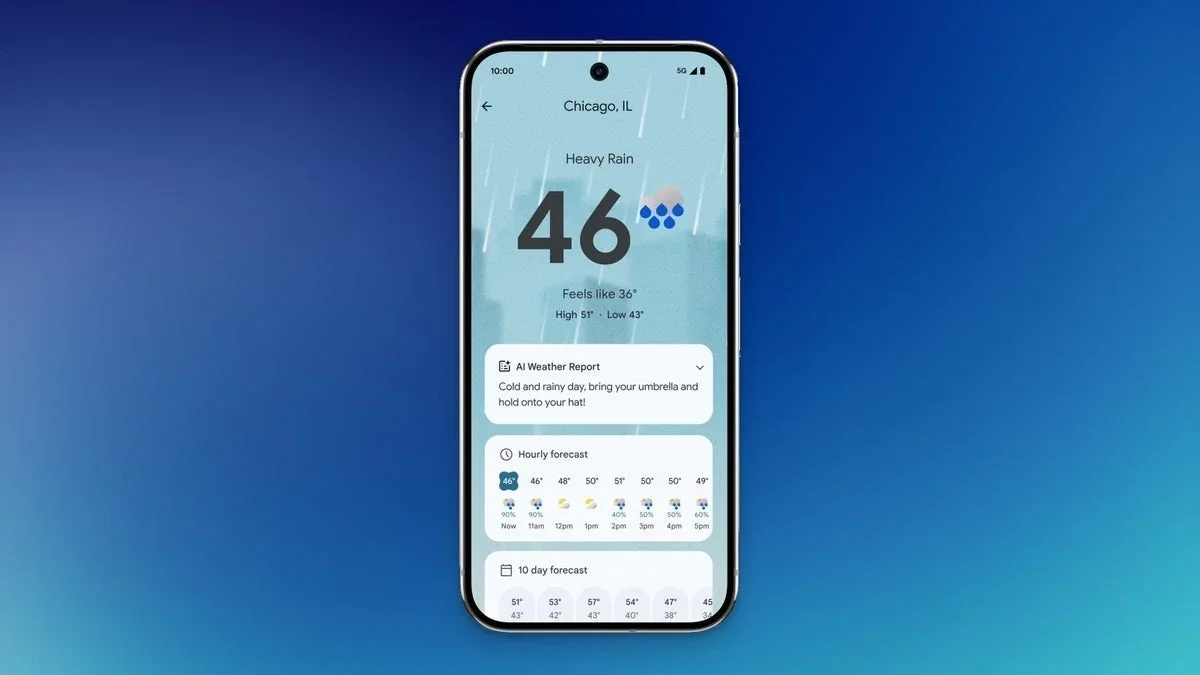
They take in huge volumes of observations from satellites, ground stations, aircraft and ocean buoys, and run equations of fluid dynamics and thermodynamics on powerful supercomputers. That approach has been extremely successful, but it is expensive, slow and energy-hungry. Running a global forecast can easily take around an hour of compute time even on dedicated hardware, and refreshing those runs several times a day is a constant race against the clock.
WeatherNext 2 keeps the science but changes the engine. Instead of simulating every physical process step by step, the system learns how the atmosphere usually behaves by devouring historic weather data and matching it with the ground truth that actually happened. Once trained, the model no longer needs to solve every equation from scratch. It can generate a new forecast in under a minute on Google’s own Tensor Processing Units, chips specifically designed to accelerate AI and machine-learning workloads.
Speed, accuracy and 15-day outlooks
That speed is not just a nice benchmark number. Google says WeatherNext 2 can generate forecasts eight times faster than traditional physics-based systems. It also produces four updated forecasts each day, each one covering a fresh six-hour window and extending the outlook out to 15 days. For people checking tomorrow’s rain chances or planning a weekend trip, that means forecasts that are refreshed more often and are ready sooner, not lagging behind the real world.
Accuracy matters just as much as speed, and this is where the upgrade from WeatherNext 1 really shows. According to Google, WeatherNext 2 outperforms its predecessor on about 99 percent of the key variables that make up a forecast: wind speed and direction, temperature, precipitation, pressure and humidity. Those variables are tightly linked by the physics of the atmosphere. When an AI model can capture those relationships well, you get forecasts that feel less erratic, with smoother changes in temperature, more realistic rainfall patterns and fewer surprises from wind swings.
Inside the Functional Generative Network
Under the hood, WeatherNext 2 switches to a new modelling approach called a Functional Generative Network. It replaces the Graph Neural Network and Conditional Diffusion setup used in the first version of WeatherNext. The older models are not being thrown away; they are still available for researchers and developers as a reference, but Google clearly sees the new architecture as its flagship. In simple terms, the Functional Generative Network is better at representing continuous fields like temperature or pressure across the globe, and at generating whole sequences of future states that stay physically consistent.
Where you will see WeatherNext 2 in action
The rollout is already under way. WeatherNext 2 is being made available to developers, researchers and end users at the same time. On the consumer side, it powers the refreshed forecasts in the Pixel Weather app from the Play Store, in the results you see when you simply search for the weather in Google Search, and in the Gemini app on Android. On the platform side, it feeds the Weather API that sits underneath the Google Maps platform, and Google says that in the coming weeks WeatherNext 2 will fully take over the forecasting duties for Maps.
If you notice that hourly rain charts in Pixel Weather feel more precise, or that Google Maps seems better at timing when a storm will cross your route, WeatherNext 2 is probably the reason. Because the model can generate hundreds of thousands of forecasts very quickly, Google can afford to run high-resolution scenarios more often and tailor more of them to the locations and time windows that people actually care about.
Why AI weather feels different
What makes AI weather different from the old supercomputer era is the way it treats the atmosphere. Rather than just crunching through equations, systems like WeatherNext 2 look for patterns that repeat: the subtle ways that pressure fields evolve into storms, or how humidity and wind interact before a downpour. The physics is still there in the training data and constraints, but the day-to-day work of producing a forecast becomes a problem of pattern recognition and generation.
For users, all of this complexity is meant to disappear behind a simple interface: a timeline of temperatures, icons for sun and rain, and maybe a radar map. Behind the scenes, however, there is a major shift under way in how those numbers are produced. WeatherNext 2 hints at a near future in which global-scale, 15-day forecasts can be produced in minutes instead of hours, opening the door to more personalised, more local and ultimately more useful weather information wherever you see Google’s forecast appear.