NVIDIA has quietly built one of its strangest professional GPUs in years: the RTX 6000D Blackwell, a China-only variant designed to slip under strict US export rules while still looking attractive on spec sheets. On paper it carries the Blackwell name and sits in the same family as the RTX PRO 6000, but a closer look at leaked benchmarks shows a heavily cut down configuration with fewer cores, less memory bandwidth and noticeably lower performance than the global flagship. 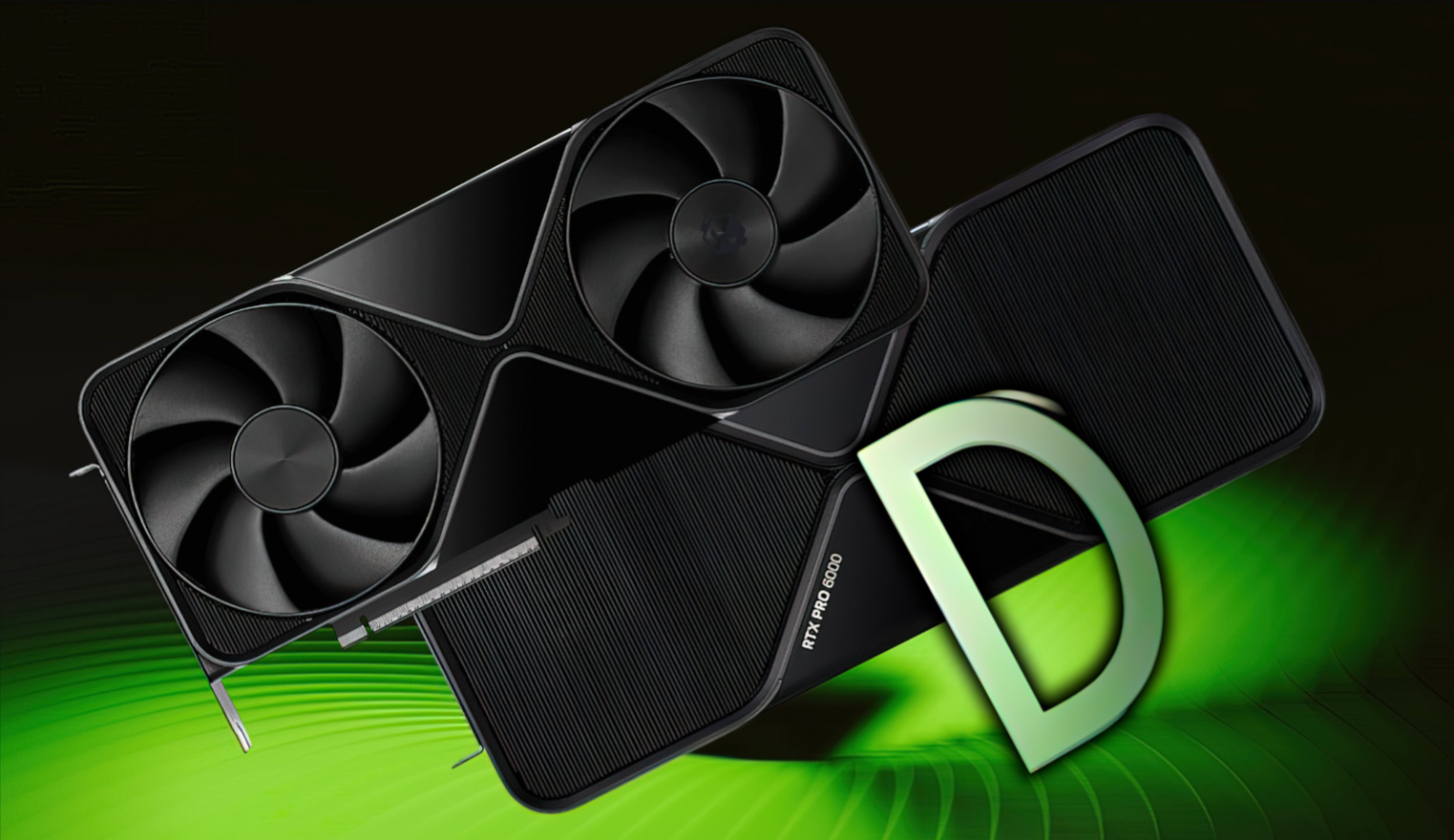
For many engineers and AI buyers in China, it feels less like a breakthrough accelerator and more like a carefully nerfed compromise.
The RTX PRO 6000 series was supposed to be NVIDIA’s all-round workhorse for AI, visualization and high end content creation. You get the same Blackwell-class GPU die in several form factors: a full power desktop card, a Max Q tuned version for systems that need to keep power in check, and a server variant for dense racks. All of those global models share one basic idea: 24,064 CUDA cores spread across 188 streaming multiprocessors, 96 GB of GDDR7 memory on a 512 bit bus and clocks comfortably north of 2.6 GHz under load. The RTX 6000D for China, however, trims that formula almost everywhere.
Why a special Blackwell for China
The existence of the RTX 6000D Blackwell is a direct reaction to the latest rounds of US export controls on high end AI hardware. Regulators are not just looking at raw FLOPS any more; they track interconnect bandwidth, memory capacity, and even how many accelerators can be clustered together. NVIDIA cannot simply ship the same RTX PRO 6000 and hope for the best. Instead, the company is carving out customized SKUs that stay just under specific thresholds, with the RTX 6000D being one of the most visible examples on the professional side.
This strategy has not gone unnoticed in enthusiast circles. While gamers keep joking about delayed GeForce refreshes and maybe canceled Super or Ti cards, China is getting an exclusive workstation product that looks suspiciously similar to a downclocked, semi disabled Blackwell that might otherwise have become a high end gaming SKU. Among the more cynical voices, the RTX 6000D is already being nicknamed a forbidden 5080 Ti with absurd amounts of VRAM, created for compliance paperwork rather than for performance leadership.
RTX 6000D Blackwell specs: fewer cores, narrower bus, odd VRAM number
Under the hood the RTX 6000D Blackwell uses the same GB202 class silicon as the mainstream RTX PRO 6000, but with 156 SMs enabled instead of 188. That translates into 19,968 CUDA cores, roughly 17 percent fewer than the full configuration with its 24,064 cores. In workloads that scale well with core count, you can almost predict the performance loss before even looking at benchmarks. The cuts do not stop there. The memory subsystem, usually a standout feature of RTX PRO 6000, is slimmed down as well.
The standard RTX PRO 6000 ships with 96 GB of GDDR7 across a 512 bit interface, delivering a huge chunk of bandwidth for AI models and large scene data. The RTX 6000D, according to early reports, carries 83 GB of VRAM, a number that immediately raised eyebrows because it does not line up cleanly with typical memory chip sizes. Given that NVIDIA is known to use 3 GB GDDR7 modules on this generation, 84 GB would be the natural configuration, implying a 448 bit bus instead of 512 bit. That would neatly explain a drop in peak bandwidth from 1792 GB per second on the full card to roughly 1568 GB per second on the cut down variant, though NVIDIA has not detailed this publicly.
Clock speeds are also dialed back. While global RTX PRO 6000 configurations can boost well past 2600 MHz under real workloads, the RTX 6000D is listed at around 2430 MHz. That is not a catastrophic drop, but combined with fewer cores and reduced memory width it nudges the card further away from the flagship tier. We still do not have an official TDP figure, yet the overall picture is clear: this is a constrained Blackwell, built to hit a specific performance envelope that regulators will sign off on.
Leaked Geekbench results: measurable but not disastrous cuts
Performance wise, the most concrete data so far comes from Geekbench 6’s OpenCL test. In a leaked result, the RTX 6000D scores around 390,656 points when paired with a serious host platform: a dual socket system running two AMD EPYC 9654 processors, for a total of 192 Zen 4 cores. That is a strong workstation in its own right, ensuring the GPU is not massively CPU bottlenecked. Even so, the score places the card visibly below the full fat RTX PRO 6000, which typically lands somewhere in the 450,000 to 500,000 point range depending on system configuration and clocks.
A roughly 15 to 20 percent deficit lines up well with the hardware numbers. The 17 percent core reduction is almost mirrored in the OpenCL score, while slightly lower clocks and narrower memory push it a little further down. In isolation, 390K in Geekbench is not bad at all: it is still far ahead of many previous generation professional cards and consumer GPUs. But for buyers who know they are getting something that could have been faster without the policy constraints, it naturally feels like leaving performance on the table.
Reception in China: lukewarm at best
On the ground, the RTX 6000D Blackwell does not appear to be generating the excitement NVIDIA might hope for. Chinese AI firms are increasingly turning toward domestic accelerators from local vendors, both for political reasons and to avoid the risk of future export clampdowns cutting off their supply. At the same time, a thriving gray market continues to route global SKUs into the country via intermediaries, even if that comes with higher costs and legal risk. Against that backdrop, a castrated RTX 6000D is a hard sell as a long term strategic platform.
There is also a community perception angle. Enthusiasts see NVIDIA quickly spinning up a tailored GPU for China while desktop gamers worldwide are still waiting on fresh GeForce models and clearer roadmaps. Jokes about loyal ‘nvidiots’ getting milked are everywhere in comment sections, and the RTX 6000D becomes yet another data point in that narrative: if the company can carve up GB202 into a special China card over a weekend, surely it could also ship more attractive gaming SKUs instead of repurposing dies into tightly restricted professional parts.
Some readers even question the point of the product, noting that local authorities have reportedly tightened their own rules on certain imported accelerators. If a board like the RTX 6000D risks being whacked from both sides, first by US regulators and then by Chinese regulators, it starts to look like an answer to a moving target. In the meantime, modders keep strapping oversized coolers and custom memory configurations onto consumer cards to push them into AI duty, a trend that makes carefully handicapped workstation GPUs feel oddly out of touch.
How RTX 6000D fits into the wider RTX PRO stack
To understand where the RTX 6000D sits, it helps to look at the rest of NVIDIA’s current professional lineup. Above it, in spirit if not name, is the full RTX PRO 6000 with its 24,064 cores, roughly 4000 AI TOPS, 125 TFLOPS of FP32 compute and 380 RT TFLOPS, backed by 96 GB of GDDR7 on a 512 bit bus at up to 1792 GB per second. A Max Q tuned version keeps the same core configuration and memory but trims power down to around 300 W for more compact systems, while a 600 W extended form factor targets heavy duty workstations and servers.
Below that, NVIDIA offers the RTX PRO 5000 built around 14,080 cores and up to 72 GB of GDDR7 on a 384 bit bus, followed by the RTX PRO 4500 and RTX PRO 4000 lines built on smaller GB203 silicon with fewer cores, narrower buses and between 24 and 32 GB of VRAM. At the entry level sits the RTX PRO 2000 with 4352 cores, 16 GB of memory on a 128 bit interface and a 70 W TDP. The RTX 6000D drops into this stack as an odd, region locked offshoot of the 6000 tier: 19,968 cores, around 84 GB of GDDR7 on a 448 bit bus and a dual slot full height form factor that mirrors the standard card while missing some of its muscle.
| Model | GPU cores | VRAM | Bus | Form factor | Approx TDP |
|---|---|---|---|---|---|
| RTX PRO 6000 | 24,064 | 96 GB GDDR7 | 512 bit | Dual slot extended | 600 W |
| RTX PRO 6000 Max Q | 24,064 | 96 GB GDDR7 | 512 bit | Dual slot full height | 300 W |
| RTX 6000D Blackwell | 19,968 | Approx 84 GB GDDR7 | 448 bit | Dual slot full height | TBD |
| RTX PRO 5000 | 14,080 | 48 to 72 GB GDDR7 | 384 bit | Dual slot full height | 300 W |
| RTX PRO 4500 | 10,496 | 32 GB GDDR7 | 256 bit | Dual slot full height | 200 W |
| RTX PRO 4000 | 8,960 | 24 GB GDDR7 | 192 bit | Single slot full height | 140 W |
| RTX PRO 4000 SFF | 8,960 | 24 GB GDDR7 | 192 bit | Dual slot half height | 70 W |
| RTX PRO 2000 | 4,352 | 16 GB GDDR7 | 128 bit | Dual slot | 70 W |
What the RTX 6000D tells us about NVIDIA’s priorities
The RTX 6000D Blackwell is not a bad GPU in isolation; it is still a high end accelerator with a lot of cores, plenty of VRAM and enough bandwidth to feed serious AI and compute workloads. But it is also a stark example of how geopolitics now shapes semiconductor roadmaps. Instead of shipping the same best in class product everywhere, NVIDIA is slicing up its lineup into customized, constrained SKUs whose main purpose is to navigate an ever tighter regulatory maze. For buyers in China, that means paying for premium Blackwell branding while knowing that somewhere else in the world, a faster version of the same chip exists and is off limits.
For the rest of the market, the RTX 6000D also fuels speculation about what could have been on the consumer side. A die with around 20,000 cores and massive 84 GB VRAM sounds like the sort of monster that, with different firmware and a gaming focused driver stack, could become an extreme GeForce card. Instead, it is locked into a niche professional role and capped to stay beneath political tripwires. In the short term that might maximize NVIDIA’s revenue under current rules. In the longer term, as Chinese firms double down on domestic designs and gray imports, such artificially constrained products risk being remembered as footnotes in a much larger shift away from dependency on any single foreign vendor.
1 comment
Dayum, so Jensen can spin up a custom Blackwell for China in like 5 minutes but my next GeForce refresh is still MIA lol. Loyal nvidiots getting milked again 😂