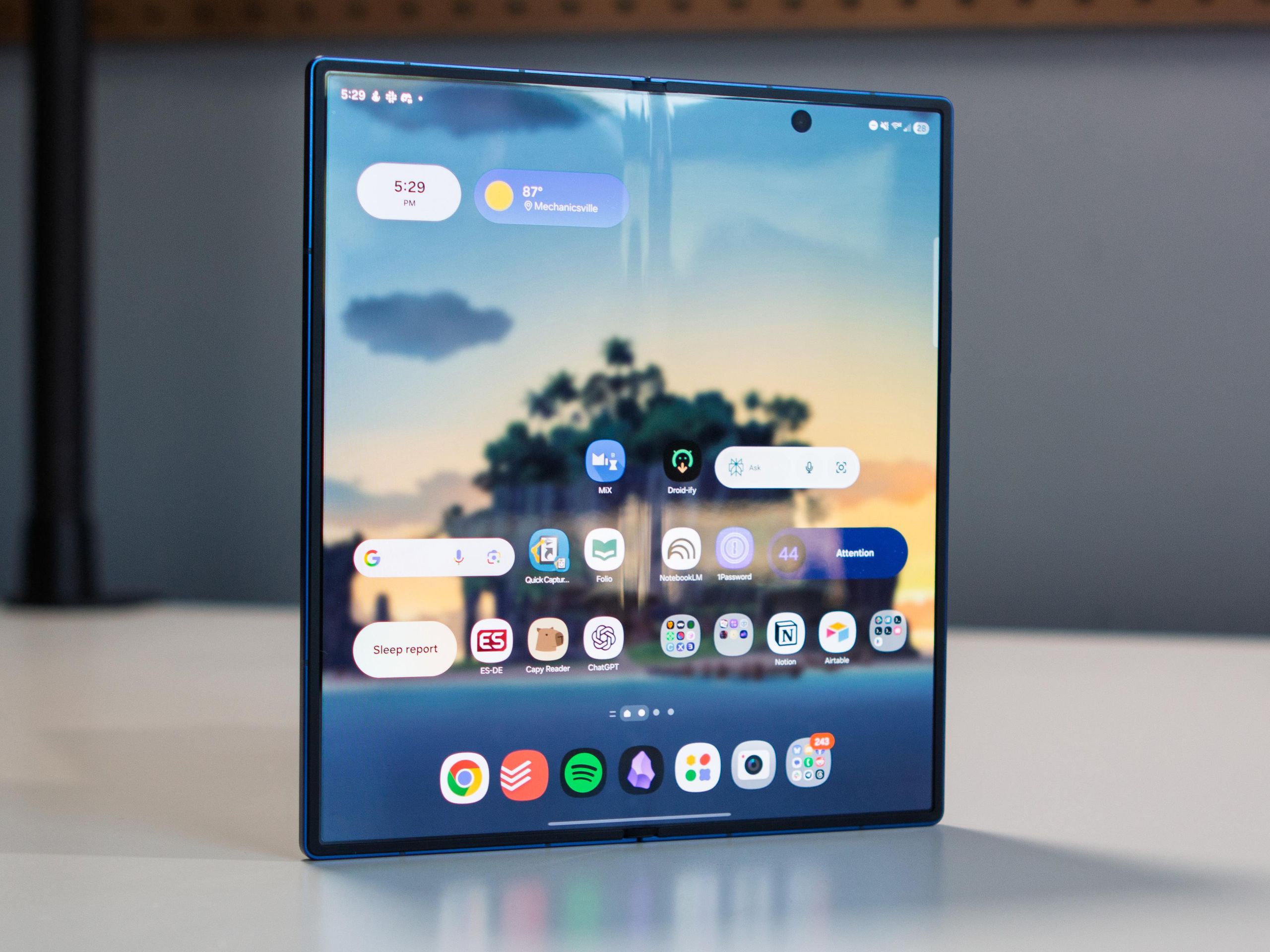
Samsung finally perfects its Fold just as Apple arrives
Samsung has been carrying the modern foldable market on its back for years, often acting as the company that experiments in public so everyone else can quietly learn from its mistakes. In 2025 that patience finally paid off. The Galaxy Z Fold 7 was not just another Fold, but the first Samsung book-style foldable that felt truly finished: slimmer hinge, brighter displays, better cameras, smarter multitasking, and battery life that no longer felt like a compromise. Consumers noticed. The Z Fold 7 quickly became Samsung’s fastest-selling foldable so far and, for a brief moment, it looked like Samsung had locked down the category it helped create.
The celebration will be short. In 2026, the Galaxy Z Fold 8 will arrive as a more refined, more mature foldable, yet it will almost certainly be overshadowed by a device that does not even exist yet in stores: Apple’s long-rumoured iPhone Fold. And that is the uncomfortable truth for Samsung. Even if the Z Fold 8 ends up with the cleaner spec sheet, the first foldable iPhone is likely to outsell it with room to spare.
On paper, Samsung should have the advantage. It has generations of experience with ultra-thin glass, hinge mechanisms and software tuned for large inner displays. Rumours already point to another round of incremental upgrades for the Z Fold 8: more efficient chipsets, a lighter chassis, smarter camera processing and more refined multitasking tools. Meanwhile, reports say Apple is preparing a foldable iPhone with a battery well north of 5,000 mAh, a huge number for an iPhone but nothing shocking for Android users who have watched Chinese brands push 5,000 to 5,500 mAh packs for years.
Why the best hardware does not always win
Here is the catch: in smartphones, best rarely equals most successful. Samsung already knows this from the classic slab-phone wars. The Galaxy S25 Ultra is a monster of a flagship, yet it competes against Chinese devices that offer bigger batteries, faster wired charging and at times even higher benchmark scores. Still, the Galaxy line consistently sells better globally because the spec sheet is only one part of the story. Brand trust, software support, camera tuning, carrier deals and how a phone actually feels in daily use matter more than raw numbers in a table.
The same dynamic is playing out in foldables. The Galaxy Z Fold 7 is a terrific device, but it is not objectively the most advanced foldable on Earth. Honor’s Magic V5, for example, achieves a slimmer body and a bigger battery without sacrificing flagship-grade displays or cameras. Huawei’s portfolio goes even further in experimentation: the Mate X6, the tri-fold Mate XT and the book-style Pura X all explore different ideas of what a flexible screen can be. Yet it is Huawei, with its home-grown chipsets that still trail Qualcomm’s best, that has nearly seventy percent of China’s foldable market.
What does that tell us? Specs are necessary, but they are not sufficient. People buy into an ecosystem, into a story, into a feeling that their purchase is the safe or cool option. Buyers want to feel that they picked the default, not the risky experiment. And no company is better at selling that feeling than Apple.
Apple, hype and the golden cage of its ecosystem
For years, Apple has shipped iPhones that looked unimpressive on paper next to Android flagships. Lower-resolution displays, smaller batteries, less RAM, yet queues still form outside stores on launch day. Apple fans proudly point out how smooth iOS feels despite the weaker specs, turning what should be a disadvantage into a badge of honour. Performance, optimisation and polish become the talking points, not battery capacity or charging wattage.
At the same time, Apple’s famously tight ecosystem creates a kind of golden cage. Once you own an iPhone, a MacBook, AirPods, an Apple Watch and a couple of services, switching platforms stops being a simple hardware decision and becomes a life choice. Messages, photos, subscriptions, smart home gear and even your friend group habits get tied to that Apple ID. Walking away feels like starting from zero.
That lock-in cuts both ways. Fans see a seamless experience, critics see a wall. Many argue that Apple is brilliant at creating hype around products that, if any other brand released them, would be called underwhelming. By tightly controlling when and how new categories are introduced, Apple effectively denies its users choice until it is ready to sell them its own version. We saw it with big-screen phones, with smartwatches, even with styluses. For years, people were told they did not need those things, and then suddenly they were magical once Apple approved them. When Apple finally joins, the market quietly resets around its narrative, its limitations and its price point.
Battery life as the secret weapon of the iPhone Fold
Foldables are shaping up to be the next example. Samsung, Huawei, Honor and others have done the risky early work: strengthening hinges, improving durability, convincing app developers that large inner screens are worth supporting. They lived through creases, cracked plastic layers and clumsy software. Apple can now arrive with a first-generation foldable iPhone that does not need to be the most experimental or the most cutting edge. It just needs to feel polished, reasonably durable and Apple enough to win over existing iPhone owners who have been curious but unwilling to abandon iOS.
Battery life is one area where Apple could choose to overdeliver, not because of a spec race with Samsung but because it solves a very real pain point. Large, bright foldable displays are power hungry, and many early foldables struggle to comfortably last a heavy day of use. As nice as it is to carry a tablet-sized screen in your pocket, it is far less fun when the battery hits red by late afternoon. If the iPhone Fold ships with a genuinely big battery and Apple’s usual efficiency tricks, offering true all-day endurance in both folded and unfolded modes, that single promise could be the headline feature and an easy marketing win over the Galaxy Z Fold 8.
How Samsung can fight back
Even then, raw specifications will remain a secondary story. The simple fact that there is finally a foldable iPhone will drive mindshare and, most likely, sales. Tech-curious iPhone users who have been eyeing Samsung’s Fold series but never felt comfortable leaving iOS will suddenly have an option that keeps all their apps, messages and accessories intact. For many of them, the question will not be whether the iPhone Fold is better than the Z Fold 8, but whether it is good enough that they do not have to think about Samsung at all. Apple does not have to win the spec battle, it only has to remove the excuse to switch.
From Samsung’s point of view, that is the worrying part. The Galaxy Z Fold 8 could be a brilliant piece of hardware and still be remembered as the year Apple walked in and stole foldables from under its nose. Samsung’s best move is to double down on what it already does well: aggressive innovation, rapid iteration and delivering features Apple will not touch for years, such as desktop-style DeX, open file systems, deeper customisation and genuine multitasking freedom. There will always be a slice of power users who value that openness over Apple’s controlled experience, and Samsung has to make sure the Fold 8 is the ultimate device for them.
The likely outcome of the foldable fight
In the end, though, the outcome seems almost predetermined. Unless Apple commits a rare, spectacular misstep with its first foldable, such as a durability scandal, a disastrous price or software that feels half baked, the iPhone Fold is poised to define the conversation around foldables the moment it appears. The Galaxy Z Fold 8 may well be the better foldable on a lab bench, with stronger numbers in a few boxes, but in the only test that really matters, the one at the checkout counter, Apple is heavily favoured to win. Samsung will still build the more daring hardware, but Apple will once again own the narrative, the mindshare and, most likely, the sales charts.