In a watch world that has drifted back toward modest diameters, soft colours and so-called quiet luxury, Zenith has walked into Dubai Watch Week 2025 with something that feels almost defiantly loud. The Zenith Defy Extreme Lapis Lazuli is not the kind of watch that tries to blend into a linen shirt cuff or disappear in a boardroom. It is a 45mm, two-tone, mirror-bright statement piece topped with glimmering blue stone subdials, built around one of the wildest high-frequency chronograph calibres currently in serial production. 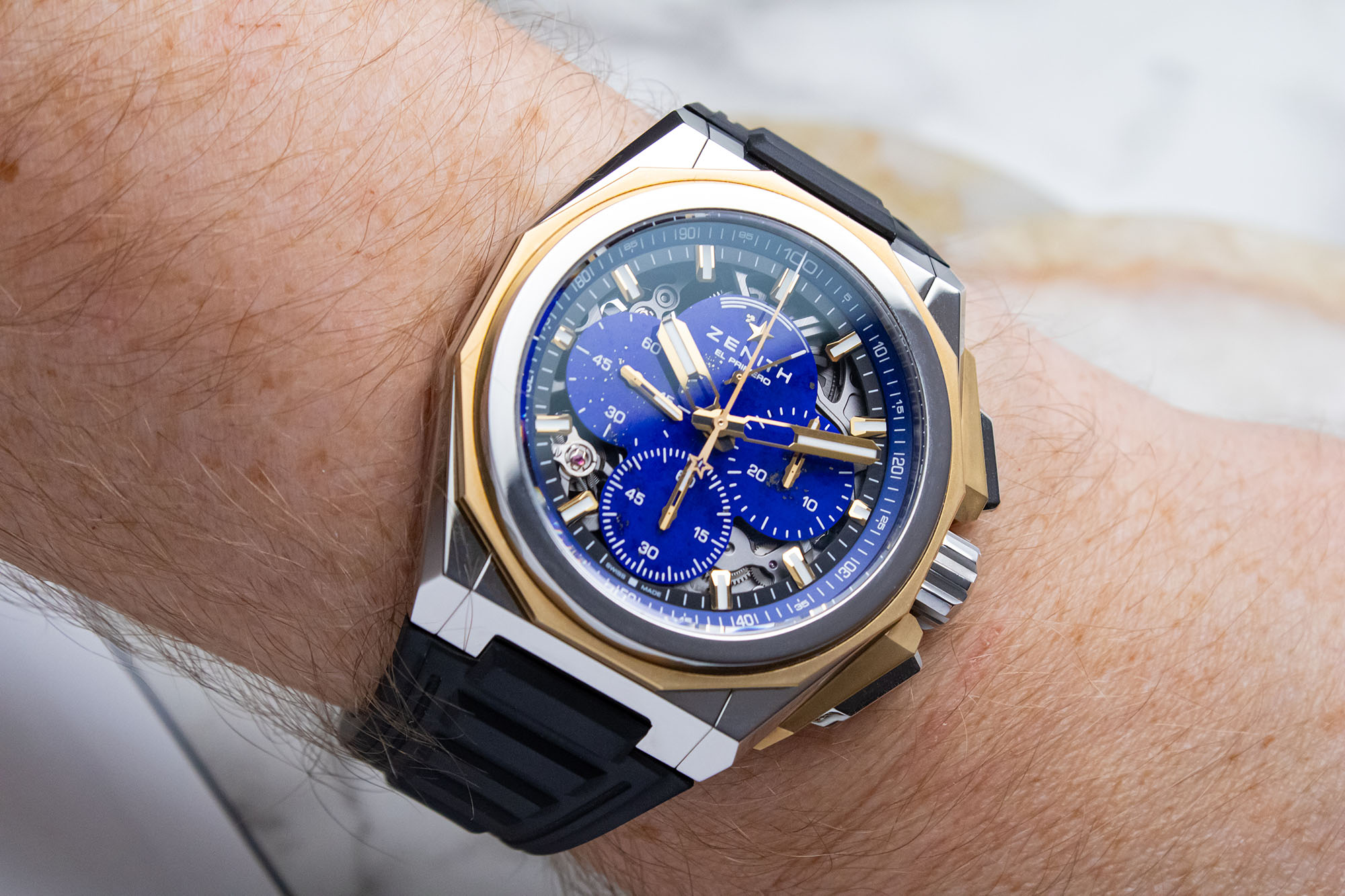
It is also, if you listen to the early reactions, one of the most polarising Defy Extremes yet: some enthusiasts call it completely bonkers in the best way, others dismiss it as overpriced, oversized and visually chaotic. In other words, it is a perfect conversation piece for a collection that has never tried to be subtle.
The broader Defy Extreme family was conceived as the no-holds-barred side of Zenith: bigger, more architectural cases, extreme materials like carbon and microblasted titanium, colour palettes that flirt openly with the territory usually occupied by brands like Hublot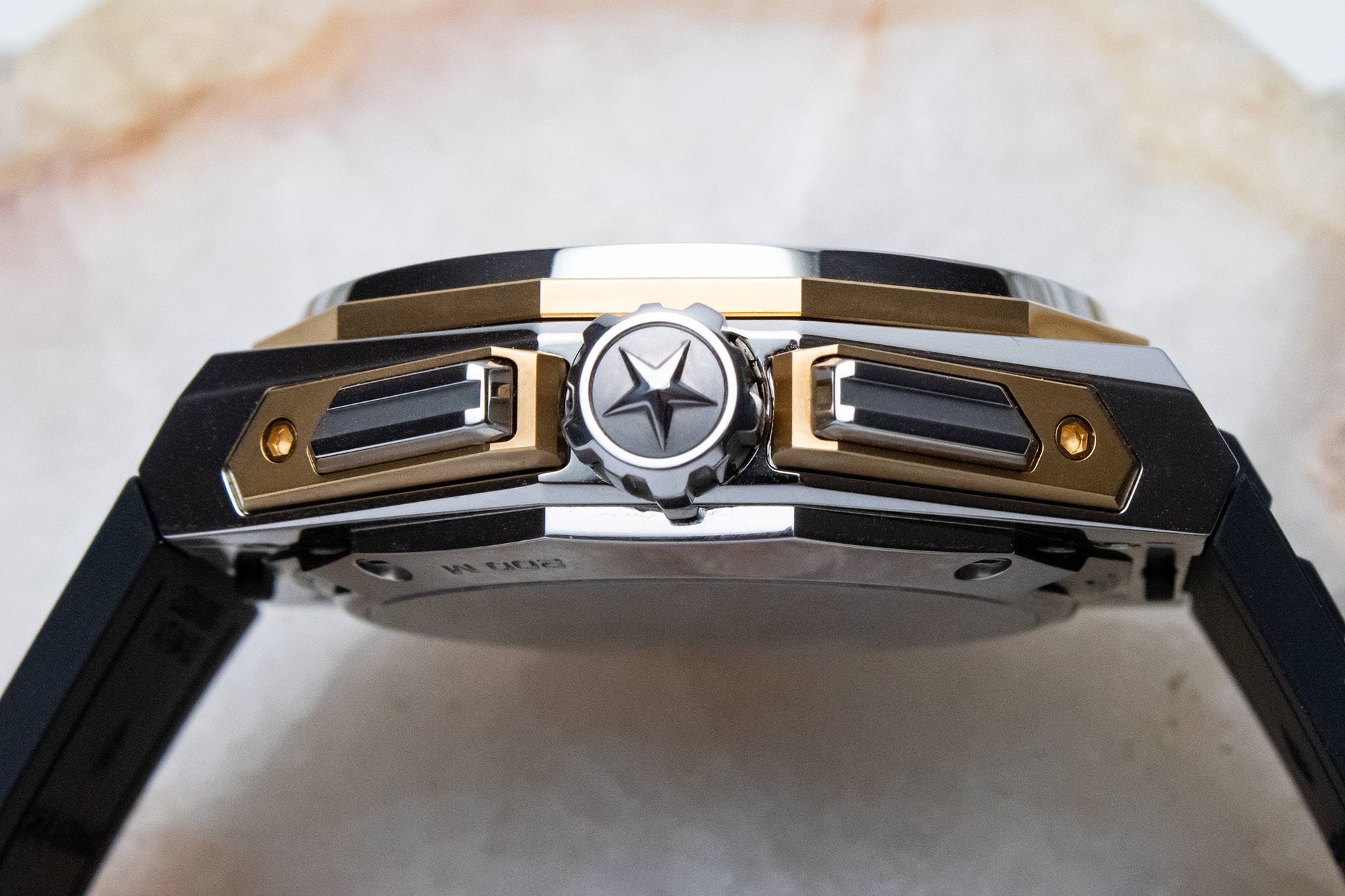
. We have already seen jungle-green editions, tiger motifs and mirrored or semi-transparent executions. This new Lapis Lazuli version pushes in a more opulent direction, swapping camouflage and carbon for precious metal and a stone associated with pharaonic jewellery. It feels less like a piece of cutting-edge sports gear and more like something designed to catch smartphone flashes inside a VIP lounge.
A maximalist case built for attention
On paper, the dimensions of the Zenith Defy Extreme Lapis Lazuli are unashamedly large: 45mm in diameter and around 15.4mm thick, with broad integrated lugs and a wide, angular footprint. 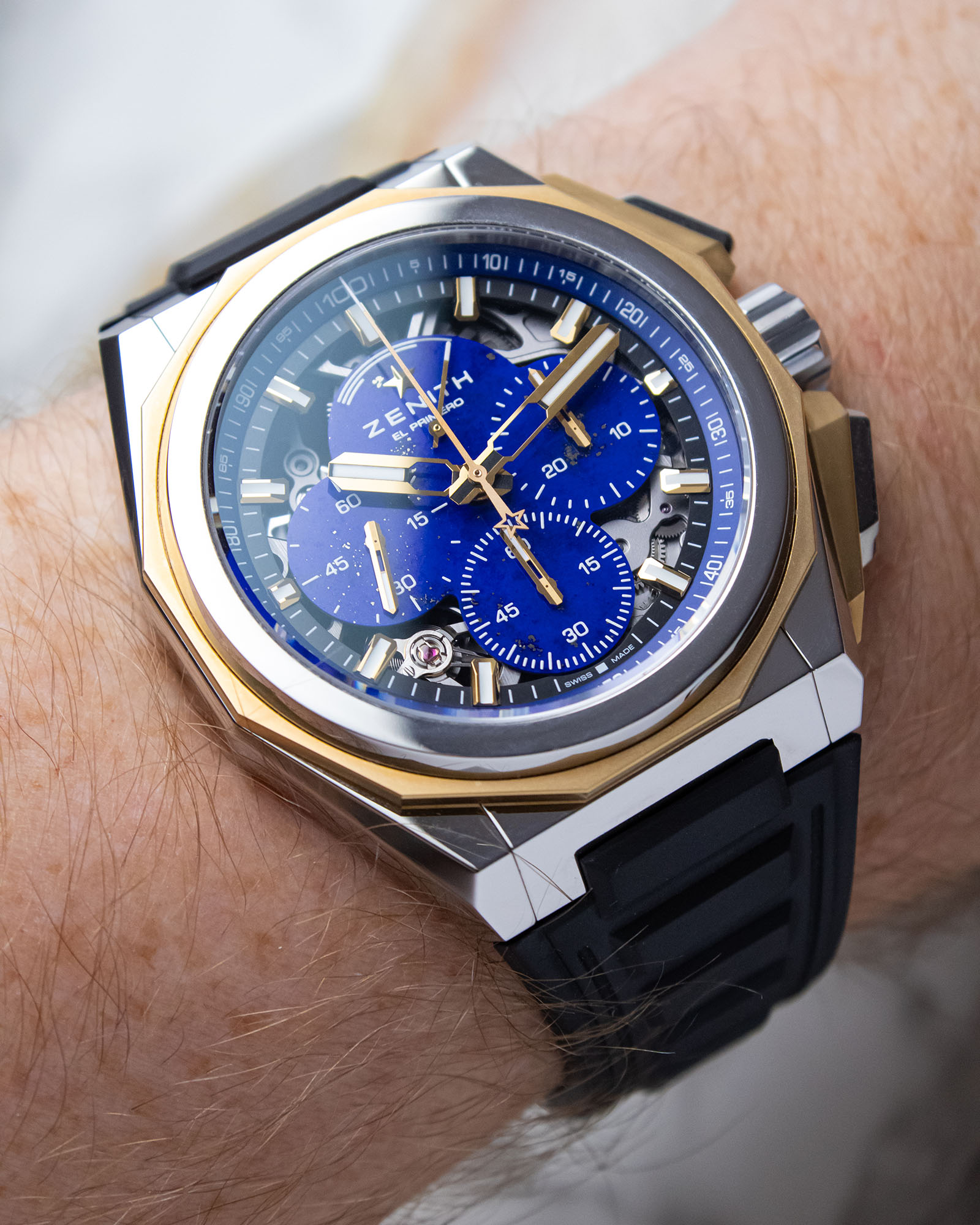
If you are someone who already finds 41mm sporty watches too much, this one will feel like a small wrist-mounted spacecraft. Yet the proportions are not sloppy. Zenith leans hard into the size, using it as a canvas for a complex geometry that starts from an octagonal base case and stacks on a circular bezel ring, then a dodecagonal outer bezel with exposed screws. Massive crown and pusher guards flank the right side, echoing the angled lines of futuristic supercars rather than vintage chronographs.
The two-tone construction is where the watch immediately divides the crowd. The central case, bezel ring and caseback are executed in stainless steel, but the upper bezel and crown-guard elements are rendered in yellow gold. Instead of the traditional approach of brushing the steel and polishing the gold, Zenith inverts expectations. The gold sections are matte-blasted, with razor-thin polished chamfers to catch the light, while the vast expanse of steel is fully mirror-polished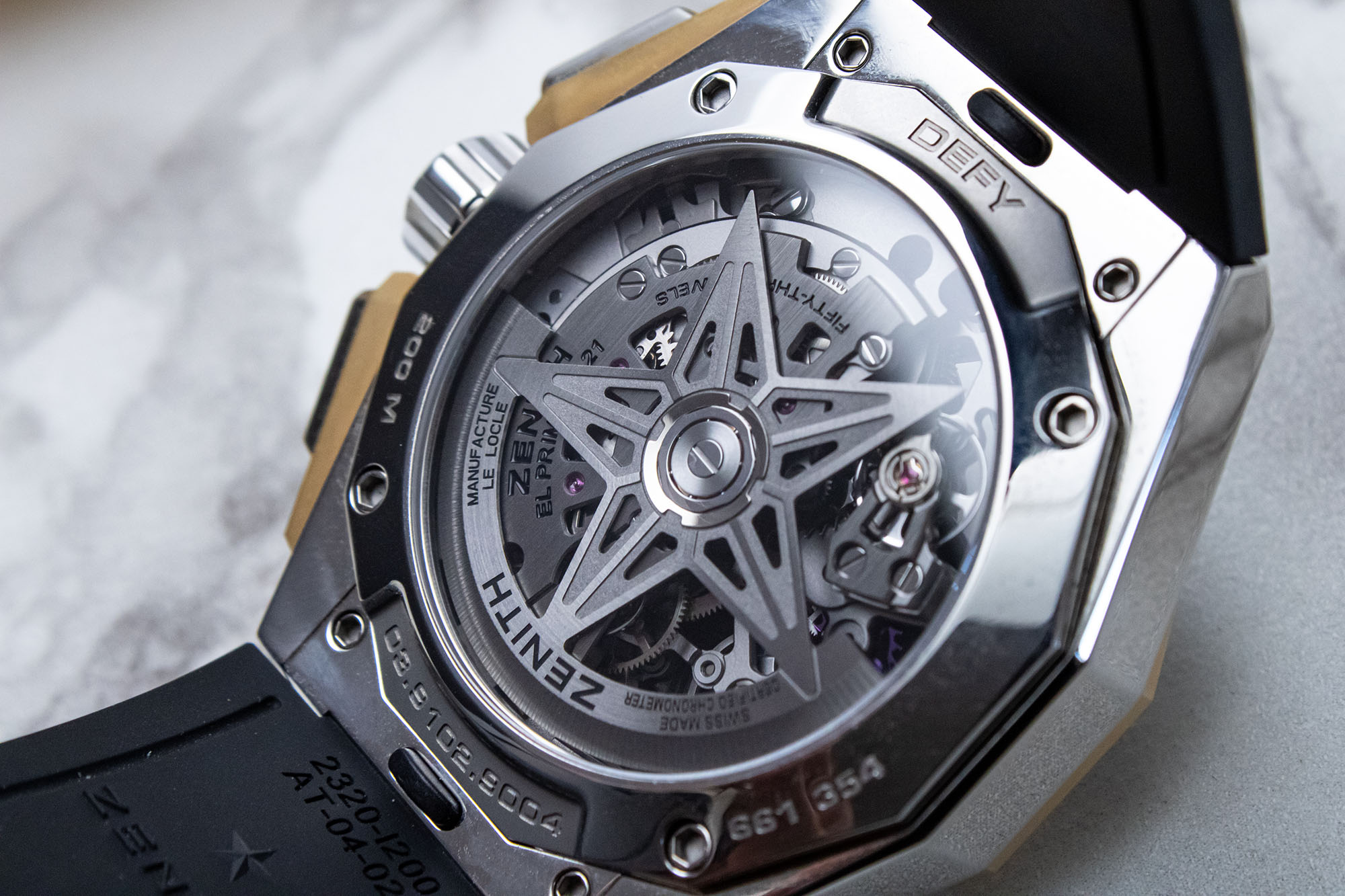
. In person, that means the watch behaves almost like a piece of sculpted chrome, throwing reflections in every direction and making photography a challenge. It is the opposite of restrained, tool-watch finishing.
For some enthusiasts, this is exactly the problem. The combination of big case, ultra-bright polishing, aggressive angles and two-tone sheen has already drawn comparisons to the so-called Invicta-isation of horology, and even revived memories of Thierry Nataf’s wildly divisive tenure at Zenith. To others, though, it is refreshing that a brand built on high-frequency chronographs is willing to experiment visually rather than chasing the same brushed-steel integrated-bracelet minimalism as everyone else. In the metal, there is no denying that the Defy Extreme Lapis Lazuli has presence, and it backs up the flashy case with genuine robustness: a screw-down crown, solid construction and a sapphire caseback contribute to a 200-meter water-resistance rating that many dressier chronographs cannot touch.
Lapis lazuli dial: regal stone on a fragmented canvas
Despite all the metalwork, the talking point here is the dial. Or more accurately, the lack of a traditional dial. Like other Defy Extreme models, the Lapis Lazuli edition uses a skeletonised construction where the baseplate and bridges are visible beneath a cluster of subdials and scales. At the centre of this layered architecture sit four discs of lapis lazuli, forming the minutes counter at three o’clock, the chronograph seconds counter at six, the running seconds at nine and the power-reserve indicator at twelve.
Lapis lazuli has enjoyed a resurgence in watchmaking over the past decade, prized for its deep, royal-blue tone and the flecks of golden pyrite that shimmer in the light. Not all stone is equal, and here Zenith has chosen pieces with dense colour and a generous scattering of metallic inclusions. Under a loupe, the subdials look luxurious and almost cosmic, as if tiny galaxies had been sliced into the watch. The gold-tone paddle hands and beveled hour markers pick up those sparks, creating a classical blue-and-gold palette that has been associated with power and ceremony since ancient Egypt.
Yet this is also where some collectors feel Zenith missed an opportunity. On such a large, bold watch, using lapis only in small, circular registers means the stone never quite dominates the composition. 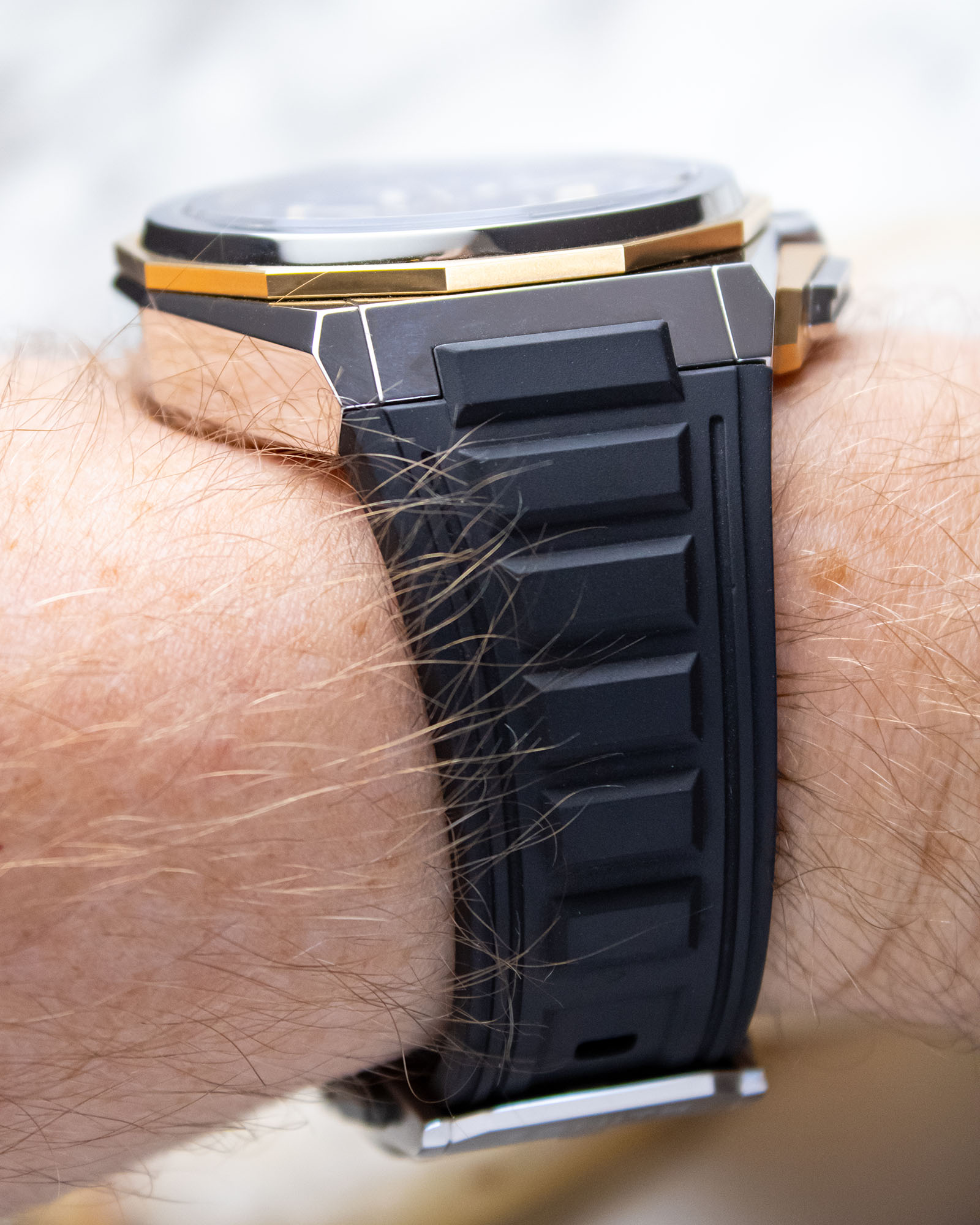
You catch flashes of blue, but much of the visual real estate is occupied by skeletonised bridges, exposed wheels and printed scales. Several enthusiasts have already argued that the lapis would have been more effective as a single, broad dial plate, or that a rich blue enamel could have offered a similar pop of colour for less money and complexity. The result, they say, is an aesthetic that feels busy rather than boldly simple, as if too many design ideas were layered on top of each other.
Legibility is better than you might fear from a skeleton chronograph, but there are still compromises. The broad, gold-coloured central hands stand out clearly against the darker mechanics, aided by a full outer ring with applied hour indices and minute track. Reading the time at a glance is reasonably straightforward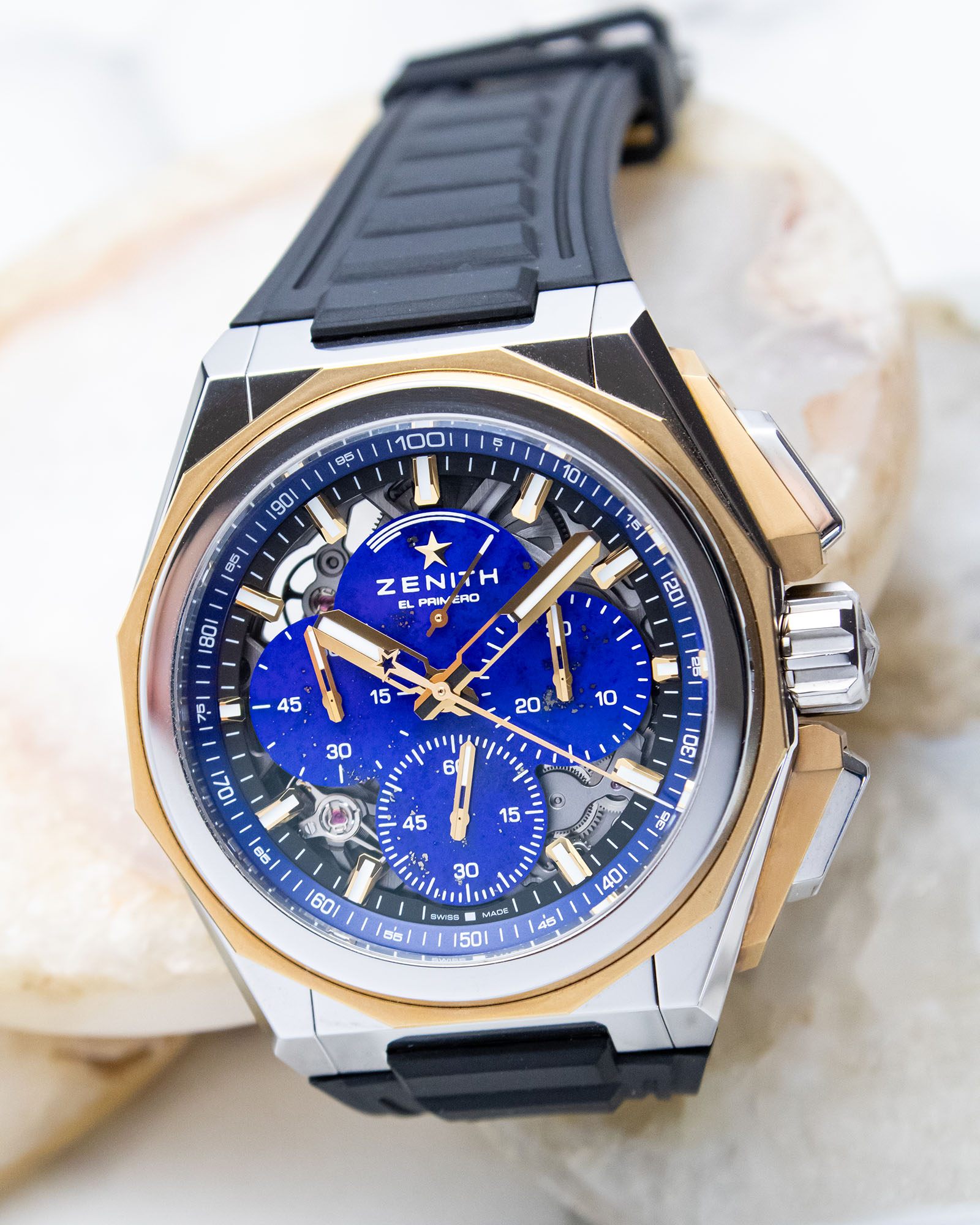
. The challenge comes when you start using the chronograph. The Defy Extreme layout is not conventional, and it takes a little mental rewiring to remember that the three-o’clock subdial records chronograph minutes, the six-o’clock subdial handles chronograph seconds, and the nine-o’clock register is simply running seconds. The small power-reserve indicator at twelve is crisp enough once you know where to look, but on our sample piece that indication was not functioning correctly, a reminder that even halo movements can suffer teething issues in the real world.
A 1/100-second spectacle: inside the El Primero 9004
Underneath all the theatrics sits a movement that fully justifies the Extreme name. The in-house El Primero 9004 is not just another high-beat chronograph; it is a dual-escapement calibre built to measure elapsed times down to one hundredth of a second. The timekeeping side of the movement runs at a familiar 36,000 vibrations per hour, the traditional El Primero frequency that allows for a smooth sweep and 1/10-second chronograph resolution in more conventional models. The party trick comes from a second escapement dedicated exclusively to the chronograph function, running at a blistering 360,000 vibrations per hour. That is one hundred beats per second, and it translates directly into the motion of the central chronograph hand.
Start the chronograph and that long, needle-like hand whips around the dial once every second, reading off 1/100-second increments against the perimeter scale. It is one of the most kinetic, slightly hypnotic displays you can experience on the wrist, more akin to a scientific instrument than a classic racing chrono. From the front, you see the wheels and levers snap into action as the chronograph engages; from the back, visible through the sapphire caseback, a dark-coated half-bridge covers much of the mechanism but still leaves the twin escapements and skeletonised rotor on show.
This level of performance does come with trade-offs. 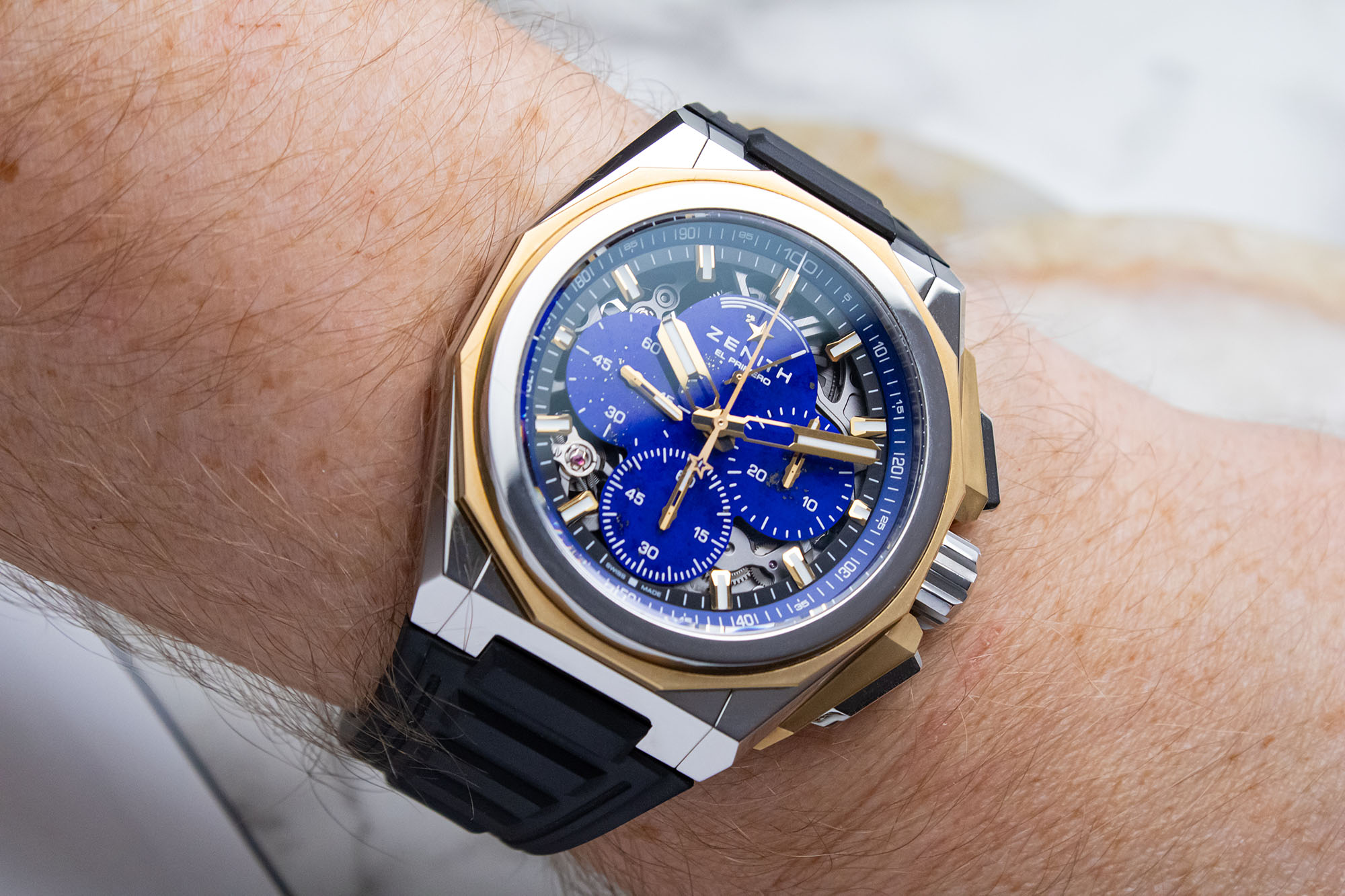
Zenit has managed to retain a quoted power reserve of around 50 hours for regular timekeeping, but running the chronograph continuously dramatically accelerates energy consumption. This is not the kind of watch you leave timing your pizza in the oven for an afternoon; it is a technical party trick designed to be demonstrated, appreciated and stopped. The movement’s complexity also pushes the watch further into rarefied territory. While some critics argue that Zenith leans too heavily on the historical cachet of the El Primero name, it is difficult to deny that the 9004 remains one of the most technically impressive automatic chronographs available from a mainstream Swiss brand.
Straps, bracelet and how it actually wears
Zenith ships the Defy Extreme Lapis Lazuli with three distinct strap and bracelet options, all using a quick-release system integrated into the lugs. The most ostentatious choice is the fully mirror-polished H-link bracelet, which continues the highly reflective theme of the case and effectively turns the watch into a single block of gleaming metal. It looks dramatic, but on wrist it amplifies the visual mass, making an already large watch feel even more dominant.
At the other end of the spectrum is a black hook-and-loop canvas strap, intended to push the watch closer to a tactical, outdoorsy aesthetic. It emphasises the Extreme’s tool-watch credentials and makes the head feel fractionally lighter, though the contrast between precious stone, polished gold and Velcro-style fabric will not be to everyone’s taste. The option fitted to our sample was the integrated black rubber strap with a folding clasp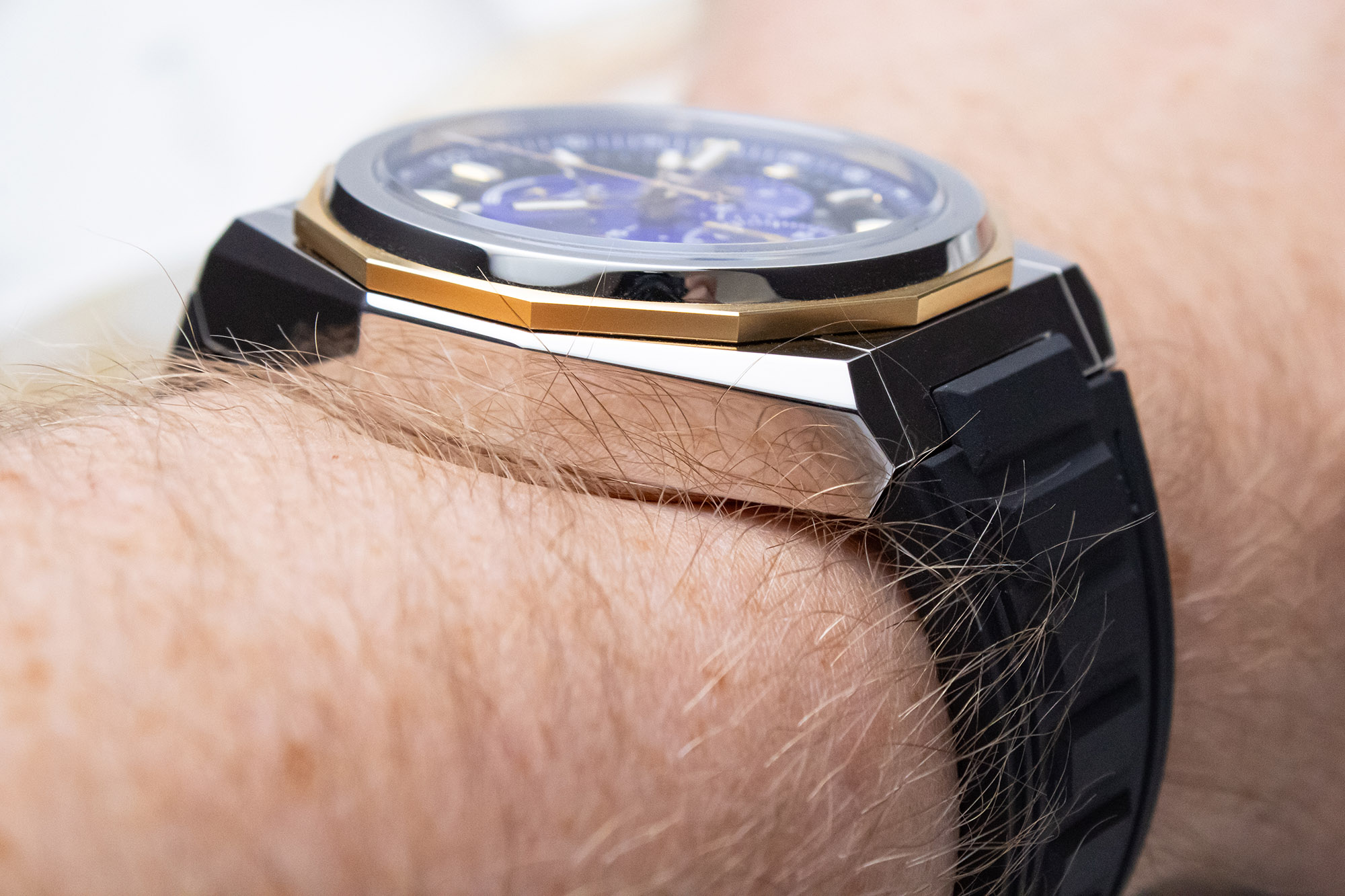
. It sits somewhere in the middle: structured enough to echo the geometry of the bracelet, flexible and forgiving on the wrist, and visually calmer than either full-polish steel or nylon.
This rubber choice has already sparked debate. Some collectors feel that pairing a watch with lapis lazuli and gold highlights with a black rubber strap feels like cutting corners, a missed chance to lean fully into the opulence with a rich blue alligator or sharkskin strap that would echo the stone. Others argue that rubber is the only thing that keeps the Defy Extreme Lapis Lazuli remotely wearable in daily life, dampening the weight and making the watch feel more like a hyper-engineered sports instrument than jewellery. In practice, the rubber and deployant combo works well: micro-adjustment via the traditional pin-style holes allows for a precise fit, while the twin-pushbutton release makes the watch easy to take on and off despite its size.
None of this changes the fact that this is a big, heavy watch best suited to larger wrists and confident personalities. It will slide under very few cuffs, and it is not a piece you forget you are wearing. But that is the point. The Defy Extreme line is about as far from the current trend of 34mm neo-vintage reissues as you can get, and the Lapis Lazuli edition leans into that with a grin.
Price, positioning and the logic of online luxury
Where opinions become truly heated is not the size or the stone, but the price. The Zenith Defy Extreme Lapis Lazuli is limited to just 50 pieces worldwide and carries an MSRP of 33,900 USD. That puts it up against full gold chronographs from other big-name brands, including watches that offer solid precious-metal cases and bracelets rather than the two-tone configuration seen here. 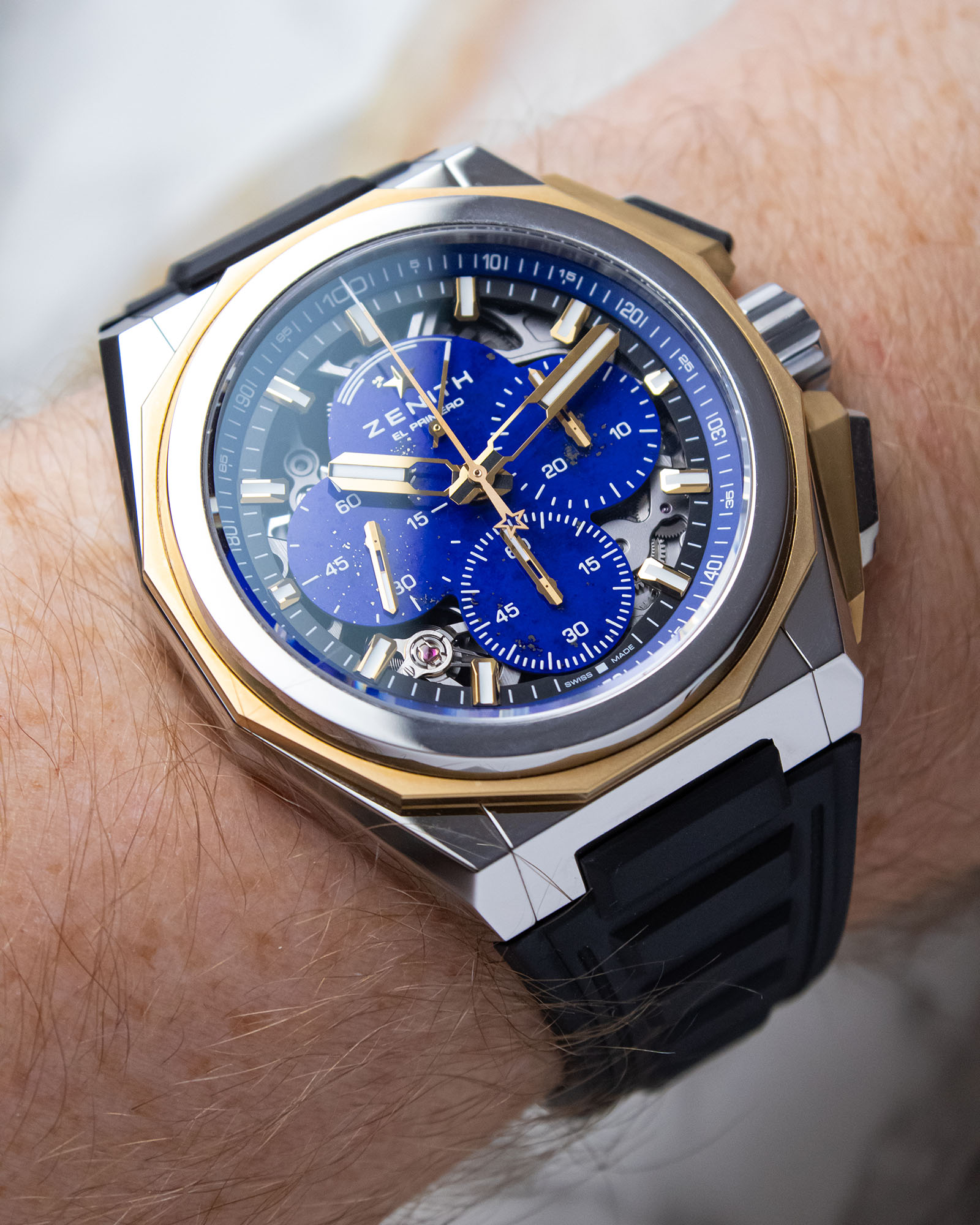
It is no surprise that some enthusiasts look at the spec sheet and conclude that a full-gold Speedmaster or similar makes this Zenith look like a tough sell on a purely material basis.
But to treat the watch purely as a heap of metal and stone is to miss the broader context of where luxury is heading. Across fashion, jewellery and watches, brands are increasingly designing for a digital shop window, where pieces need to stop scrolling thumbs in under a second. Loud colours, exaggerated proportions and striking textures play better on a smartphone screen than another sensible 40mm steel piece with a silver dial. One thoughtful observer framed it as the wrist-watch equivalent of the super-wide trouser trend in high-end fashion: everyone in the industry knows that extreme silhouettes will look ridiculous on most real people, but they photograph brilliantly and create a halo of attention that filters down into more wearable products.
Zenith sits within the LVMH universe, alongside fashion and jewellery brands that are also pushing maximalist aesthetics to appeal to the very online, very wealthy 0.1%. The Defy Extreme Lapis Lazuli feels like a deliberate play in that space. It is a halo object, designed to be photographed at Dubai Watch Week, shared on social feeds, debated in enthusiast forums and, ultimately, sold to a handful of clients who want something visually louder than their neighbours’ steel integrated bracelet watches. For many traditionalists, this is exactly the problem: they worry that watchmaking is sliding toward a world of attention-grabbing exotica, leaving quiet, long-term design behind.
And yet, even some of the critics admit a begrudging affection. They might decry the case size, shake their heads at the price and roll their eyes at another limited edition with a stone dial, but they will also confess that the watch is strangely appealing in photos. The blue-and-gold combination taps into something timeless; the spinning 1/100-second hand is pure mechanical theatre; the over-the-top look feels oddly honest in an era when many brands are faking restraint while quietly raising prices. Love it or hate it, the Defy Extreme Lapis Lazuli has a point of view, and that alone sets it apart from the sea of derivative sports watches.
Verdict: a polarising future-retro beast
The Zenith Defy Extreme Lapis Lazuli will not rescue the brand for those who believe Zenith has lost its mojo outside the El Primero story. If you already think the Defy Extreme line is too brash, too complicated and too far from the vintage-inspired charm that dominates Instagram, this watch will confirm every prejudice. It is large, visually dense and unapologetically expensive.
For others, however, it shows a brand willing to experiment at the edges of what a luxury sports chronograph can be. Technically, the El Primero 9004 remains a marvel. Aesthetically, the combination of blue lapis, gold accents and a hyper-modern case offers something few competitors dare to attempt. The execution is not perfect: some will wish for a simpler dial that lets the stone breathe, a more cohesive mix of textures, or a strap that leans harder into the regal colour palette. But as an object that captures the current moment in high-end watchmaking – a moment where spectacle and scarcity are often valued as highly as heritage – the Defy Extreme Lapis Lazuli is right on the money.
Ultimately, this is a watch for collectors who embrace excess, who enjoy the idea of wearing something that will start conversations and arguments in equal measure. On the wrist, under the Dubai sun or the glow of a nightclub, it looks like nothing else. Whether that makes it a stroke of genius or an expensive misstep will depend entirely on your taste, your wrist size and your tolerance for horological drama.
1 comment
This thing is absolutely nuts and I kinda love it 😂 Big shiny UFO on the wrist, lapis glittering everywhere and that chrono hand doing laps like it’s on espresso. Completely impractical and absolutely not for my tiny wrist… but if someone handed me one I’d wear it to the supermarket just for the chaos