Intel’s next big swing in the AI PC battle may not be about more CPU cores or a monster iGPU, but about a compact block of silicon labeled NPU6. According to a new leak shared by X user @jaykihn0, the upcoming Nova Lake platform could ship with a sixth-generation neural processing unit capable of up to 74 TOPS (trillions of operations per second) of INT8 performance. 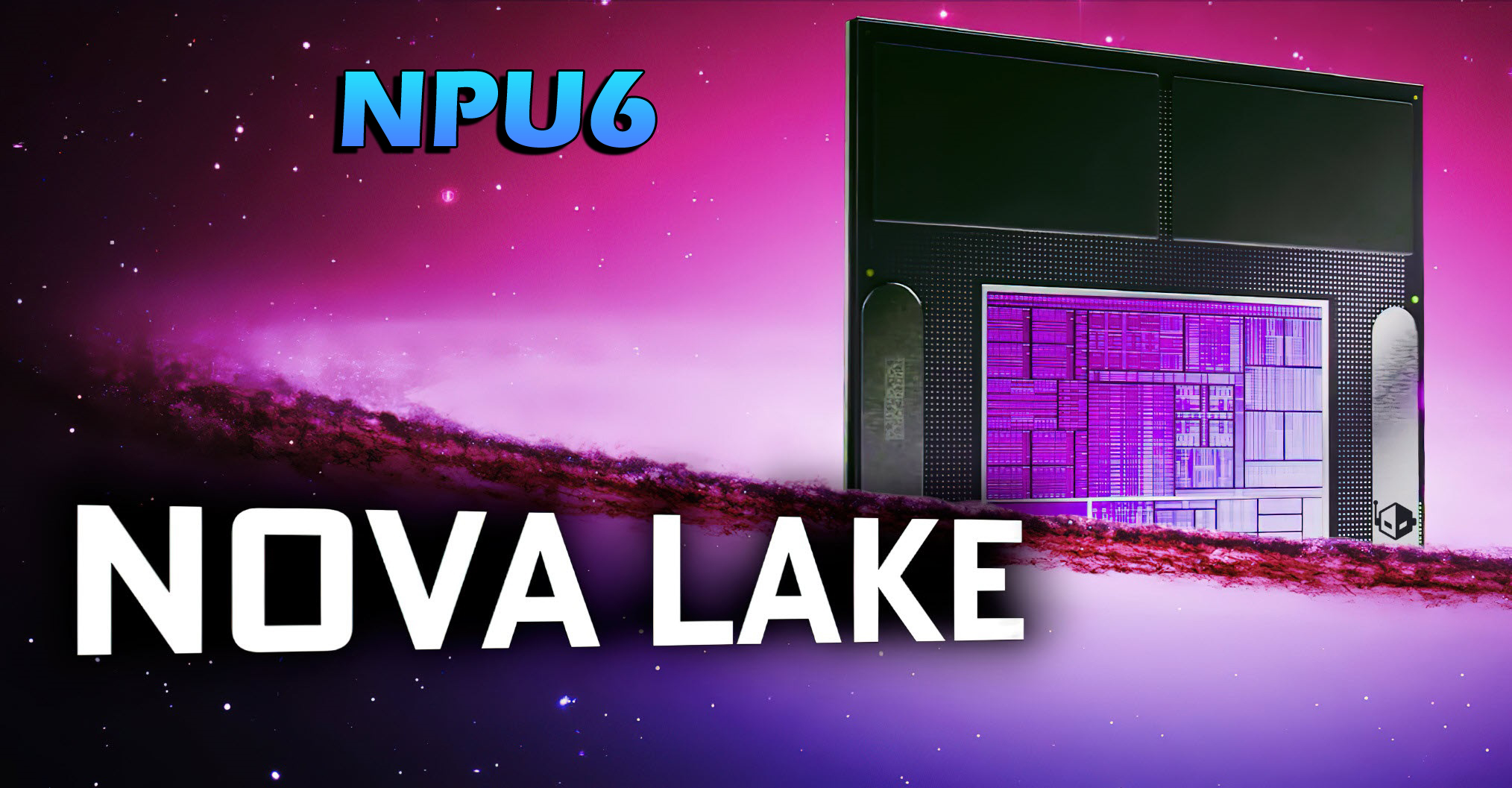
If that figure holds, Nova Lake would pull comfortably ahead of today’s Lunar Lake NPU4 and even the still-unreleased Panther Lake NPU5 in terms of raw on-chip AI throughput.
To understand why this matters, it helps to look at what an NPU actually does. A neural processing unit is a piece of dedicated logic designed specifically for matrix math and tensor operations, the kind of heavy lifting at the heart of modern AI workloads. Instead of burning power on the CPU or GPU every time you run a local assistant, denoise a webcam feed or generate subtitles in real time, the NPU can crunch those operations far more efficiently. The TOPS figure is a rough yardstick: the higher it goes, the more AI work a chip can potentially do within a given power envelope.
From NPU3 to NPU6: Intel’s rapid AI evolution
Intel’s recent client roadmap shows just how aggressively the company is ramping those AI numbers. Meteor Lake and Arrow Lake used what is often labeled NPU3, hovering around 11.5–13 TOPS of INT8 performance. Lunar Lake, shipping in a new wave of Copilot+ PCs, jumps to NPU4 with about 48 AI TOPS. Panther Lake is expected to move to NPU5, but the rumored figure of 50 TOPS is essentially a mild bump. Nova Lake with NPU6 at 74 TOPS would instead represent a much bigger step: roughly 1.5× Lunar Lake and more than 5× the capability of Arrow Lake’s AI block.
Even so, this is still a rumor, not a product announcement. Based on the information currently available, the claim that NPU6 hits 74 TOPS sits in the middle of the credibility spectrum: plausible but not yet strongly confirmed. The source appears reasonably established in the PC-hardware leak community, which scores well. There is also some technical smoke in the form of a Linux kernel patch referencing a sixth-generation Intel NPU. On the other hand, corroboration is thin and the timeline is early, with Intel keeping quiet about detailed Nova Lake specs. Combining those factors, a rating around the mid-50% range feels fair: believable, but far from guaranteed.
What Nova Lake could bring beyond TOPS numbers
Importantly, NPU6 is only one piece of the broader Nova Lake story. The platform is widely expected to debut a fresh CPU architecture with meaningful IPC (instructions per clock) gains over today’s cores, plus support for AVX10 instructions that should help in both content creation and some AI-adjacent workloads. Rumors also point to a more flexible graphics setup, with two different graphic architectures across the stack, as Intel continues to refine its integrated Xe graphics and align them with discrete Arc GPUs. If all of that lands alongside a 74-TOPS NPU, Nova Lake would look like a full-stack update rather than a one-trick AI pony.
However, enthusiasts are already arguing about where that silicon budget should go. In community discussions, one recurring complaint is that vendors talk up bigger NPUs while quietly cutting back on iGPU cores, and then brag about "5× faster AI" based on a tiny baseline. For desktop users with a powerful dGPU sitting idle, an NPU can feel like pointless decoration: they’d rather have more shaders, more cache, or higher clocks. For them, the idea of losing a chunk of graphics horsepower in exchange for an on-die AI accelerator looks like a bad trade, especially when the system is plugged into the wall and power savings aren’t a priority.
The mobile picture is different. On a thin-and-light laptop, routing every AI-assisted feature through the GPU can quickly chew through a battery. An NPU tuned for low-power INT8 workloads can keep tasks like local transcription, background upscaling or camera effects running for hours without spinning fans or draining the battery in record time. In that context, the rumored 74 TOPS starts to look less like marketing fluff and more like a way to make AI features feel instant and invisible, instead of something you consciously toggle because you are worried about battery life or heat.
What can you actually do with 74 TOPS?
Real-world performance is always more nuanced than a single number, but a 74-TOPS NPU would open the door to running larger and more complex models locally. Think multimodal assistants that can listen, see and respond in real time, image generators that refine content as you edit, or small language models with several billion parameters running entirely on your laptop without touching the cloud. That said, an NPU is not a magic portal to full-fat data-center models: system memory bandwidth, storage speed and software optimization will still define what feels "instant" and what still feels sluggish.
There is also the question of software maturity. Intel will need to keep pushing its AI toolchain, drivers and frameworks so that popular apps actually tap into NPU6 instead of defaulting to the GPU. We have already seen early Copilot+ demos where some tasks bounce between CPU, GPU and NPU depending on workload and power state. With Nova Lake, the ideal scenario is a seamless scheduler that picks the right engine automatically: NPU for light to medium AI tasks, GPU for heavier creative pipelines, and CPU as the orchestrator. Without that, 74 TOPS risks becoming a big number on a slide that users rarely notice.
The AMD Zen 6 pressure
All of this unfolds against serious competition. AMD’s Zen 5 generation is just the opening act of its AI-focused roadmap, and Zen 6 is expected to bring its own leap in NPU capability alongside higher IPC and more efficient chiplets. If AMD pairs its XDNA-based accelerators with strong integrated graphics and competitive pricing, Intel cannot rely on marketing "AI PCs" alone. Nova Lake needs to deliver convincing CPU and GPU gains as well, or the AI block will be dismissed as a distraction by power users who already run their AI workloads on beefy discrete GPUs.
For now, then, NPU6 at 74 TOPS should be viewed as a promising but unconfirmed piece of the Nova Lake puzzle. If it lands as rumored, Intel would dramatically widen the gap over its own previous NPUs and put real pressure on rivals to match on-device AI performance, especially in the mobile space. If the final silicon dials back those ambitions, Nova Lake could end up remembered as another incremental step rather than a revolution. Until Intel shares concrete specs, the safest position is cautious optimism: the numbers look exciting, the technical story makes sense, but the silicon will have to prove it.
1 comment
So we lose some iGPU juice but get a 74 TOPS NPU instead… yeah ok Intel, sure 😂