The iPhone 17 Pro Max has just given us a glimpse of a future Apple itself refuses to ship. Thanks to a clever exploit, one owner has managed to load iPadOS onto the flagship phone and turn it into something Apple keeps just out of reach: a pocket computer that behaves almost like a Mac when you hook it up to an external monitor. This is not a polished feature, there is no friendly setup wizard, and Cupertino would almost certainly classify it as a serious security issue. 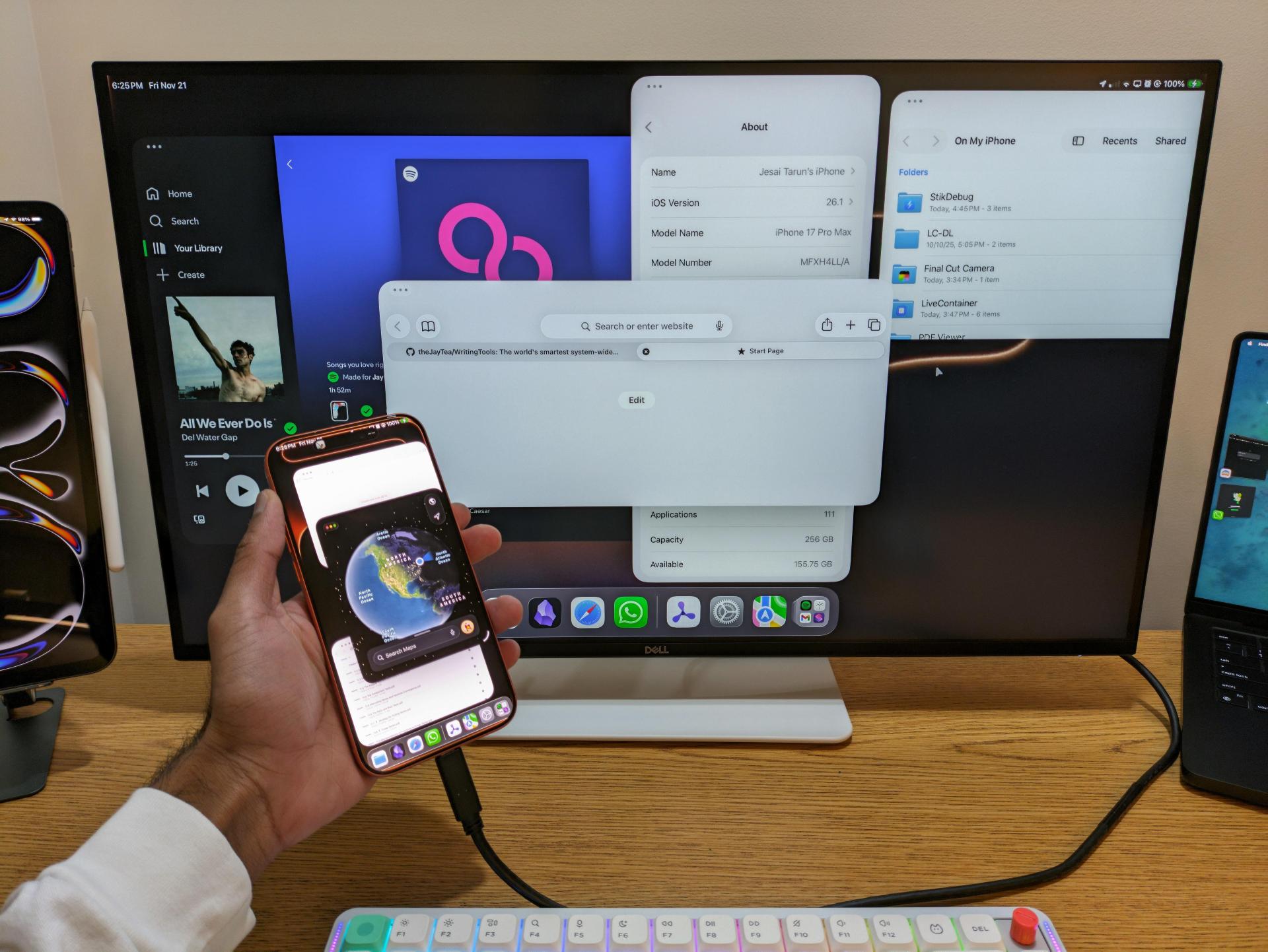
Yet the hack proves a point power users have repeated for years. The limiting factor on modern iPhones is not the A-series chip or the amount of RAM; it is Apple’s decision about what you are allowed to do with that hardware.
Under the surface, iOS and iPadOS have always been extremely close relatives. They share the same low level foundations, rely on the same App Store, and often use identical interface elements. The difference is in the freedom Apple grants the iPad. iPadOS gets more advanced multitasking, features like Stage Manager, a richer external display mode, and an interface that feels much closer to a traditional computer when you add a keyboard, mouse, or trackpad. Apple uses this artificial separation to sell the idea that you need three device types in its ecosystem: iPhone for your pocket, iPad for your lap or the coffee table, and Mac for real work.
This neat product segmentation is exactly what the new experiment cuts through. A Reddit user known as TechExpert2910 demonstrated an iPhone 17 Pro Max running iPadOS by abusing an exploit in iOS 26.1. The phone, powered by Apple’s A19 Pro chip and backed by 12 GB of RAM, is connected to an external monitor with a single USB-C cable. On the big screen you see multiple app windows arranged side by side, a dock, and a layout that behaves far more like a desktop than a giant phone. The iPhone’s own display becomes more of a control panel than the main screen. In practice the device is quietly doing what its hardware has been capable of for a long time: driving a full multitasking, desktop-style workspace without ever touching a Mac.
There is, however, a huge catch. The exploit only works on iOS 26.1, and Apple has already closed the hole in iOS 26.2 beta 1. Anyone who updates loses the trick, and future builds will almost certainly lock things down even further. From a security point of view, Apple’s reaction makes sense. The company invests heavily in code signing, sandboxing, and locked bootloaders precisely to prevent software from running in ways it did not explicitly approve. An exploit that lets you boot a different variant of the operating system, even one as close as iPadOS, is the kind of thing its engineers are expected to patch quickly. From a user freedom perspective, though, this is a sharp reminder that many of the walls around the iPhone are policy choices, not fundamental technical limitations.
In their post, TechExpert2910 suggests that Apple refuses to support a full desktop-style mode on the iPhone because it would eat into Mac sales. The logic is simple enough. If your phone can become a capable computer when you plug it into a monitor, keyboard, and mouse, a percentage of users might decide they no longer need a separate MacBook Air or entry level Mac mini. It is not hard to imagine students, freelancers, or office workers whose daily life revolves around a browser, documents, and messaging deciding that one device is enough, especially when that device is already in their pocket every hour of the day.
At the same time, history suggests the threat to traditional computers is easy to exaggerate. Android manufacturers have been experimenting with similar ideas for years. Samsung’s DeX mode, first introduced with the Galaxy S8 back in 2017, allowed users to plug their phone into a display and get a windowed, mouse-driven interface that looked surprisingly like a lightweight desktop. Other brands followed with their own takes on the concept. Fast forward to 2025 and even non-flagship Android phones have chipsets and memory rivaling budget laptops, yet these desktop modes are still mostly used by enthusiasts, mobile professionals, and niche corporate deployments rather than by the average person scrolling social media on the couch.
There are plenty of reasons for that limited adoption. Desktop modes demand that people understand external displays, docks, and peripherals, which is already more complexity than many users want. Most mobile apps are designed with small touchscreens in mind and do not always scale gracefully to large monitors or precise mouse input. And a big part of the mainstream audience simply prefers the clarity of having a separate laptop where everything behaves exactly as expected. The majority of consumers are not eager to tinker with exploits, hidden menus, or unusual workflows. They want devices that are predictable, repairable under warranty, and supported by official documentation. That reality weakens the argument that a desktop-like iPhone mode would instantly destroy Mac sales.
What makes Apple’s stance especially interesting is the way it is willing to blur the line between iPad and Mac while keeping the iPhone carefully fenced off. The company is preparing OLED MacBook Pro models with touch support, something it resisted for years in the name of ergonomics. A thin, high refresh, touch-enabled OLED MacBook starts to step on the iPad’s toes as the most versatile creative canvas in the lineup. If Apple is prepared to let the Mac take on more and more of the tablet’s strengths, it suggests that the real sacred boundary for the company might be the one that keeps the iPhone clearly below the Mac in capability, even when the silicon inside could easily handle more.
Gaming is where Apple has been far less shy about unleashing the iPhone’s potential. With every new A-series chip, the company talks about console-class graphics, advanced ray tracing, and ports of big budget titles once reserved for PCs and dedicated consoles. We have already seen Resident Evil Village running on an iPhone 15 Pro connected to an external monitor using a USB-C cable, effectively turning the phone into a small but surprisingly serious games console. Scale that up to the iPhone 17 Pro Max with its A19 Pro GPU and generous 12 GB of RAM, and you are looking at a device that could comfortably power lengthy big screen gaming sessions while still functioning as a normal phone when you unplug it.
That is exactly where the iPadOS hack exposes another gap in Apple’s strategy. Even if the company never wants to let the iPhone boot a full tablet-class interface, nothing stops it from designing a richer external display experience specifically focused on games, streaming, and a handful of productivity tools. Imagine plugging an iPhone 17 Pro Max into a monitor and automatically getting a clean, console-like hub for your game library, entertainment apps, and maybe a trimmed down set of desktop-grade utilities, while your Bluetooth keyboard, mouse, and controller connect quietly in the background. No exploits, no jailbreaking, just an official mode that leans into what the hardware can already do with ease.
Realistically, the iPadOS on iPhone experiment is unlikely to become widespread. Apple has patched the underlying vulnerability, and reproducing the hack will become progressively harder and riskier as new versions of iOS roll out. Most owners will quite sensibly stay on the safe, supported path rather than chasing an unstable unofficial setup. Yet as a proof of concept, this stunt is powerful. It shows that an iPhone is not inherently incapable of running more ambitious software or powering a desktop-like environment; it is simply constrained by Apple’s business priorities and its curated view of how people should interact with their devices.
For everyday users, the story is more subtle than a simple good guy versus bad guy narrative. Most people will never jailbreak, sideload, or exploit anything at all. They will happily accept Apple’s defaults and live entirely inside the garden the company designs for them. But experiments like the one from TechExpert2910 still matter, because they expand our imagination of what a phone could be. When you see an iPhone 17 Pro Max driving a Mac-like workspace on a monitor while fitting into the same pocket as always, it becomes much harder to pretend that a smartphone is just a phone. The boundaries between phone, tablet, and laptop are now almost entirely a matter of policy, and for the moment, Apple is the one drawing those lines in permanent ink.