The weather forecast on your phone is one of those things you glance at dozens of times a week and yet rarely fully trust. One app insists the weekend will be sunny, another swears a storm is coming, and by the time reality arrives, you are either overdressed, soaked, or both. That gap between what we are told and what actually happens is exactly the problem Google is aiming at with its new AI driven weather model called WeatherNext2 – and this time, it is tackling a genuinely practical problem, not just another flashy demo.
How weather forecasts are usually made
To understand why WeatherNext2 matters, it helps to look at how modern forecasts are usually made. 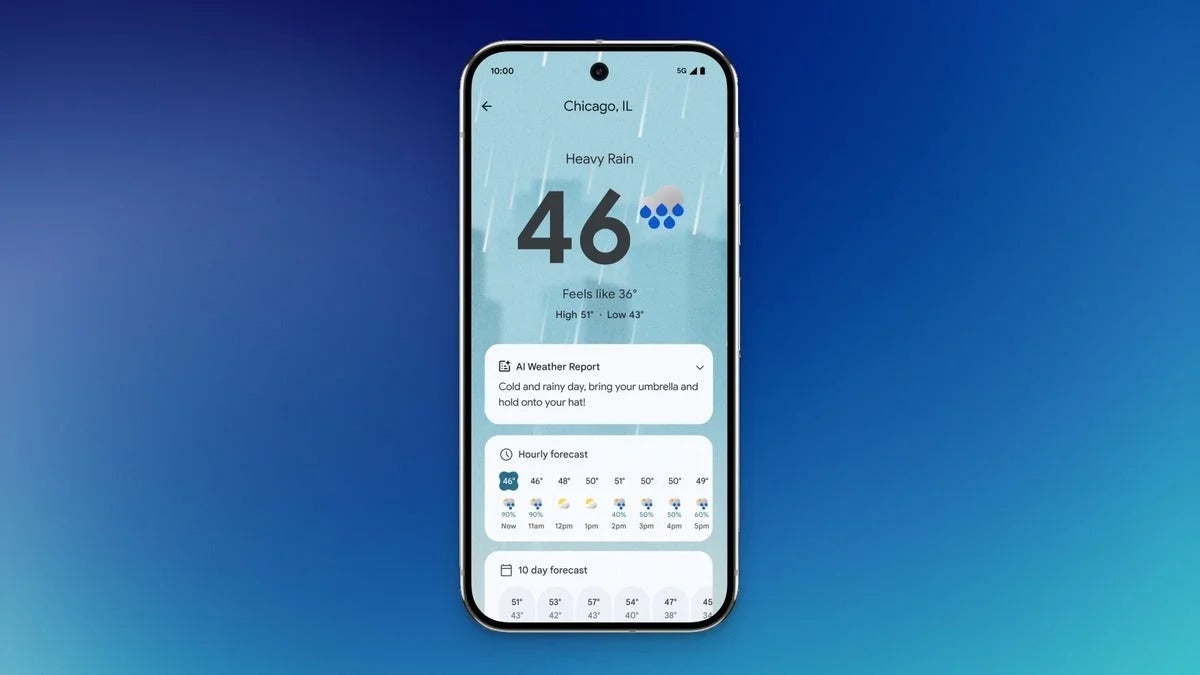
Today’s predictions mostly come from huge numerical weather prediction systems that simulate the physics of the atmosphere in three dimensions. These models run on supercomputers, crunching equations about temperature, humidity, pressure, and wind across the globe. The results are impressively accurate, but they are also computationally expensive: running a full forecast can take hours, which limits how often you can refresh the data and how far into the future you can reliably see.
Inside Google WeatherNext2
Google’s new approach keeps the scientific foundations but swaps the heavy lifting to AI. WeatherNext2 is trained on enormous archives of historical weather observations and reanalysis data, learning the patterns that typically precede rain, snow, wind shifts, and temperature swings. Instead of numerically simulating every physical interaction in the sky step by step, the model predicts the most likely future state directly. Running on one of Google’s custom Tensor Processing Units – chips built specifically for AI workloads – WeatherNext2 can generate a detailed forecast in under a minute. According to Google, it can better capture 99.9 percent of the key variables that define local weather, from precipitation and wind to cloud cover and temperature.
Range is another area where the model pushes beyond what many consumer apps offer today. While a lot of familiar forecasts are most trustworthy out to about ten days, WeatherNext2 is designed to predict conditions up to roughly fifteen days ahead. That extra window may not sound dramatic, but for travellers, farmers, event organisers, and even power grid operators balancing renewable energy sources, a more reliable two week horizon can be transformative. It turns planning from guesswork into something closer to strategy.
Functional Generative Network: instant ensemble forecasts
The real secret sauce behind this leap is a technique Google calls a Functional Generative Network. Instead of painstakingly rolling the atmosphere forward in many small time steps, WeatherNext2 can generate hundreds of plausible future scenarios in a single move. Think of it as creating an instant ensemble forecast, where each scenario represents a slightly different way the next few days could unfold. This makes the system especially good at short term and rapidly changing situations – the exact moments when traditional forecasts often struggle. Sudden downpours, quick forming storms, or oppressive heat waves can all be captured more sharply because the model is built to explore many possibilities at once and then converge on the most likely outcomes.
From lab model to everyday apps
Compared with the older pipeline that needed continuous data processing just to arrive at one polished forecast, this single step ensemble approach is far more efficient. It also lends itself to frequent updates, so forecasts can be refreshed as new observations come in without starting from scratch. That efficiency is what makes it realistic for Google to plug WeatherNext2 into products people already use: the weather layer in Google Maps, the forecast cards on Android phones, the Google app’s at a glance widgets, and, of course, Gemini’s conversational weather answers.
Google is also positioning WeatherNext2 as a platform, not just another backend service users never hear about. The company has mentioned an early access programme for organisations and researchers who want to build their own bespoke models on top of the same technology – imagine a ski resort operator tuning forecasts specifically for snowfall and avalanche risk, or a city transport authority focusing on fog and ice on key routes. Custom models could sit alongside Google’s general purpose forecast, giving specialists tools that reflect the exact conditions they care about.
AI that solves real problems
For me, that idea of AI quietly taking on real world, messy problems is where the technology becomes genuinely exciting. I already lean on AI in smaller, everyday ways: tools that clean up my grammar before I hit send, systems that spin up playful images from a half formed idea, and the Camera Coach feature on my Pixel 10 that helps me frame a shot just right instead of wrestling with manual settings. In healthcare, Google’s MedGemma project is tackling something far more serious, reading and classifying medical images and answering complex, expert level questions that can support clinicians. WeatherNext2 sits in the same family of tools: AI systems that do not just entertain us, but help us see and understand the world with more precision.
Why Gemini needs better weather answers
At the same time, there is plenty of room for improvement in how these advances surface in everyday products. Right now, Gemini’s built in weather responses tend to be extremely high level. It might tell you that it will snow tomorrow, but skip crucial details such as when the snowfall will start, how intense it is likely to be, or whether it will turn to freezing rain during your commute home. With a model as capable as WeatherNext2 running in the background, there is no reason those answers could not become richer, more conversational briefings: explaining the timing of showers, highlighting confidence levels, and flagging the kind of anomalies people actually care about.
Better forecasts would not only help chronic over packers and nervous travellers. More granular predictions could guide pilots and airlines planning routes, renewable energy companies forecasting wind and solar output, or even remote workers deciding whether today is the day to escape to a cafe before a thunderstorm knocks out the power. When you combine that with more reliable connectivity on the move – yes, including eSIM services that keep you online while hopping between countries – you start to see a travel experience where both your data and your expectations about the weather stay stable.
The bottom line
Underneath the marketing gloss, that is the real promise of WeatherNext2. It takes AI out of the realm of vague speculation and puts it to work on one of humanity’s oldest questions: what will the sky do next. If Google can deliver on its claims – and make sure tools like Gemini actually expose the full depth of these forecasts instead of a one line summary – checking the weather on your phone could finally feel less like rolling the dice and more like reading a well informed briefing. For once, being excited about a new AI model does not mean being dazzled by yet another chatbot; it means getting to live, travel, and plan with a little more confidence.
1 comment
as someone who hikes a lot, 15 day forecast that actually works sounds amazing tbh