If you spent part of today wondering why X refused to refresh or why ChatGPT would not even show a basic reply, the problem almost certainly was not your device or your internet provider. 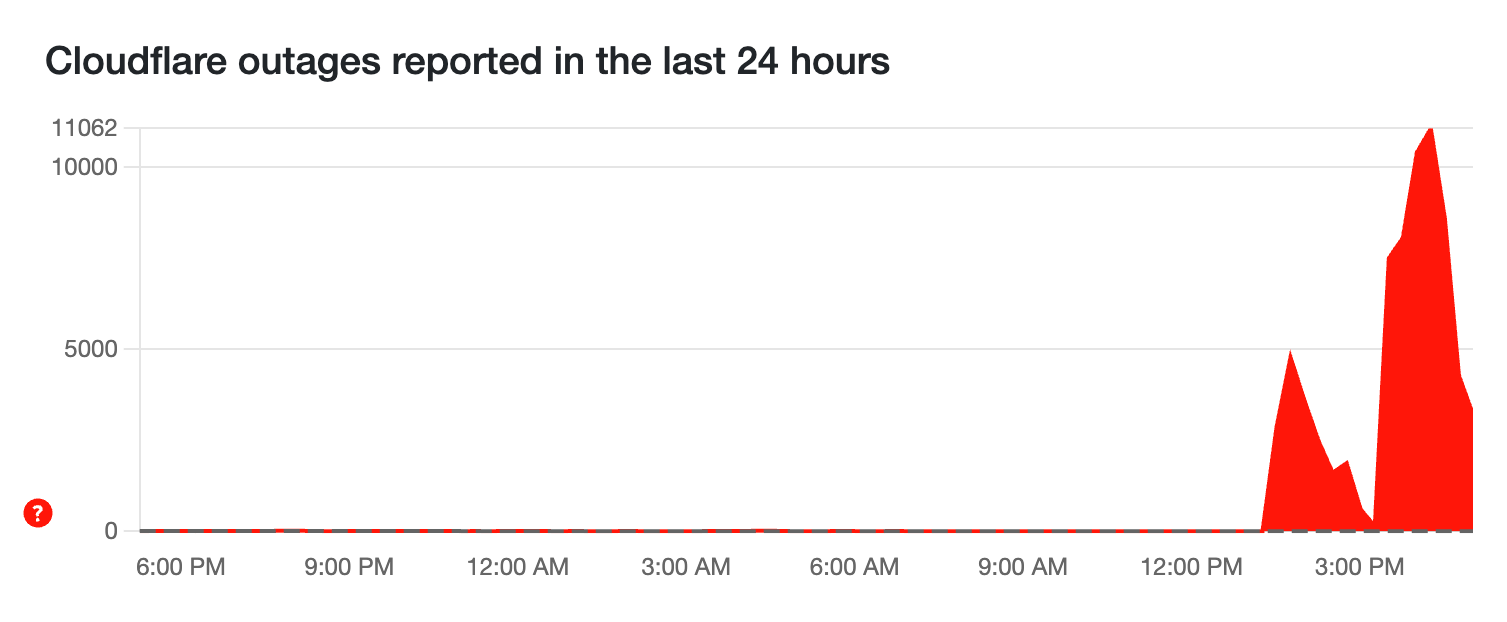
A major chunk of the modern web briefly went sideways because Cloudflare, one of the biggest traffic guardians on the internet, ran into a serious disruption that rippled across popular apps and websites worldwide.
Cloudflare usually works quietly in the background. The company sits between you and the sites you visit, helping route data, filter out malicious requests, and speed up page loads with caching. On Tuesday, that invisible middle layer suddenly became very visible. Around 11:30 GMT, users across different regions started seeing sites stall at loading screens, serve cryptic error codes, or simply refuse to appear at all, even though local connections looked perfectly healthy.
Among the services that stumbled were some of the most visited platforms on the planet. X, the social network many people still instinctively call Twitter, was difficult or impossible to load for some users. OpenAI's ChatGPT, which has become a daily assistant for students, developers, and office workers, also showed problems. Reports surfaced for Shopify stores, Anthropic's Claude chatbot, job platform Indeed, and a long list of other sites that rely on Cloudflare for protection and performance. Monitoring hubs like Downdetector quickly lit up as complaints poured in from users who suddenly could not reach their usual digital tools.
What actually went wrong at Cloudflare?
Cloudflare explained that it saw an unexpected surge of highly unusual traffic directed at one of its core services. In less technical terms, a massive spike of odd requests hit its network at once, overloading part of the system responsible for steering data to the right places. When that layer started to fail, legitimate traffic from everyday users got caught in the crossfire. Instead of reaching the site you wanted, your browser ended up at a Cloudflare error page calmly insisting that your device and the destination website were fine, but the intermediary service in the middle had run into a problem.
For individual users, this kind of outage is especially frustrating because there is virtually nothing you can do to fix it. Restarting your phone, toggling airplane mode, or swapping between home Wi-Fi and mobile data will not magically repair an overloaded infrastructure provider. The issue lives deep inside Cloudflare's global network, not inside your living room. When one of these backbone services stumbles, the only realistic response for users is to wait while engineers reroute traffic, add capacity where needed, and slowly bring systems back into balance.
Why a single outage breaks so many sites
The reason a Cloudflare incident feels like half the internet has vanished is simple: the company has become a massive shared dependency. Cloudflare now provides security, traffic management, and speed optimisations for roughly one fifth of public websites. Small blogs, growing online stores, AI platforms, media outlets, forums, and enterprise dashboards all lean on the same set of tools so they do not have to build complex protection and caching systems themselves. That centralisation is efficient and cost-effective, but it also means that when one provider hits trouble, countless other businesses suffer knock-on effects within minutes.
This outage also echoes other recent episodes that exposed how centralised our digital life has become. Amazon Web Services has previously gone down in high profile fashion, taking with it parts of Amazon's own store, Alexa voice services, and apps like Snapchat and Fortnite. Microsoft's Azure cloud and its 365 suite have had global disruptions that temporarily locked people out of email, documents, and collaboration tools. Each incident has its own technical root cause, but the human experience is similar: one company sneezes, and millions of users around the world catch the cold.
For organisations that rely heavily on online tools, these outages are not just a minor inconvenience. A few hours of broken logins can mean abandoned shopping carts, delayed customer support, stalled advertising campaigns, and bewildered employees staring at status pages instead of getting work done. Some companies now build contingency plans for these moments, from alternative communication channels to backup systems that handle a bare minimum of critical tasks. Yet even the best prepared teams find it hard to operate normally when a key cloud provider stops answering requests.
A reminder of our hidden dependencies
Events like today's Cloudflare disruption are a sharp reminder of how invisible most of our online dependencies really are. People rarely think about content delivery networks, DDoS mitigation layers, or complex routing policies. What they notice is whether their favourite social network loads, whether their online shopping finishes at the payment screen, and whether a chatbot can help them draft an email or debug a piece of code. When a behind-the-scenes service fails, that comfortable illusion of constant, reliable connectivity disappears in an instant.
At the time of writing, Cloudflare's systems appear to be stabilising, and many of the affected services are again accessible for most users. What remains unclear is the full scale of the incident: how many sites were impacted, how long different regions felt the disruption, and precisely what kind of unusual traffic triggered the problem in the first place. Those answers will likely arrive later in a detailed technical breakdown. For everyone who spent the day double-checking their own devices and cursing at unresponsive apps, however, the lesson is already obvious. The modern web might feel limitless, but it still depends on a relatively small number of companies keeping their infrastructure healthy. When one of them falters, the offline world quickly reminds us it is still very much there, waiting on the other side of the screen.
1 comment
every time one company hiccups my workday just evaporates… this is kinda scary tbh