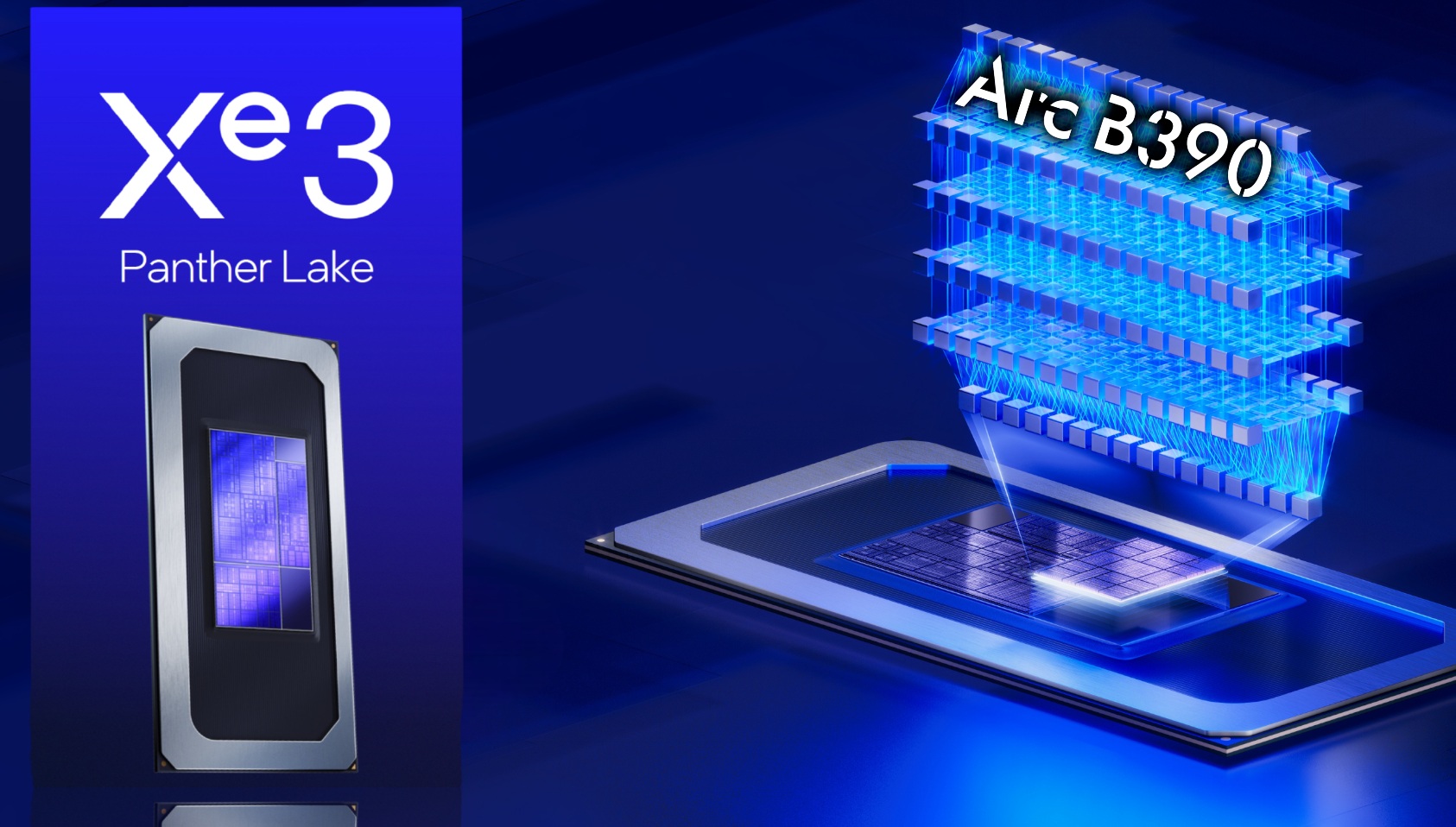
Intel’s next mobile architecture, Panther Lake, has popped up again in the benchmark databases – and this time the spotlight is on the Intel Core Ultra X7 358H, a mid-range mobile chip that’s supposed to power thin-and-light gaming laptops and creator notebooks from 2026 onward. A fresh PassMark entry gives us the clearest look yet at early performance, and the numbers are raising eyebrows for all the wrong reasons, especially when stacked against today’s Arrow Lake-H parts.
Core Ultra X7 358H: Specs and positioning
The listing confirms that the Core Ultra X7 358H features a 16-core design in a 4+8+4 configuration, pairing four performance cores with eight efficiency cores and four low-power efficiency cores. The chip is backed by 18 MB of L3 cache, which lines up with previous leaks and helps cement that this is indeed a genuine Panther Lake engineering sample rather than a mislabelled Arrow Lake SKU.
Clock speeds are still absent from the database – a crucial detail when judging early silicon. Without final boost clocks, it’s difficult to say how aggressively Intel is currently driving this sample, and whether there’s meaningful headroom left for retail silicon. That uncertainty is exactly why some enthusiasts are calling these first scores “interesting but inconclusive” rather than a definitive verdict on Panther Lake.
PassMark CPU scores: Behind today’s Arrow Lake
On the CPU side, the Core Ultra X7 358H scores 4,282 points in the single-thread test and 29,426 points in the multi-thread test. Those numbers don’t exist in a vacuum; they sit uncomfortably behind Intel’s current Arrow Lake-H lineup.
For comparison, the Core Ultra 7 255H posts around 4,347 points in single-thread and the Core Ultra 7 265H pushes that further to roughly 4,433 points. In other words, the X7 358H looks slightly slower in single-threaded work than the very chips it’s supposed to replace. The picture doesn’t get prettier in multi-thread: the new part trails the Ultra 7 255H by about 4% and falls roughly 15% behind the Ultra 7 265H. That’s more than rounding error; it’s a noticeable step back in a benchmark that tends to favor raw throughput.
It’s no surprise, then, that reactions range from cautious to outright mocking. Some readers point out that for an early engineering sample this isn’t catastrophic – performance can still climb once clocks, power limits and firmware are finalized. Others are far less charitable, arguing that if your next-gen mid-range chip can’t at least match your own current mid-range, something in the roadmap is off.
Arc B390 iGPU: Better than entry level, but not a game-changer
PassMark also gives us another datapoint for the integrated GPU, an Intel Arc B390 based on the company’s Xe3 architecture. In the PassMark 3D test, the iGPU scores around 9,339 points. That puts it in the rough neighborhood of a desktop GeForce GTX 1650 Super in synthetic workloads, which is decent for an integrated solution but still behind modern discrete laptop GPUs.
Compared with NVIDIA’s RTX 3050 mobile GPU, the Arc B390 in this sample is reported to be about 23% slower. That’s a far cry from earlier Geekbench leaks where the same iGPU was trading blows with an RTX 3050 Ti laptop GPU in certain tests. The discrepancy isn’t shocking – Geekbench’s graphics tests are notoriously quirky – and it’s exactly why many in the community treat PassMark as the more grounded reference point for cross-platform CPU and GPU comparisons.
Still, even here the context matters. We’re dealing with a pre-release chip whose power limits, memory speeds and drivers may be far from final. A few percentage points up or down could easily be hidden behind immature firmware, yet the fact remains: nothing in these early numbers screams “next-generation leap” on the graphics front.
Engineering sample caveats – and missing data
Intel leakers and seasoned benchmark watchers are quick to repeat the same warning: this is an early engineering sample. ES chips often run at conservative clocks, use non-final power profiles and sit in reference platforms with immature BIOS versions. Small gaps to current hardware can vanish by launch; big gaps usually don’t.
On top of that, the PassMark page itself is littered with “N/A” entries for key fields like base frequency, boost frequency and TDP. That’s why some users dismiss the whole run as a “pretty useless benchmark” for now – we can see the scores, but we don’t know what power envelope or clock strategy Intel used to get them. If this result came from a heavily power-capped laptop, the situation looks very different than if the chip was already unleashed at its intended TDP.
Panther Lake vs AMD’s Strix Halo and the Zen 7 horizon
Beyond the raw numbers, there’s a bigger strategic concern. By the time Panther Lake lands – currently rumored for January 2026 and apparently limited to mobile – AMD will already be deep into its hybrid APU push with parts like Strix Halo. Enthusiasts are already joking that, at this pace, Intel’s “new” mobile silicon will still be trading blows with Strix Halo when Zen 7 shows up.
If these early PassMark results are even vaguely representative of final silicon, Intel risks entering 2026 with a mobile lineup that struggles to decisively beat its own Arrow Lake chips, let alone whatever AMD has in store. The situation becomes even more delicate when you factor in AI accelerators, battery life, and thermals – areas where mobile buyers increasingly care more than raw multi-threaded scores.
What it means for Nova Lake
All of this puts extra pressure on Nova Lake, Intel’s next major architectural step expected in late 2026. Some loyalists in the community are already half-joking that what Intel really needs is “a new benchmark tool that actually does their CPUs justice.” But if every synthetic chart keeps painting the same picture – modest IPC gains and incremental iGPU progress – no amount of benchmark shopping will fix the narrative.
The more optimistic read is that Panther Lake is going through a very early validation phase, and Intel still has time to tune clocks, efficiency and firmware before launch. The pessimistic interpretation is simpler: the days of massive year-over-year jumps are gone, and Intel’s mid-range mobile chips may be in for another evolutionary, not revolutionary, cycle.
Bottom line: the PassMark appearance of the Core Ultra X7 358H is a useful – if imperfect – first look at Panther Lake. Right now, it suggests an early chip that lags current Arrow Lake-H parts in both CPU and GPU tests. Until we see retail systems, full spec sheets and a wider spread of benchmarks, the only safe conclusion is that Intel still has work to do if it wants Panther Lake to feel like a true generational upgrade rather than a sideways step.
3 comments
If Panther Lake launches like this, Nova Lake is gonna have to be a miracle chip just to fix the narrative. Good luck with that, Intel 😅
People keep saying “it’s just an engineering sample bro”, but ES or not, next gen should not be LOSING to current gen in both ST and MT
Arc B390 being kinda around 1650 Super but still behind a 3050 laptop is… fine I guess, but deff not the iGPU revolution some were hyping