AMD has unveiled its much-anticipated roadmap for its upcoming Zen CPU architectures, revealing both the Zen 6 and Zen 7 cores. These next-generation designs promise significant upgrades in performance, efficiency, and AI capabilities, with new process technologies and cutting-edge hardware features. 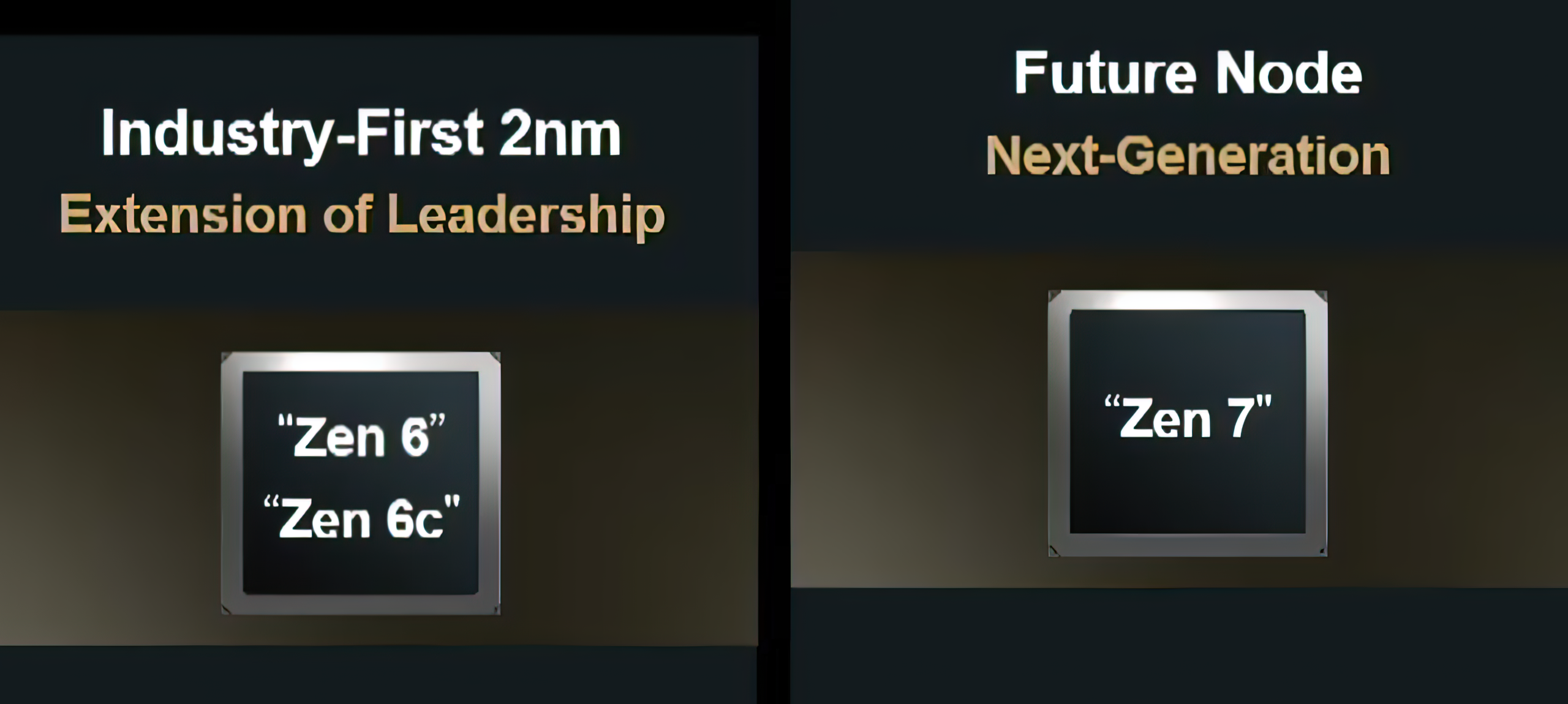
AMD’s announcement, which took place at the 2025 Financial Analyst Day, sheds light on the future of its EPYC and Ryzen processors, giving us a glimpse of what the company has planned for the next few years.
The Zen 6 architecture is set to launch in 2026 and will be built on TSMC’s revolutionary 2nm process technology, making it one of the most advanced processors ever released by AMD. This new architecture will offer notable improvements in both performance and efficiency compared to its predecessors. Mark Papermaster, AMD’s CTO, confirmed that Zen 6 will feature both standard “Zen 6” cores for high-performance applications and a more efficiency-oriented “Zen 6C” core variant. This dual approach allows AMD to cater to a broader range of computing needs, from high-end server workloads to power-efficient mobile platforms.
In addition to Zen 6, AMD has also given us a sneak peek at the Zen 7 architecture, which will build upon the foundation laid by Zen 6. Although details about Zen 7 are still limited, it is clear that it will incorporate new technologies aimed at expanding the capabilities of AI. The Zen 7 CPUs will include a next-generation Matrix Engine, designed to accelerate AI workloads. AMD has emphasized that this new architecture will support emerging AI data formats, marking a significant step forward in machine learning and artificial intelligence integration. Furthermore, Zen 7 will enhance AI pipeline capabilities, ensuring that these CPUs are ready to handle the most demanding AI tasks for years to come.
Zen 6 will be featured in several product lines, including the EPYC Venice series, Olympic Ridge (Ryzen Desktop), and Medusa Point (Ryzen Mobile) families. The EPYC Venice processors will be the flagship offering, optimized for high-performance server environments. These CPUs will be coupled with AMD’s 5th Gen Infinity Fabric, which will ensure faster data transfer speeds and greater overall efficiency. The Venice lineup will also utilize 2.5D packaging and include an impressive 64 GB/s SerDes interconnect. These components will work together to offer up to 224 GB/s of raw bandwidth, making the Venice processors a perfect fit for enterprise-level workloads that require vast amounts of memory bandwidth.
The EPYC Venice series will also feature the next-generation CDNA 5 GPUs, such as the MI400 series, and a set of AI Network Interface Cards (NICs). These innovations will allow AMD to deliver systems that are not only fast but also capable of handling cutting-edge AI workloads in data centers. Helios servers, another part of the EPYC Venice family, will be AMD’s leadership product, incorporating these advancements to provide the best possible performance for AI and high-performance computing tasks.
While Zen 6 will be an exciting release for both consumers and enterprises, Zen 7, scheduled for a 2027 debut, promises even greater innovations. Zen 7 will be featured in the upcoming EPYC Verano processors, which are expected to offer even higher performance and AI capabilities. Though AMD has not yet revealed any consumer-tier products based on the Zen 7 core, it is likely that more information will emerge as we approach its release. The launch of Zen 7 will coincide with advancements in AMD’s process technology, paving the way for future generations of computing hardware that will be more powerful and efficient than ever before.
These advancements in both Zen 6 and Zen 7 cores underscore AMD’s commitment to providing high-performance, energy-efficient solutions for both consumer and enterprise markets. With the upcoming launch of these next-gen processors, AMD is positioning itself as a leader in the ever-evolving world of computing, offering products that will drive the future of AI, data centers, and consumer computing alike.