Only Apple could announce a $230 fabric sleeve for your phone and immediately be compared to Borat’s fluorescent mankini. The company’s new iPhone Pocket accessory – a ribbed, knitted holder created with the design studio of Issey Miyake – was clearly meant to sit at the intersection of tech, fashion and art. Instead, the internet took one look and collectively said: “So… it’s a sock? For how much?!”
Officially, Apple pitches iPhone Pocket as a “beautiful way to wear and carry iPhone,” a kind of minimalist wearable holster that blurs the line between clothing and gadget. 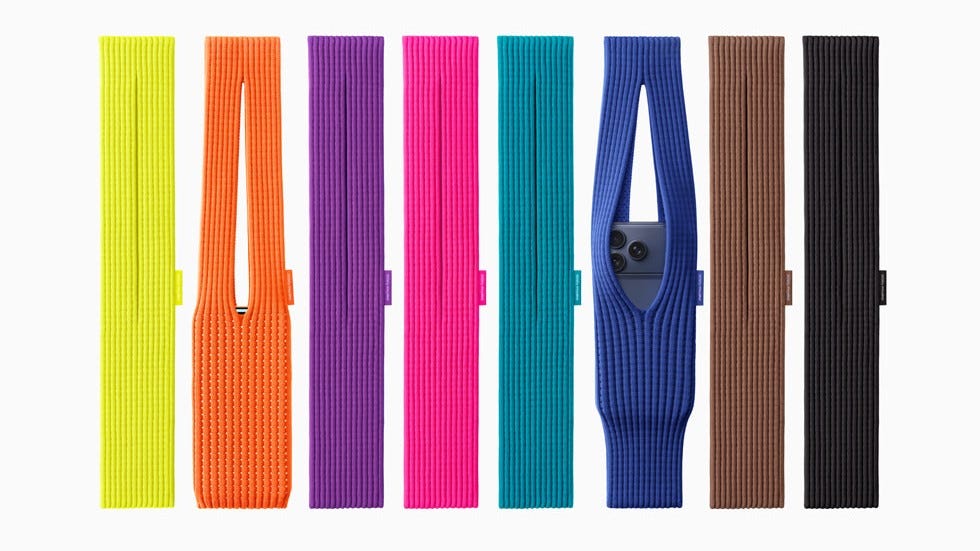
The piece uses a 3D-knitted construction developed by Issey Miyake’s team, building on the same research that gave the brand its famous pleated garments and, by extension, some of Steve Jobs’ iconic turtlenecks. The idea is to treat the phone as something you literally wear, not just slip in a pocket or fling into a bag.
In practice, though, a lot of people see something far less lofty and far more ridiculous. From certain angles, the tightly ribbed, high-cut design really does resemble Borat’s infamous mankini, only stretched into a long strap and wrapped around a smartphone. Memes comparing the two exploded within hours. One commenter joked that instead of a luxury accessory, it looks more like an expensive comedy prop – the kind of thing you’d spot in a parody sketch, not a glass-and-steel Apple Store.
Underneath the memes is a familiar criticism: the sense that Apple has perfected the art of selling very simple objects at luxury prices to a devoted fanbase. iPhone Pocket is, at the end of the day, a fabric sleeve with a strap. No MagSafe system, no structured shell, no hidden pocket, no zipper. Online critics calculated that for the same money you could buy dozens of cheeseburgers, pay a chunk of rent, or pick up a decent budget Android phone – and still have change left over instead of owning what many described as a “$230 sock.”
There’s also the question of what you actually get for that price. The iPhone Pocket comes in two main versions: a shorter strap variant for $149.95, and a longer crossbody-style strap for $229.95. Both are 3D-knit in Japan, draw on Issey Miyake’s textile expertise and come in a palette of bold colors – lemon, mandarin, purple, pink, peacock, sapphire, cinnamon and black. Apple says the design works with nearly all iPhone models, partly because there’s no rigid housing to constrain the size. If it’s roughly phone-shaped, it fits.
But the simplicity that makes it universal also makes some people nervous. The sleeve has no closure or clasp, and the knit is relatively open. Critics point out that in cities where smartphone theft is already a problem, visibly dangling a phone in a brightly colored designer sling is almost an invitation. As one nervous user put it in a viral reaction, the combo of no zipper, no structure and rising street theft makes the accessory feel more like a flex than a practical everyday carry solution.
Still, that may be the point. iPhone Pocket isn’t trying to be a rugged case or a hidden security pouch. It’s closer to a fashion necklace for your device – the kind of object you wear at a gallery opening, a design conference or an upscale café, where the message “I own this and I want you to see it” is part of the appeal. Apple and Issey Miyake are clearly talking to the same crowd that buys avant-garde tote bags, $300 hoodies and limited-run collabs that sell out in minutes.
The backlash, however, has laid bare a deep divide between that world and the average smartphone owner. Commenters are openly wondering what the profit margin looks like on a 3D-knitted sleeve, sarcastically imagining internal meetings where an executive suggests, “Our users will buy anything – let’s see how far we can push it.” Others joke about Apple fans happily skipping rent or bills to own the latest shiny thing, spinning the iPhone Pocket into a symbol of brand loyalty turned all the way up to eleven.
Beyond the jokes, there’s a real conversation about how far tech brands can lean into fashion pricing. Apple has been positioning itself as a lifestyle label for years, from the Apple Watch Hermès bands to premium AirPods Max finishes and carefully curated store displays that feel more like boutiques than electronics retailers. The iPhone Pocket fits neatly into that strategy. It’s limited-edition, sold only through select Apple Stores in markets like the U.S., UK, France, Greater China, Italy, Japan, Singapore and South Korea, and designed to look like it belongs on a runway moodboard rather than in a bargain bin.
Whether that approach resonates or repels depends entirely on your relationship with the brand. For some, iPhone Pocket will be an eye-roll-inducing example of Apple excess, proof that the company can slap a logo on almost anything and sell it out. For others, it will be a collectible: a conversation-starting piece that nods to both Apple history and high fashion, and a way to treat the phone as an accessory rather than a slab of glass you hide in your jeans.
What’s undeniable is that, once again, Apple has found a way to turn a very basic idea into a culture moment. The iPhone Pocket may not be everyone’s style – and the Borat comparisons probably aren’t what the designers had in mind – but the debate around it says a lot about where tech, fashion and fandom intersect in 2025. If nothing else, this might go down as the year the humble phone sock made a bizarre, couture-level comeback.
1 comment
I’d love to see the margin on this, the profit % must be absolutely insane for a glorified ribbed sleeve