Intel Panther Lake Compute Tile: First Real Look at the 18A Client Flagship
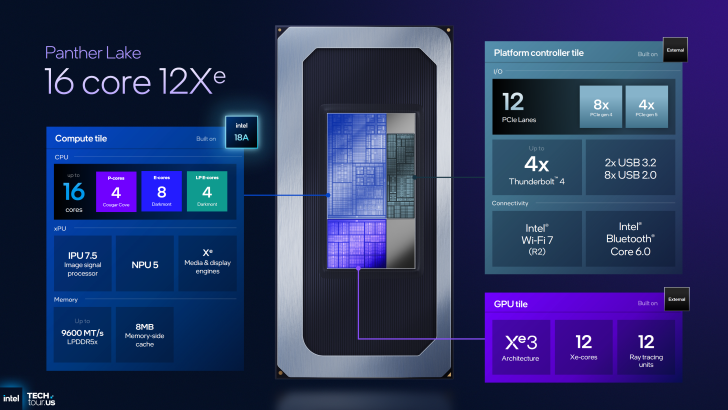
Intel’s next big step in the client CPU roadmap, codenamed Panther Lake, is finally more than a slide in a keynote. A close-up die shot of the new 18A Compute Tile has surfaced, giving us a much clearer idea of how Intel is arranging its next-generation Cougar Cove performance cores (P-cores) and Darkmont efficiency cores (E-cores) inside the upcoming Core Ultra Series 3 chips.
Panther Lake is designed as the successor to Lunar Lake in Intel’s mobile stack and will be one of the first client products manufactured on the company’s cutting-edge 18A process. Alongside new CPU cores, the platform brings updated integrated graphics, a refreshed NPU for AI workloads, and brand-new media engines aimed at video creators and streamers. But at the heart of it all sits the Compute Tile, the piece of silicon that actually does the heavy lifting for everyday compute tasks.
What the 18A Compute Tile Reveals
The leaked die shot focuses entirely on the Compute Tile, the part of Panther Lake that houses the Cougar Cove P-cores, Darkmont E-cores, and low-power Darkmont LP-E cores, as well as the L2 and L3 cache blocks that feed them. Intel is again relying on its disaggregated, tiled approach, so this is only one element of a much more complex package that also includes:
- Compute Tile – built on Intel 18A
- Graphics Tile – expected on Intel 3 or TSMC N3E
- Platform Controller Tile – fabbed on TSMC N6
- Base Tile – manufactured on Intel 12xx-class process
- Filler Tiles – used to complete the Foveros 3D package
- CPU Interposer Package – tying everything together
According to the published image analysis, the 18A Compute Tile currently shows three Darkmont E-core clusters, each cluster containing four efficiency cores. Sitting alongside them are two Cougar Cove P-cores, with space clearly reserved on the die for another two P-cores that are not populated on this particular configuration. Around these blocks, you can spot the distinct regions reserved for L2 and L3 cache segments.
Die Sizes: Cougar Cove vs Lion Cove and Darkmont vs Skymont
The tile analysis also breaks down approximate die areas for each core type, allowing an early comparison with Intel’s recent architectures:
- Cougar Cove P-core: ~4.49 mm²
- Darkmont E-core (per core): ~1.09 mm²
- Darkmont E-core cluster: ~6.47 mm²
When you line these numbers up against previous generations, Cougar Cove ends up very close in size to the Lion Cove P-core used in Lunar Lake, while still noticeably smaller than Redwood Cove from Meteor Lake. On the efficiency side, Darkmont’s per-core die area comes in around 13% smaller than Skymont, and the whole Darkmont cluster is roughly 5% smaller than a comparable Skymont cluster. That may sound like a minor tweak, but on a dense 18A tile, every square millimeter reclaimed can be turned into more cache, more cores, or lower power.
Cache Configuration: Feeding the New Cores
Cache layout is another area where Panther Lake quietly evolves Intel’s design. Each Cougar Cove P-core is paired with a generous 3 MB of private L2 cache, backed by a classic 256 KB L1 cache with a split sub-cache design: 192 KB of L1 data cache (L1D) and 48 KB of L0 data cache (L0D). This is a sizable on-core memory pool intended to keep high-performance threads fed and minimize trips out to slower shared cache or memory.
Darkmont E-cores, meanwhile, are organized at the cluster level. Each four-core Darkmont cluster is associated with 4 MB of L2 cache and 96 KB of L1, while the sub-cache blocks provide 64 KB of instruction cache (L1I) and 32 KB of L0 data cache. The goal here is to make sure the efficiency cores are not starved when handling background tasks, light workloads, or highly parallel jobs like compiling code or handling many browser tabs.
Early Hype, Realistic Expectations
Because this die shot arrives well ahead of launch, it fuels a lot of speculation. Enthusiasts are already debating whether these “E-cores everywhere” designs really help gaming or just add complexity that software schedulers struggle to use well. Some skeptics argue that Intel has over-promised before with designs such as Arrow Lake, only for real-world performance and scheduling to fall short of the marketing. To them, Panther Lake risks being another over-hyped refresh unless Intel can prove that Darkmont cores and improved thread management genuinely translate into smoother frame times, faster content creation, and better battery life.
On the other hand, the tight die sizes, richer caches, and the leap to the 18A node suggest Panther Lake is more than a cosmetic update. Combined with updated graphics and NPUs on other tiles, it could mark a significant generational shift for thin-and-light laptops and premium ultrabooks – provided Intel’s firmware, drivers, and operating-system level schedulers are ready to take proper advantage of the heterogenous core layout.
Looking Ahead to CES 2026
The current information remains preliminary, based on early silicon and die analysis rather than final retail chips. Intel has already shown Panther Lake wafers and demo systems at its Tech Tour 2025 events, hinting that the platform is tracking toward a public debut around CES 2026. Between now and then, expect more details on exact core counts, boost clocks, AI capabilities, and battery life claims as Intel tries to convince both OEMs and enthusiasts that 18A is ready for prime time.
For now, the new compute tile shot at least turns the abstract idea of Panther Lake into something tangible: a compact 18A slice of silicon packed with Cougar Cove P-cores, Darkmont E-cores, and a carefully tuned cache hierarchy that will define Intel’s next generation of mobile CPUs.
1 comment
ngl this looks like DOA silicon to me, more tiny e-cores and still hoping thread director magically fixes games lol