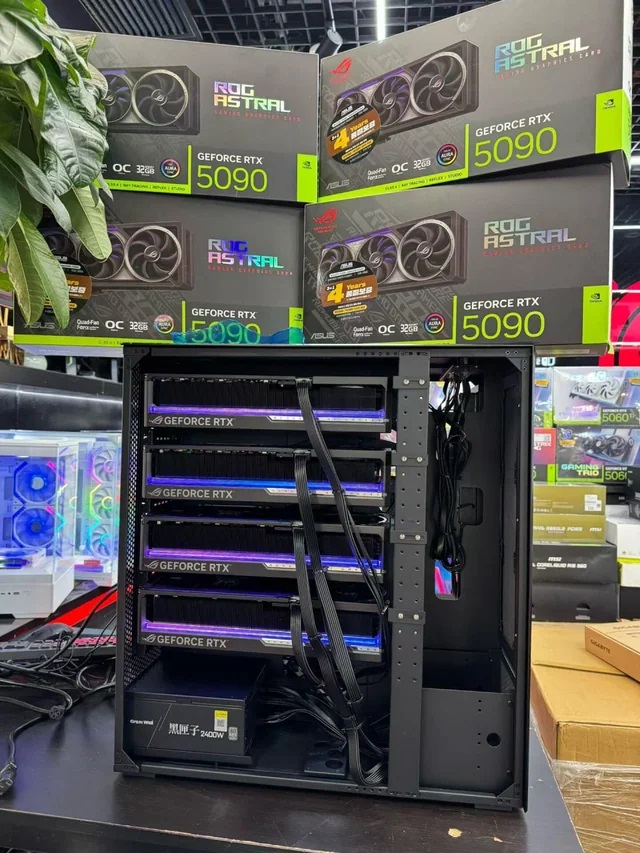
Quad RTX 5090 Battlestation Fills a Tower: Spectacle, Science, and the Smell of Hot Silicone
Some builds whisper. This one roars. A Redditor’s battlestation has gone viral for stuffing four ASUS ROG Astral GeForce RTX 5090 graphics cards into a single, cavernous tower – so many fans and heat pipes that the GPUs practically become the case. It’s the kind of rig that makes the old “Can it run Crysis?” meme feel quaint. The real question here is: can it run without flipping a breaker, melting a connector, or turning the side panel into a convection oven?
What’s Actually Inside
The core is a workstation-class platform that appears to be paired with an Intel Xeon CPU cooled by a 240/360-class AIO. To make four slot-thick ROG Astral 5090s coexist with the motherboard, the builder routed the cards into the case’s second chamber using PCIe 5.0 riser cables. It’s a clever way to preserve motherboard breathing room while keeping the CPU cooler unobstructed. Even so, the quartet of open-air coolers consumes most of the chassis volume – roughly three-quarters by eyeball – leaving only a narrow corridor for power delivery and cable management.
Power Math That Makes Electricians Sweat
NVIDIA’s GeForce RTX 5090 can draw up to 600W under full load. Multiply that by four and you’re flirting with 2,400W before the CPU, motherboard, memory, storage, pumps, and fans even say good morning. Realistically, a hard-working CPU and platform add hundreds more watts. That’s why the community quickly noticed a key detail: this tower isn’t relying on a single brick. Observers pointed out two GreatWall BlackBox 2400W 80+ Platinum power supplies mounted on opposite sides, and also clarified that a shiny “silver box” visible in photos is not a PSU. In other words, the builder is spreading the load – smart, but still aggressive.
For homes wired on standard 110–120V 15A circuits, yanking north of 2kW continuously is a fast track to tripped breakers. On 220–240V lines with appropriately rated outlets, there’s more headroom, but the message stands: this is industrial appetite in consumer clothing. Several readers joked the setup needs a range plug; they’re not far off.
Cooling and the 16-Pin Elephant
Four-slot, open-air coolers excel when they can inhale cool air and exhale hot air into open space. Stack four of them side by side, then compress them into a side chamber, and even pristine fan curves can’t bend the laws of thermodynamics. That’s why veteran builders advocated blower-style coolers for multi-GPU workstations: less romantic, more surgical airflow.
Then there’s the 12V-2×6 (formerly 12VHPWR) 16-pin connector. The standard is safer and clearer than the first-gen era, but the physics haven’t changed: tight bends near the housing, poorly seated plugs, or over-stressed splitters can still invite failure. Four cards mean four connectors and four opportunities to get lazy with bend radius or seating pressure. Cable discipline is not a suggestion here; it’s survival. If anything “melts,” it won’t be because the standard is cursed – it’ll be because tolerances and best practices weren’t followed to the letter.
Is This for Gaming? Not Really.
Even if you could cajole games into seeing four 5090s, modern titles don’t scale across multiple consumer GPUs. Multi-GPU rendering for games is effectively a relic. Where this build makes sense is in workloads that natively exploit many GPUs: local LLM inference and fine-tuning, diffusion-based image/video pipelines, CUDA-heavy scientific work, or VR research that bakes assets while you iterate. In those domains, frameworks can shard across GPUs and deliver the throughput you paid for. Just don’t expect a clean SLI toggle to transform your Steam library.
The Price of Flex
Premium ROG Astral RTX 5090 cards list in the ballpark of $3,300+ each, making the GPU stack alone a roughly $13,000 conversation starter. Add two Platinum PSUs, a serious chassis, industrial-grade risers, and a Xeon platform, and you’ve wandered into boutique workstation territory. That’s before you factor in power bills – or the time you’ll spend tuning fan curves and cable geometry.
Lessons From the Crowd
- Spot the hardware: Two GreatWall BlackBox 2400W units appear to share the load; the mirror-finish box others saw isn’t a PSU.
- Airflow first: Open-air coolers in close quarters are asking a lot from convection. Blower cards are ugly heroes for multi-GPU.
- Electrical reality: Sustained 2–3kW draws belong on properly rated circuits.
- Connector care: Respect the 16-pin playbook: full seating, no sharp bends, and one cable per connector when possible.
- Use-case clarity: This is an AI/compute workstation masquerading as a gaming PC. And that’s fine.
Bottom Line
As a feat of ambition, this quad-5090 tower is glorious. As a daily driver, it’s a meticulous engineering project that will live or die by airflow, cabling, and electrical planning. If the builder treats power and thermals like first-class citizens, this isn’t just a meme machine for Microsoft Paint – it’s a compact compute lab with the personality of a LAN party. If not, it’s four times the heat, four times the noise, and four times the risk. In other words: breathtaking either way.
1 comment
4x 600W = 2400W before CPU… you’re gonna need a range plug or your breakers will nope out