Apple’s first foldable iPhone is getting louder in the rumor mill, and one detail stands out: to make the design cleaner and the hardware slimmer, Apple may swap the familiar Face ID system for a new under-display selfie camera paired with a return of Touch ID. A leaked spec sheet analysis attributed to J.P. Morgan points to a 24MP camera hidden beneath the cover display, and a dual-selfie configuration overall – likely one camera per screen. 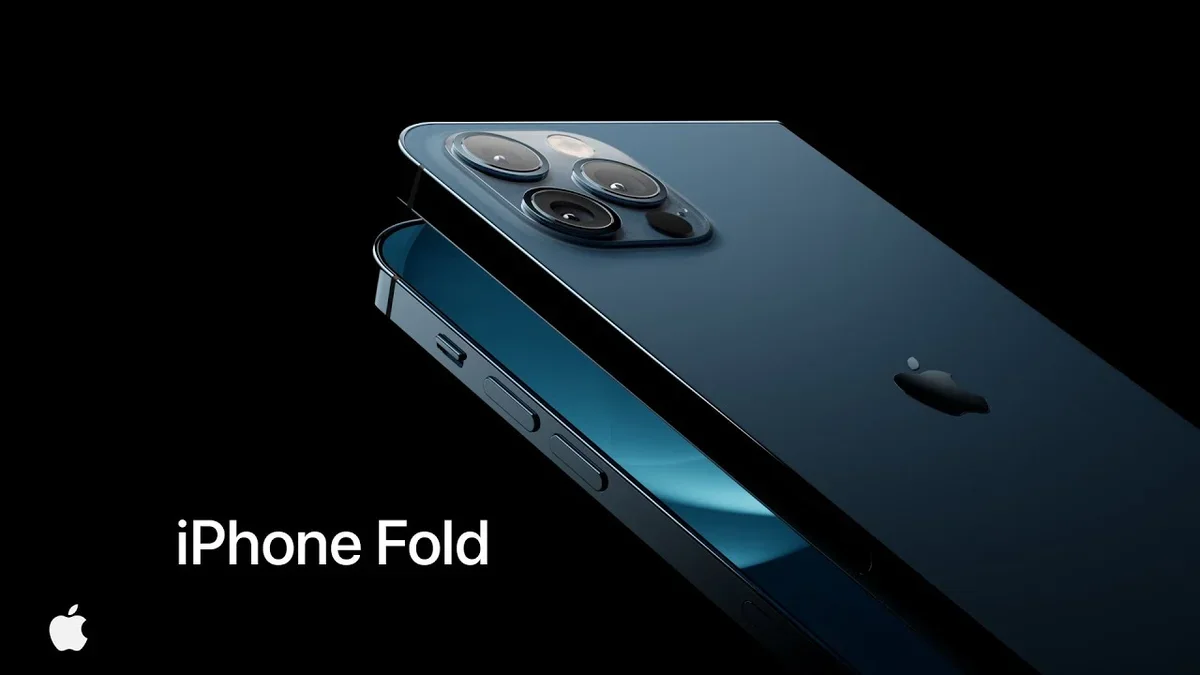
If true, Apple would be prioritizing uninterrupted screens and practical ergonomics over the depth-sensing hardware that powers Face ID.
Why Apple might ditch Face ID on a foldable
Face ID requires a cluster of sensors – infrared emitter, dot projector, flood illuminator, and an IR camera – plus room to house them. On a foldable, every cubic millimeter counts. Thicker display stacks, hinge mechanics, battery segmentation, and heat dissipation leave less space for a large sensor array. Hiding hardware under pixels further complicates light transmission. Removing the depth module gives Apple more freedom to create uniformly thin bezels and a seamless, punch-hole-free look across both the outer and inner displays.
There’s also the user-experience angle. Foldables are opened and closed dozens of times a day. Depending on the hinge angle, Face ID can misalign with your face or be blocked by your hand. A tactile fingerprint reader works at any angle, whether you’re glancing at the cover screen on the go or using the large inner canvas at a desk.
Under-display camera: benefits and trade-offs
An under-panel camera keeps the cover screen pristine, but the tech has compromises. Light passes through a pixel matrix, and even advanced algorithms must combat haze, color shift, and softness. Apple’s image processing could mitigate these issues with multi-frame capture and deconvolution, yet physics still matters. A 24MP sensor suggests Apple wants plentiful detail to start with, then lean on computational photography to restore clarity lost under the OLED layer.
Touch ID’s comeback, and where it could live
If Face ID is out, Touch ID is in – most plausibly on the side button. A side-mounted capacitive reader is consistent, fast, and unaffected by display creases or partial folds. It works when the phone is flat on a table, half-open for notifications, or closed. Under-display Touch ID has floated through the rumor cycle, but veteran analyst Ming-Chi Kuo has long considered it unlikely for near-term iPhones, and the foldable’s mechanical complexity makes a robust side key even more compelling. You also gain continuity: the same unlock gesture regardless of which screen you’re using.
Rear cameras: a pragmatic dual 48MP setup
The same leak hints at two rear cameras: a 48MP wide and a 48MP ultra-wide, reportedly without sensor-shift stabilization. That mirrors the stripped-back strategy seen on standard iPhones like the vanilla iPhone 17 tier – prioritizing high-quality main and ultra-wide shooters while skipping telephoto to save thickness, weight, and cost. On a foldable, the massive inner display already doubles as an excellent viewfinder, so Apple can emphasize computational zoom and cropping from a detailed 48MP base rather than squeezing in a bulky periscope module.
No sensor-shift may raise eyebrows, but it reduces module height. Expect Apple to compensate with optical design, OIS alternatives where feasible, and aggressive gyro-assisted stabilization in software. Given how much modern iPhone imagery relies on processing, a tuned dual-camera pipeline could still deliver consistent, flagship-level results.
Launch window: 2026 vs. 2027
Timelines are fuzzy. The current chatter places the iPhone Fold in the second half of 2026 alongside the second iPhone Air and iPhone 18 Pro models, while a recent report out of Korea suggested 2027. Apple historically ships when the experience feels finished, not when the calendar says go. Hinge durability, crease visibility, panel longevity, and camera image quality under a display are all areas Apple would rather perfect than rush.
How it compares with Samsung and Google
Every foldable brand compromises somewhere. Samsung’s Galaxy Z Fold 7 reportedly chases thinner frames and better efficiency, while Google’s Pixel 10 Pro Fold is said to iterate on size, weight, and cameras. A hypothetical Apple playbook – no Face ID, yes to side-button Touch ID, streamlined rear cameras – fits the same pattern: simplify the stack, polish the basics, and let software magic close the gap.
What to watch next
- Biometrics: A reliable side-button Touch ID that unlocks in any orientation could become a foldable favorite.
- Under-panel imaging: Watch for low-light selfie quality improvements and reduced haze compared to first-gen UDCs.
- Durability: Hinge life, crease minimization, and panel scratch resistance will be decisive.
- Software: Split-screen, drag-and-drop, and continuity between inner and outer displays could define Apple’s advantage.
- Cameras: A two-lens, 48MP-centric system will test how far computational photography can stretch on a foldable.
Bottom line: If these leaks hold, Apple’s foldable will favor a clean design, consistent ergonomics, and smart trade-offs over spec-sheet brute force. Losing Face ID may sound dramatic, but in a foldable world, a great fingerprint reader and a truly uninterrupted display might be exactly what people love.
1 comment
No Face ID? finally I can unlock it on my desk without doing the weird chin lean lol