Intel Panther Lake “Core Ultra Series 3” leak: final clocks, full SKU map, and what 4 P-cores really mean
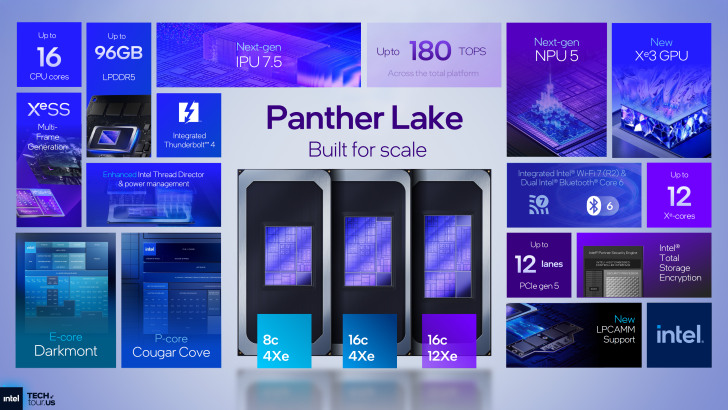
Intel’s next mobile family, codenamed Panther Lake and marketed as Core Ultra Series 3, has surfaced again with what appears to be the final clock targets and an almost complete SKU stack. While nothing is official until Intel takes the stage, the leaked matrix paints a coherent picture: fourteen laptop models split across performance-oriented H parts and efficiency-first U parts, topping out at a claimed 5.1 GHz on the flagship. Equally notable is Intel’s bet on a beefier integrated GPU (Xe3) and a tri-cluster CPU layout that leans on a small number of large cores, a sizeable pack of efficiency cores, and an additional low-power E-cluster.
The four segments at a glance
The lineup is said to be organized into four logical groups, each defined by CPU topology and integrated graphics capacity:
- 4 + 8 + 4 dies with 12 Xe3 cores: the top H-series designs. These use four performance cores (Cougar Cove), eight efficiency cores (Darkmont), and four low-power E-cores. The iGPU is the full 12-core Xe3 slice – internally referenced as an Arc B390-class configuration – clocked roughly in the 2.5–3.0 GHz window.
- 4 + 4 + 4 dies with 10 Xe3 cores: mid-range H-series where the iGPU steps down to 10 Xe3 units (Arc B370 tier) and CPU turbos are a hair lower.
- 4 + 0 + 4 dies: non-H parts aimed at mainstream thin-and-lights. Same four big cores and four LP-E cores, without the extra E-cluster in the middle. These reportedly pair with a 4-core Xe3 iGPU and still reach high single-core boosts.
- 2 + 0 + 4 dies: the U-series entry level, tuned for 15–28 W envelopes, emphasizing battery life while keeping snappy burst performance.
Flagship: Core Ultra X9 388H
At the top sits the Core Ultra X9 388H, a full-die part with 4 P-cores + 8 E-cores + 4 LP-E cores and a claimed up-to-5.1 GHz peak. The iGPU is the complete 12-core Xe3 configuration. Several derivatives reuse the same silicon with clipped clocks or iGPU slices – SKUs like 386H, 368H, 366H, 358H, and 356H appear in the stack, targeting different thermals and price points, but keeping the overarching 45 W H-series positioning.
Mid-range H: Core Ultra 5 338H & 336H
The 4+4+4 duo – the Core Ultra 5 338H and Core Ultra 5 336H – allegedly carries a 10-core Xe3 GPU (Arc B370 class). Turbo frequencies land a notch below the flagship tier: as leaked, 4.7 GHz for the 338H and 4.6 GHz for the 336H. Expect these to be the volume sweet spot for gaming-capable ultrabooks that rely on integrated graphics or pair with 50–60 W discrete GPUs.
Mainstream non-H: 4+0+4 with snappy boosts
The non-H quartet – Core Ultra 365, 355, 335, 325 – keeps the four big cores and the LP-E cluster while dropping the eight-core E-island in the middle. Even so, leaks point to boosts as high as 4.8 GHz, paired with a cut-down 4-core Xe3 iGPU. These are the likely candidates for fan-quiet premium ultraportables where bursty responsiveness matters as much as endurance.
U-series: efficient by design
Finally, the Core Ultra 332 and Core Ultra 322 form the U-series. The recipe – 2 P-cores + 4 LP-E cores – targets a 15–28 W TDP range with 4.4 GHz boosts. Expect them to anchor long-battery machines and compact form factors while retaining modern AI and media blocks.
Specs snapshot (selected, leaked)
| Model | CPU topology | Max boost | iGPU | TDP class |
|---|---|---|---|---|
| Core Ultra X9 388H | 4P + 8E + 4 LP-E | Up to 5.1 GHz | 12 Xe3 (Arc B390 class) | 45 W |
| Core Ultra X7 358H | 4P + 8E + 4 LP-E | ~4.8 GHz (leaked) | 12 Xe3 | 45 W |
| Core Ultra 5 338H | 4P + 4E + 4 LP-E | Up to 4.7 GHz | 10 Xe3 (Arc B370) | 45 W |
| Core Ultra 365 (non-H) | 4P + 0E + 4 LP-E | Up to 4.8 GHz | 4 Xe3 | Non-H |
| Core Ultra 332 (U) | 2P + 0E + 4 LP-E | Up to 4.4 GHz | – | 15–28 W |
Note: early materials alternately label the LP-E cluster as Darkmont LP-E or Skymont-class. Either way, it’s designed for ultra-low-power background and media tasks, freeing the main E- and P-clusters for foreground work.
But only four P-cores – what about games?
This is the lightning-rod question popping up in enthusiast threads: “How can modern games run well on only four P-cores?” The short answer is that the core mix matters more than the P-core count in isolation. With up to 5.1 GHz single-thread headroom, a healthy pack of E-cores, and Windows/Thread Director steering background threads to the right cores, CPU-bound stutters can be minimized. Meanwhile, the enlarged Xe3 iGPU (up to 12 cores) should be a generational step up in integrated graphics – especially when paired with modern features such as XeSS upscaling and faster media engines. For dGPU laptops, the 4P + E-mix keeps frame-time consistency while the discrete GPU does the heavy lifting. For iGPU-only machines, memory bandwidth (LPDDR5X/LPDDR6), cooling, and OEM TDP limits will make or break gaming results; still, the architecture no longer treats iGPU as an afterthought.
Where the pieces fit
In practical terms, creators will like the high single-core peaks for timeline scrubbing and the E-core throughput for background transcodes. Road-warriors get instant wake and long runtimes from the LP-E island. And because most SKUs sit around a 45 W class for H and 15–28 W for U, OEMs can design thinner chassis without surrendering burst performance. Expect the Core Ultra 5 338H to be a volume hero – enough GPU for casual 1080p, enough CPU for compiles and Lightroom, without the flagship price.
Launch timing
According to the leak, Intel will formally unveil Core Ultra Series 3 at CES 2026, with broader availability planned for January 2026. One premium SKU is rumored to ship late this year to seed halo notebooks – a common tactic to secure design wins ahead of the main wave. As always, treat the table above as a strong guide rather than gospel until Intel publishes final specifications.
Bottom line: Panther Lake looks less like a clock-bump and more like a deliberate rebalance – lean single-thread muscle where it matters, scalable efficiency for everything else, and a much more serious integrated GPU. Four P-cores may raise eyebrows, but paired with smarter scheduling and a modern Xe3 engine, the bigger story is balance.
1 comment
4 P-cores on the top chip? idk man, modern AAA can be hungry… hope the scheduler magic is real