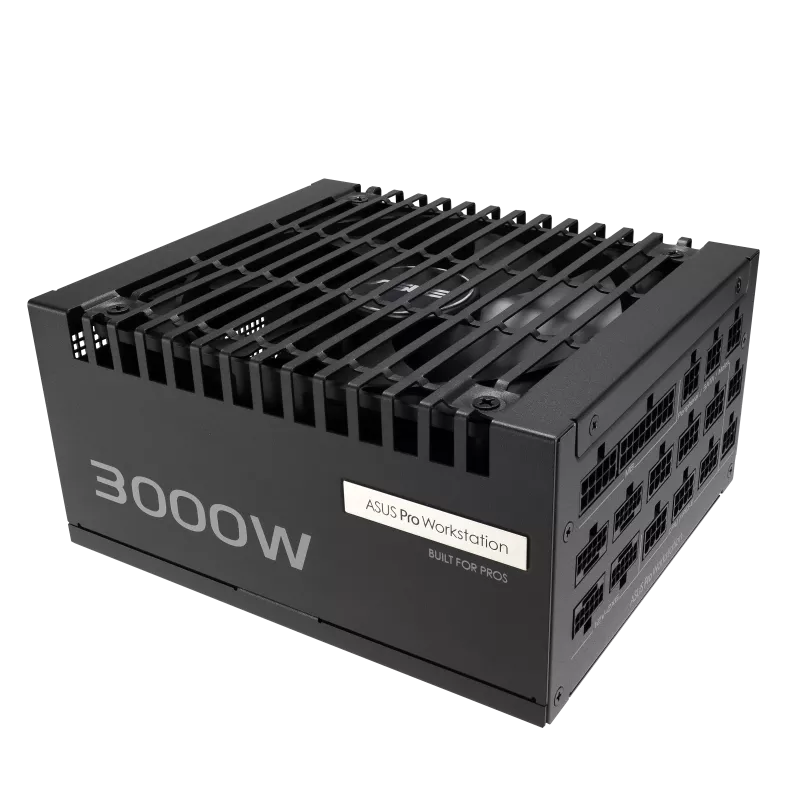
ASUS Pro WS Platinum Power Supplies Reach 3000W: Built for Multi-GPU, Designed for Real-World Power Constraints
ASUS is pushing workstation and AI rigs into new territory with its Pro WS Platinum power supply family. The series lands in three capacities – 1600W, 2200W, and a headline-grabbing 3000W – and is built to the latest ATX 3.1 and PCIe 5.1 specifications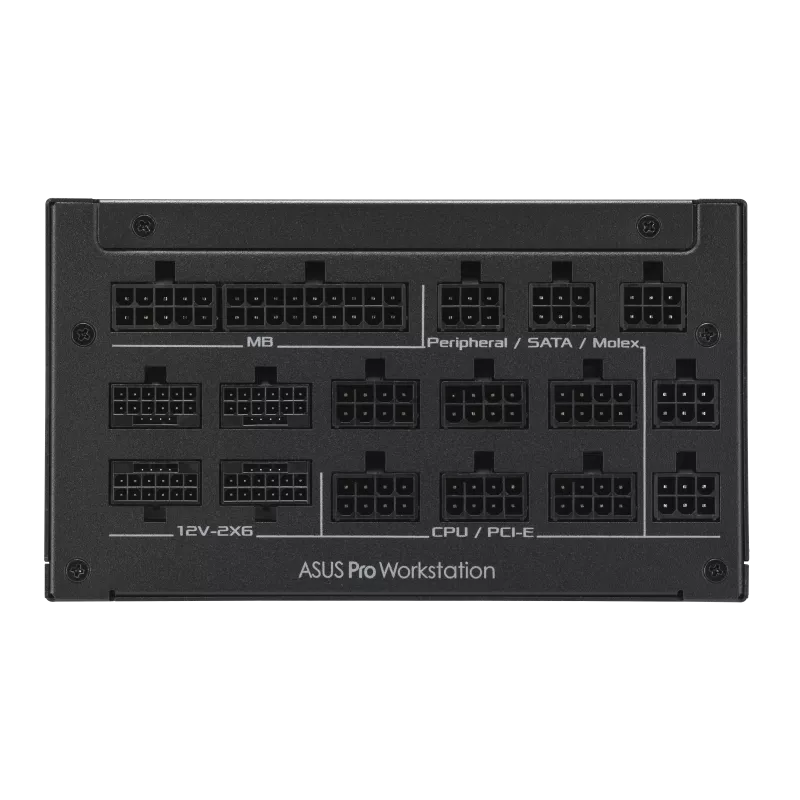
. In plain terms, these PSUs are engineered to feed the hungriest modern accelerators, including GeForce RTX 5090, RTX 5080, and NVIDIA’s RTX PRO 6000 Blackwell cards, while keeping cabling, thermals, and safety in check.
What’s actually new here?
Beyond raw wattage, ASUS focuses on connection quality and long-term reliability. The Pro WS Platinum units ship with fully-modular cabling that uses etched, high-quality wires and gold-plated copper pins. The goal of the plating isn’t mystical performance; it’s practical protection against oxidation at the contact surfaces, which helps maintain lower resistance over years of heavy load–hot/cold cycles. 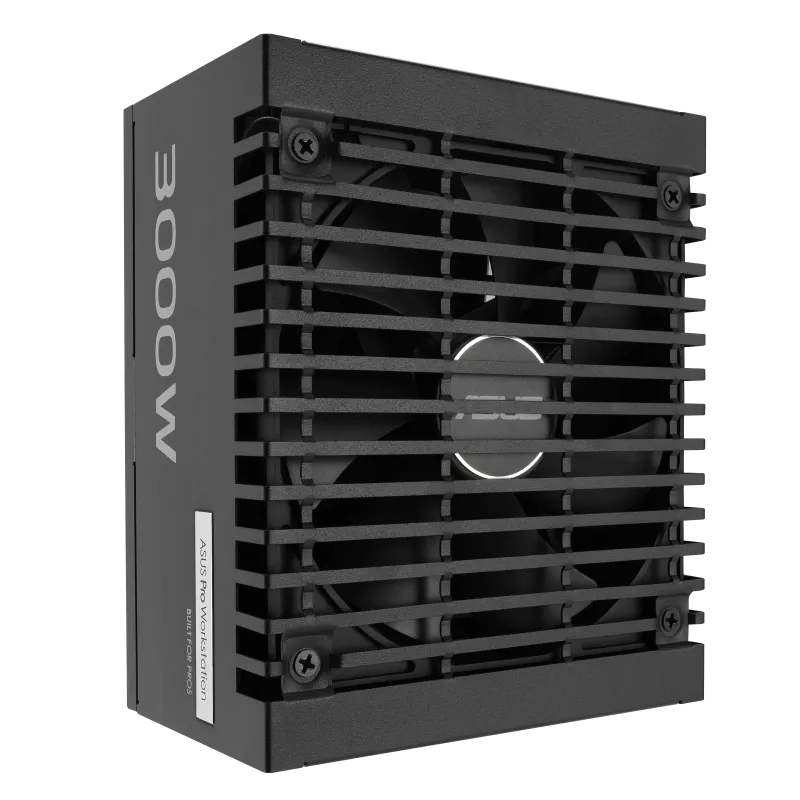
ASUS color-codes the EPS and 12V-2×6 connectors to reduce user error during complex multi-GPU builds. That 12V-2×6 plug – part of PCIe 5.1 – evolves the earlier 12VHPWR design, and ASUS claims up to a 10°C lower connector temperature thanks to its pin material and contact geometry.
Cooling and efficiency for 24/7 loads
Inside, the PSUs employ extruded aluminum heatsinks and a high-ventilation chassis to wick heat from power stages under sustained AI or rendering workloads. All models carry an 80 Plus Platinum rating: expect ~94% efficiency at typical loads and still >90% when you peg the dial. Efficiency matters twice – first at the wall (lower electricity waste), and second inside the case (less heat your fans must remove). ASUS backs the line with a 10-year warranty, which is notable at these output levels.
Designed for serious multi-GPU
The 3000W flagship is specced to supply up to four GeForce RTX 5090 or RTX PRO 6000 GPUs in a compute-first chassis, while the 2200W model targets up to four RTX 5080 cards for mixed training/inference or heavy visualization. The 1600W option aims at single- or dual-GPU creators who still want ATX 3.1 cabling, extra PCIe headroom, and Platinum efficiency without overspending.
The wall-power reality check
Three kilowatts of DC output sounds heroic – and it is – but you still have to source that power safely from your building. A typical EU outlet is 230V and rated for 10–16A, which translates to roughly 2300–3680W theoretical max before derating. In the US, most rooms offer 120V/15A circuits (about 1800W continuous) or 120V/20A (about 2400W continuous). Sustained loads should be kept near 80% of breaker rating to avoid heat-related issues at the outlet, in the wall, and at terminations. For 3kW continuous, you’re realistically looking at a dedicated 240V circuit or a 30A 120V line with appropriately sized wire gauge and receptacles, installed to local code. In other words: a 3000W PSU is only as practical as the branch circuit you plug it into.
Connector reliability and the melting elephant in the room
Recent generations made headlines for overheated GPU power connectors. ASUS’s approach – better contact materials, clear labeling, and strict spec compliance – addresses the leading causes: poor seating, marginal contact pressure, and contaminants. Gold-plated pins don’t create free performance; they preserve it by resisting corrosion that increases resistance and heat. Proper cable routing, zero bending stress at the plug, and full insertion remain critical best practices.
Price and availability
ASUS lists regional MSRP at €479 for the 1600W, €619 for the 2200W, and €899 for the 3000W model (approx. US$552 / US$713 / US$1036). The series is available now in select EU markets including Germany, Austria, and Switzerland, with broader rollout pending.
Who should buy this?
If your workflows lean on multi-GPU acceleration – LLM inference, diffusion pipelines, CUDA-heavy research, complex path-traced visualization – the Pro WS Platinum line consolidates power delivery and cabling around modern standards. For creators or gamers with one or two high-end cards, the 1600W model offers long-term headroom and tidy cabling without the hassle of splitters. Just remember that a 3000W badge doesn’t override physics: size your circuit first, then your PSU. Only then can you say, with a wink to pop culture, “I love you 3000 watts.”
- Capacities: 1600W / 2200W / 3000W
- Standards: ATX 3.1, PCIe 5.1, 12V-2×6
- Efficiency: 80 Plus Platinum (≈94% typical, >90% at full)
- Cooling: extruded aluminum heatsinks, ventilated chassis
- Cabling: fully modular, etched wires, gold-plated pins, color-coded EPS & 12V-2×6
- Warranty: 10 years
- Availability & MSRP: EU first (DE/AT/CH), €479/€619/€899
1 comment
gpu power draw in 2025 makes old Bulldozer chips look like eco champs ngl