AMD Lines Up Multiple OpenAI-Scale Customers as Instinct MI450 Nears: What It Really Means
AMD isn’t talking about a single blockbuster partnership anymore. On its latest earnings call, CEO Lisa Su framed the company’s AI trajectory around a broader roster: several customers aiming for deployments on the scale of OpenAI. The subtext is clear – rather than leaning on one giant buyer, AMD wants a diversified pipeline of hyperscalers, cloud platforms, and AI-native firms that can each soak up racks of Instinct accelerators. That shift matters for revenue durability, negotiating leverage, and – crucially – confidence that AMD’s platform is ready for prime time.
So what does “OpenAI-scale” actually look like? In practical terms, it points to multiyear, multi-region capacity plans with dedicated data center footprints, end-to-end racks, and tight co-design between the chip vendor and the customer’s model, networking, and software stack. These aren’t one-off card shipments; they’re phased rollouts with firm performance, efficiency, and availability milestones tied to training schedules and inference SLAs. By signaling several such customers, AMD is telling the market it’s building repeatable templates – not bespoke, unscalable deals.
The Instinct Roadmap: MI355 Ramping, MI450 in H2
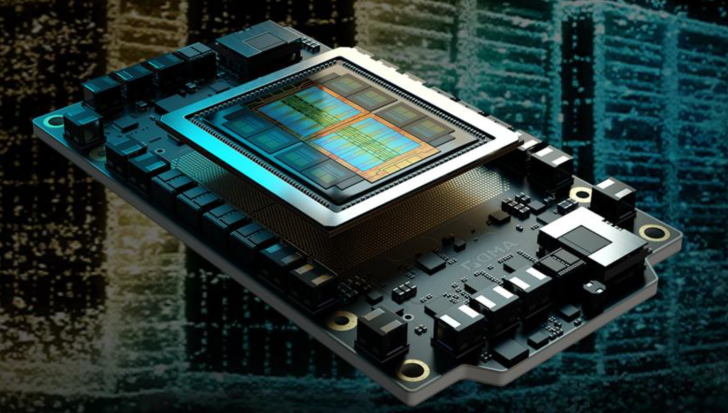
AMD’s Instinct plan underpins that message. The company says production for the Instinct MI355 family is ramping, with momentum expected to carry forward into 2026. Next up, the Instinct MI450 series is slated to land in the second half of next year. AMD is positioning MI450 as a step-function improvement in performance per watt, memory capacity, and rack-scale density – areas that directly influence total cost of ownership for training clusters and high-throughput inference farms. The goal is straightforward: erase excuses for non-adoption by narrowing (or eliminating) the perceived gap with NVIDIA in both silicon and system-level design.
Power efficiency and thermals are front and center. If MI450 can deliver higher sustained throughput within the same power envelope, operators can add meaningful model capacity without blowing past data hall limits. AMD is also emphasizing fully engineered racks – accelerators, CPUs, networking, cooling, and management as a cohesive package – so buyers can stand up capacity faster and with fewer integration surprises.
Software Gravity: CUDA vs. ROCm, and the Portability Question
No discussion of AI accelerators escapes the software question. CUDA’s decade of ecosystem gravity is real; PyTorch, TensorFlow, and a constellation of libraries have been tuned around it. AMD’s counter is ROCm and an aggressive focus on upstream frameworks, compilers, and kernels. The pitch to customers is pragmatic: where it matters most – foundation model training stability and inference efficiency – porting friction is being managed with vendor tooling, engineering resources, and growing community experience. For buyers planning multi-vendor fleets, that promise of portability is a strategic hedge against supply shocks and pricing power concentrated in one vendor.
Customer Concentration and Why “Several” Matters
Su’s remark about planning for multiple OpenAI-scale customers is also a risk statement. Concentration with a single hyperscaler can inflate results and then whipsaw them if priorities shift. A broader base smooths demand and strengthens AMD’s hand in allocating scarce advanced packaging capacity. If the Instinct pipeline spreads across a handful of titans – each with staggered ramps and refresh cycles – AMD’s growth becomes more predictable and less brittle.
What to Watch Next
- Real-world throughput: Model-measured training tokens/sec and latency/throughput for inference on production stacks.
- Perf/W and density: Whether MI450’s rack-level efficiency lets buyers add capacity without new power feeds.
- ROCm maturity: Smooth landing for mainstream PyTorch/TensorFlow workflows and third-party libraries.
- Supply and delivery: Consistent ship schedules, not just paper launches, as multiple customers ramp in parallel.
If AMD executes, the data center AI market may normalize from a single-vendor sprint into a multi-vendor marathon. And if several OpenAI-scale buyers are indeed lining up, the conversation moves from if AMD can compete to how fast operators can integrate an additional top-tier option into their fleets. That’s good news for buyers chasing capacity, and it’s a wake-up call for anyone assuming CUDA lock-in would permanently dictate the shape of every AI buildout.
Bottom line: AMD is doubling down on AI – architecturally, at the rack level, and in its customer mix. MI355’s ramp and MI450’s H2 window frame the next 12–18 months. If the hardware arrives with the promised efficiency and the software keeps smoothing out, “OpenAI-scale” won’t be a marketing flourish – it will be the new normal for how AMD sells Instinct into the heart of AI infrastructure.
1 comment
Feels a bit bubbly ngl. Everyone shouting AI AI AI… show me stable perf and power numbers, then I’ll clap