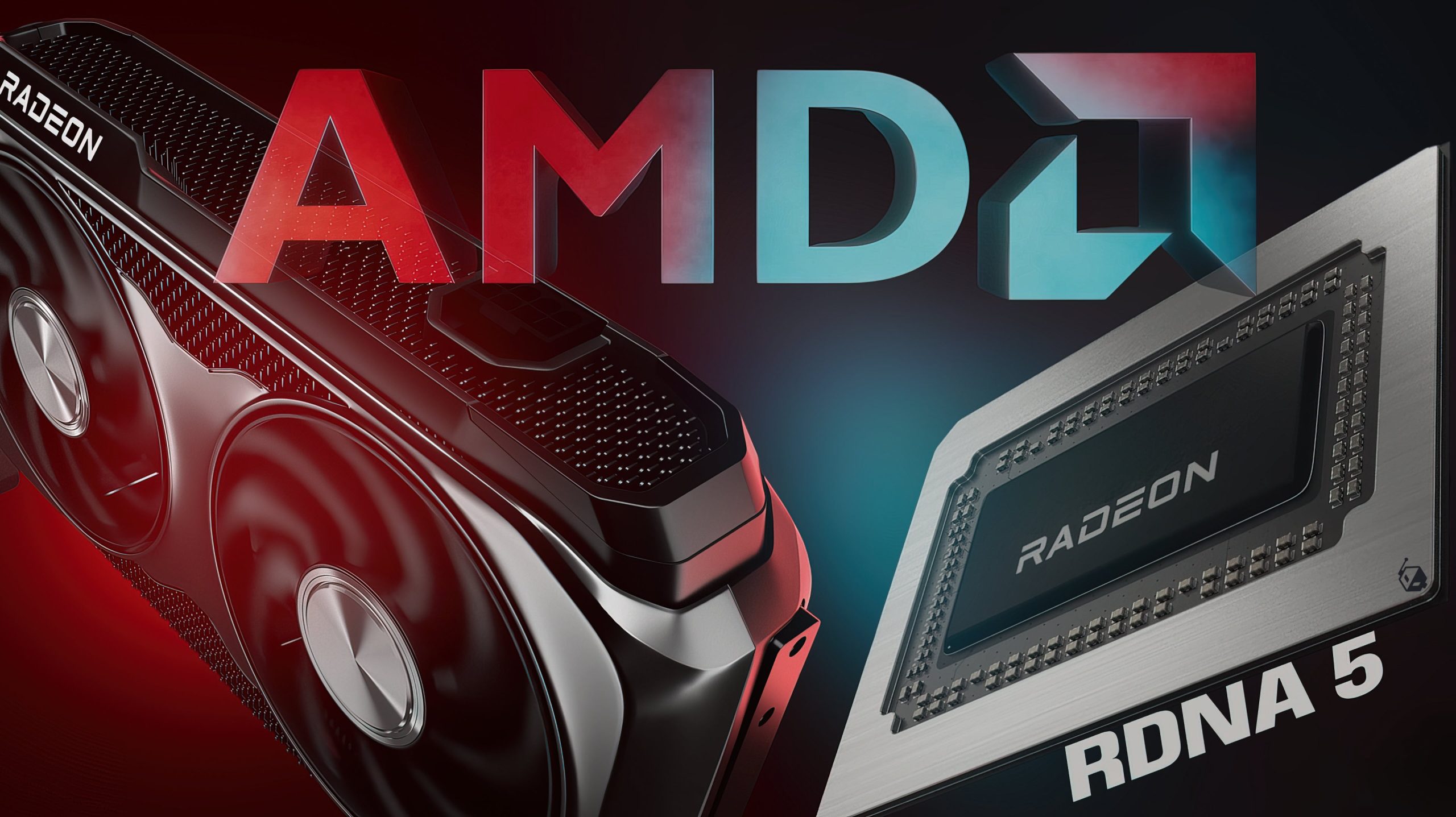
AMD RDNA 5 Explained: Strategy Shift, Rumored Specs, Performance Targets, and What Actually Matters
If RDNA 3 was AMD’s prove-you-can-do-it node, and RDNA 4 was the ‘don’t-chase-the-flagship’ correction, then RDNA 5 looks like the big swing: a unification of desktop GPUs and semi-custom silicon ideas under one umbrella that AMD insiders have teased as a more unified platform. You’ll see it referred to as RDNA 5 or UDNA in rumorland. Whatever branding ships, the story appears consistent: instead of building a one-off “90-class killer” just to headline a slide deck, AMD is aiming to scale the architecture broadly, hit the enthusiast and upper-mainstream sweet spots hard, and use smarter blocks for ray tracing, AI-adjacent workloads, and memory efficiency.
Quick take: what RDNA 5 is (likely) about
- Unified platform focus: fewer bespoke directions, more reusable IP across desktop GPUs and console/SoC programs.
- Node and layout: leaks point to a GFX13 family on advanced 3 nm class (often cited as N3E), with a strong chance AMD doubles down on chiplets for at least part of the stack.
- New fixed-function blocks: the much-rumored Radiance Cores (ray traversal), Neural Arrays (AI/neural rendering), and Universal Compression (bandwidth relief).
- Pragmatic positioning: win the 70/80-class battles that most people actually buy, not just the halo tier.
Why the RDNA 4 pivot set this up
With the Radeon RX 9000 family, AMD didn’t try to out-NVIDIA the most expensive NVIDIA. Instead, cards like the RX 9070 and RX 9070 XT chased the broad enthusiast base: plentiful supply, sensible pricing, and performance that embarrassed rival 60-/70-class parts on a frames-per-dollar basis. That strategy traded oxygen from a single 90-class headline for momentum across the lineup. The end result? A lot of gamers actually got modern cards without waiting months or emptying savings. RDNA 5 looks set to build on that logic – press harder into the tier where buyers actually are, while reserving room for one genuinely fast SKU that doesn’t distort the whole business.
RDNA 5 or UDNA? The naming and the thinking
Internally, several codenames have surfaced in the rumor mill – Alpha Trion, Ultra Magnus, Orion Pax – with chatter aligning them loosely to desktop GPUs (consumer), Xbox-class SoCs, and PlayStation-class SoCs respectively. Don’t over-read the Transformers flair; the meaningful part is the platform idea: common blocks like Radiance Cores and Neural Arrays showing up in different power envelopes and memory subsystems. That’s how you deliver features like neural rendering, fast path tracing, and tighter bandwidth usage across desktops and living rooms at once.
Architectural blocks that matter
Radiance Cores (ray/path tracing)
AMD’s current RT hardware can deliver great results when games lean on smart upscalers, but brute-force ray budgets have been NVIDIA’s playground. Radiance Cores are described as new dedicated traversal hardware – think faster BVH traversal, smarter scheduling, and better coherence. Translation: higher rays per second and less penalty for turning on RT settings.
Neural Arrays (AI & neural rendering)
Instead of a one-size-fits-all “NPU” badge, the leaks talk about a collection of compute units orchestrated like a single AI engine. The goal is straightforward: accelerate neural rendering, denoisers, super-resolution, frame generation, latency-hiding tricks, and maybe even mixed-precision primitives useful in content tools. Expect AMD’s next-gen upscaler to pair these blocks with classic shaders for a bigger uplift than raw TFLOPs alone suggest.
Universal Compression (bandwidth relief)
VRAM conversations get heated, but bandwidth is the hidden half of the story. Universal Compression is the rumored umbrella for smarter on-the-fly compression across textures, geometry, and intermediate buffers. If it works as pitched, a 256-bit bus with GDDR7 could behave like something wider under many workloads, reducing memory stalls and smoothing frame times.
The silicon: core counts, chiplets, and what “bigger numbers” actually mean
Two persistent rumors define the RDNA 5 discussion: a move (or expansion) into chiplet designs beyond just memory/cache disaggregation, and a doubling of cores per compute unit (from 64 to 128). The latter has lit up social feeds with “instant 2×!” takes. Careful there. History shows that counting cores tells you very little without considering frequency, scheduling, power budgets, cache/latency, instruction mix, compiler maturity, and how well games feed the pipeline. NVIDIA’s own shifts in SM makeup should be a reminder: raising the count changes the granularity of work but doesn’t guarantee proportional scaling.
If AMD does go 128-cores/CU, the real test will be: can those cores stay busy under ray-heavy and AI-heavy loads? That’s where Radiance/Neural/Compression blocks come in – offloading or accelerating the right work so shader arrays aren’t just idling. If AMD nails utilization, doubling cores per CU could be transformative. If not, it’s “big number, small uplift.”
Product stack expectations (rumored)
Leaks consistently reference three Navi 5X slices (flagship, mid, entry), with model counts that look like this – subject to change:
| Tier (rumored) | Max CUs (cores) | Memory Bus | VRAM Target | Notes |
|---|---|---|---|---|
| Flagship | Up to 96 CUs (12,288 cores @128/core) | 384–512-bit | 24–32 GB GDDR7 | Aim at NVIDIA 80-class; much bigger RT/AI blocks |
| Upper-Mid | 40 CUs (5,120 cores) | 256-bit | 12–24 GB GDDR7 | Successor to the RX 9070 XT class; likely volume leader |
| Mainstream | 24 CUs (3,072 cores) | 192–256-bit | 8–16 GB GDDR7 | Target 1080p/1440p with RT on-ramps |
| Entry | 12 CUs (1,536 cores) | 128-bit | 8–16 GB | Focus on efficiency, esports, media engines |
Note how the mid-stack looks far more interesting this time. With GDDR7 and compression gains, a 256-bit bus at sane clocks could be surprisingly potent, especially when paired with frame generation and neural denoisers. The enthusiast buyer who skipped a 90-class price cliff in the last cycle might finally get the “set it and forget it” 1440p/4K experience without GPU sticker shock.
Performance targets: what to expect (and not)
- Raster uplift: more cores per CU + higher clocks on a modern node should bring healthy raster gains, but the key is effective throughput once cache, front-end, and schedulers are factored in.
- RT uplift: Radiance Cores are the headline here. If AMD closes a big chunk of RT gap at equal price, that’s a win even if absolute leadership remains contested.
- AI/neural features: expect sharper, cleaner temporal upscaling and better frame generation at lower latency. The floor for “RT On” could finally rise for the mid stack.
- Memory behavior: GDDR7 plus Universal Compression should lift minimums and stabilize frametime spikes in texture-heavy scenes.
Price and positioning: painful truths and hopeful signs
High-end wafers are expensive in the AI era. Every GPU die fights data center demand for capacity and packaging. That’s why rumors place the absolute top RDNA 5 SKU well north of the old $999 line – somewhere in the $1,000–$1,500 ballpark. But don’t let the halo dictate the narrative. The stack is where RDNA 5 can win hearts: if a 70/80-class competitor lands with 16–24 GB, great acoustics, and RT-capable performance under the four-figure mark, that’s an immediate pressure point on the market.
Yes, there’s a chorus that “no one wants to pay above $699 for AMD.” The better way to phrase that: buyers pay for confidence. If RDNA 5 delivers strong drivers on day one, competitive RT, and reliable framegen without artifacts, price resistance softens quickly. Conversely, if NVIDIA’s next cycle leans too hard into AI-tax pricing, RDNA 5’s value story gets even louder.
Release window: when to expect signals
Official timing is a black box until it isn’t. Tea-leaf reading points to late next year for first looks, with fuller reveals aligned to big stages like CES or Computex the year after. Realistically, you’ll see a familiar drumbeat: dev tool chains get hints, driver branches sprout new strings, semi-custom partners whisper about SoC milestones, then desktop cards pull the sheet off.
Reality check: what we truly know vs. the wish list
Solid (as in: widely and consistently rumored)
- Three-tier Navi 5X family aligned to a GFX13 generation.
- New blocks for ray tracing, neural/AI, and compression.
- Push toward a more unified platform spanning desktop and consoles.
Likely but unconfirmed
- 128 cores per CU and broader chiplet strategy in higher SKUs.
- GDDR7 across mid and high tiers; 24 GB+ on flagship.
- Flagship designed to contest NVIDIA’s 80-class rather than chase an ultra-rare 90-class crown.
Speculative
- Exact model names, pricing, and final CU counts.
- Launch quarter and exact event timing.
- Console mappings to the codenames and how features differ by power envelope.
Who should wait – and who shouldn’t
Wait if you game at 1440p/4K and care about turning on RT without babysitting settings. The mid-upper RDNA 5 cards are built for you. Don’t wait if you’re on a strict budget and can snag an RDNA 4 deal today; those cards already deliver excellent value for 1080p/1440p raster and will age better if their VRAM configs stay ahead of game demands.
Drivers, ecosystems, and the boring but crucial parts
AMD’s driver cadence has improved, and RDNA 4 launches were far less bumpy than previous cycles. RDNA 5 has to sustain that discipline, especially around neural features and RT stability across engines (Unreal, in-house, bespoke RT pipelines). Content tools – streaming, AV1/HEVC encoders, and creator workflows – are another place value is sealed: a quiet card that crushes encodes and keeps game capture clean becomes the default recommendation for thousands of streamers.
What to watch for next
- Feature branding: the names AMD uses for upscaling, framegen, and RT this time; watch the fine print on compatibility and latency.
- Board power: 80-class performance means nothing if it demands space heater power. Efficiency wins word-of-mouth.
- Memory choices: 20–24 GB creeping into the upper-mid would be a market reset. If it happens, it happens here.
- Console echoes: when next-gen consoles talk neural rendering and advanced RT, expect desktop parallels.
Bottom line
RDNA 5 isn’t about a meme crown; it’s about shipping a modern, scalable toolkit for ray-traced, upscaled, latency-smoothed gaming to the tiers people actually buy – without making the flagship so exotic it distorts the stack. If AMD lands Radiance/Neural/Compression as advertised, the conversation flips from “how many cores?” to “how good do next-gen games feel at the price I can actually pay?” That’s the battle worth winning.
3 comments
If Nvidia goes full AI-tax again, mid RDNA5 with 16–24GB is gonna be the people’s champ. Bookmark me
Wake me when drivers + framegen are butter day one. I refuse another patch-weekend relationship 😅
Meme stocks, meme cards… if memes were money I’d be mining giggles rn 🤡