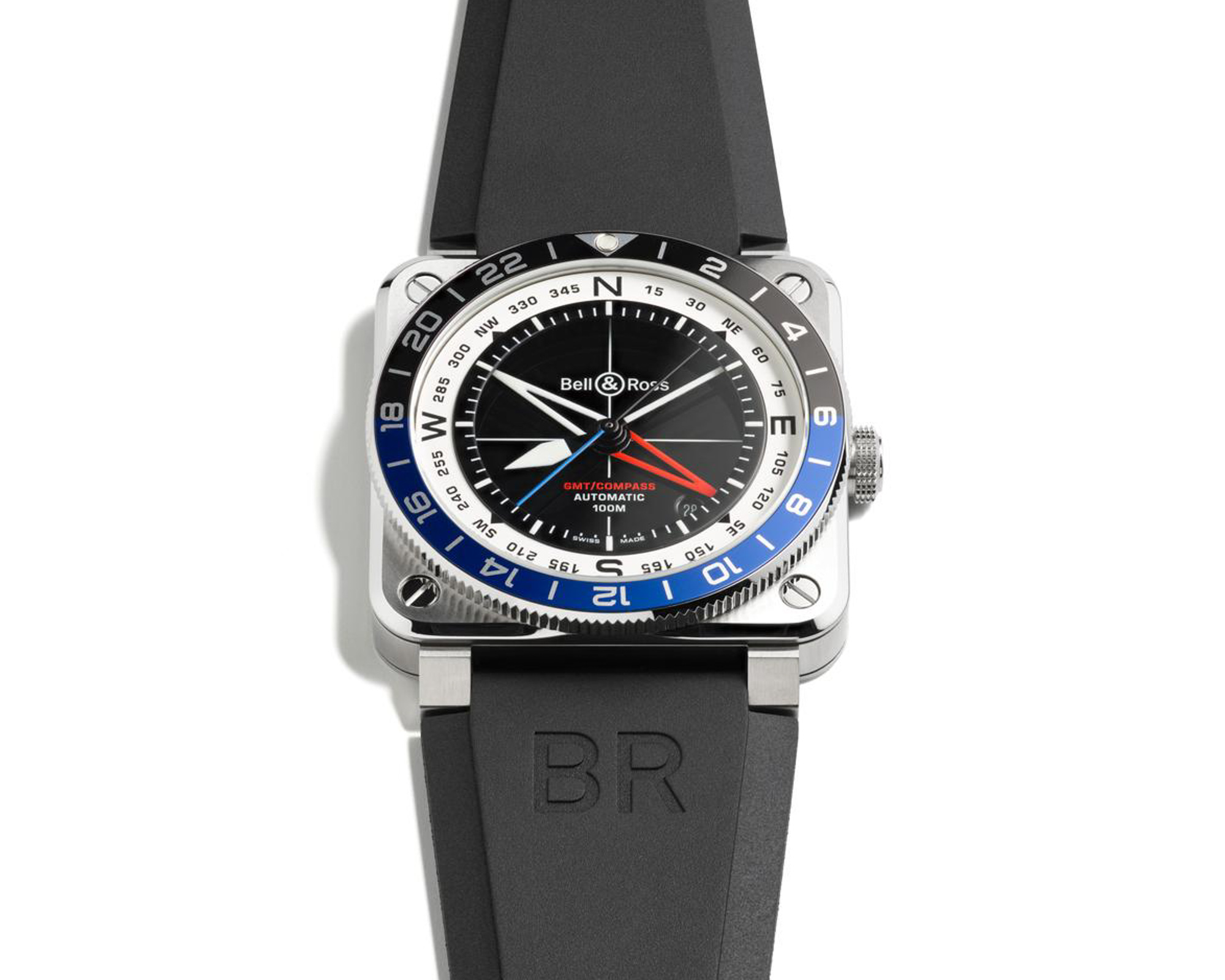
Bell & Ross BR-03 GMT Compass: a cockpit compass reimagined as a travel watch
Bell & Ross has long treated the airplane cockpit as both archive and muse, and the latest entry in its ongoing “Flight Instrument” story leans directly into that romance. The new BR-03 GMT Compass is a 500-piece limited edition for 2025 that translates the language of a traditional magnetic compass into a square-cased GMT wristwatch. It doesn’t try to be a literal navigational tool so much as a designed memory of one – an object that looks like it was lifted from the instrument panel and finished for everyday life.
This release follows earlier instrument riffs like the BR-03 Horizon, the BR 03-93 HUD, and the BR-03 Gyrocompass from 2023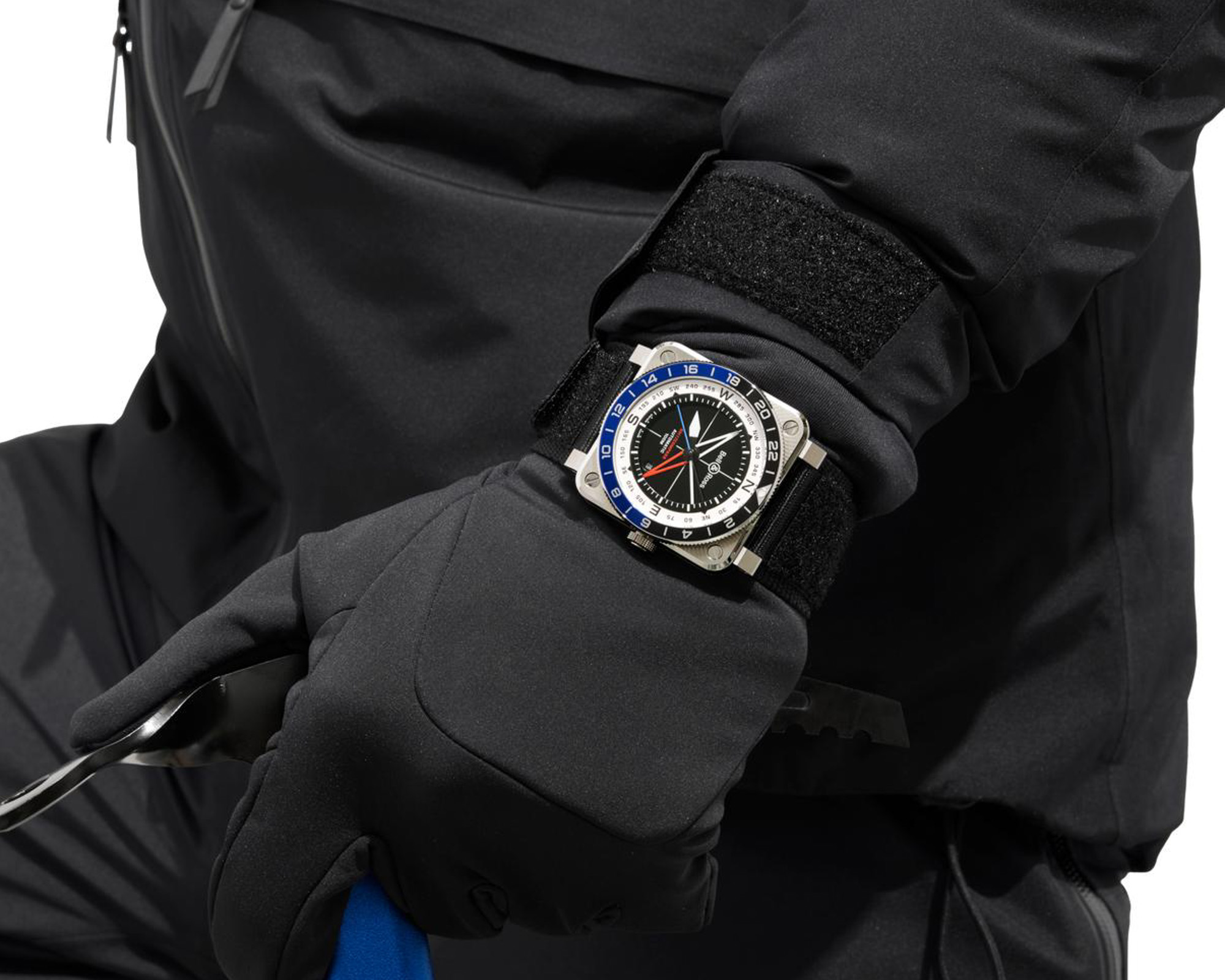
. Compared with those, the GMT Compass tempers the “pure instrument” vibe with more familiar watchmaking cues – chiefly a brushed-and-polished case and a travel-friendly bezel – so it sits closer to the brand’s standard BR-03 models in day-to-day wear while still feeling unapologetically cockpit-born.
Case and wearability
The BR-03 GMT Compass (ref. 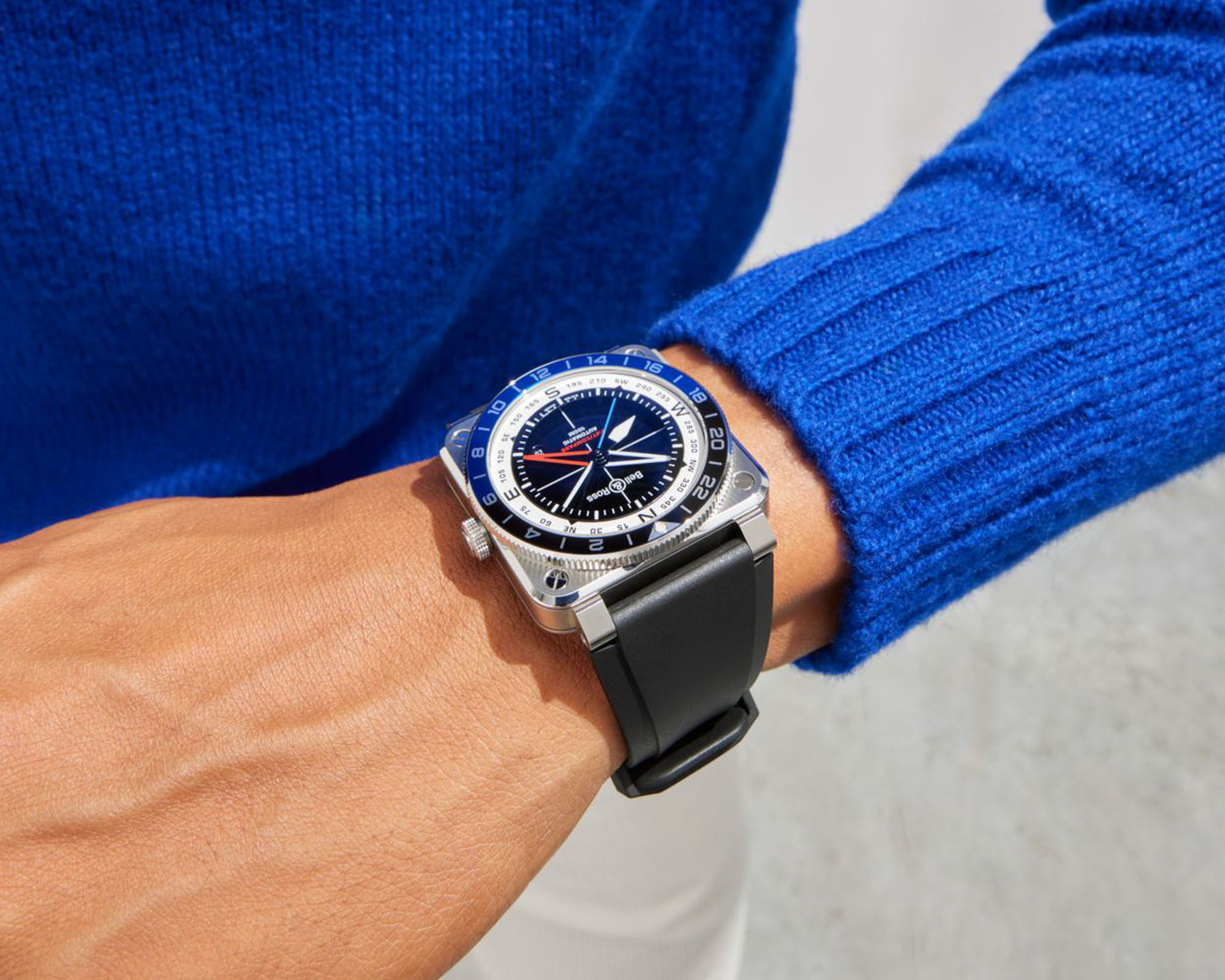
BR0393-COM-ST/SRB) uses the brand’s signature square architecture in stainless steel, rendered here at 42 mm across and 12.3 mm thick. That footprint is slightly larger than current BR-03 time-and-date pieces, but the shaping, alternating brushing and polishing, and compact, four-screw aesthetic keep it recognizably Bell & Ross. Water resistance is rated to 100 meters, and a flat sapphire crystal caps the display.
B&R ships the watch with two straps and a screw-bar attachment system rather than spring bars. One is the brand’s black rubber with a signed tang buckle; the other is a black fabric strap with a hook-and-loop (Velcro-style) closure that doubles down on the tool-watch mood and offers quick micro-adjustment on the fly. Between the two, the watch can skew more polished weekday or more field-ready weekend without touching a bracelet screwdriver.
A familiar travel bezel, dressed for the cockpit
Encircling the crystal is a bidirectional rotating bezel with a 24-hour scale. The insert is split black/blue anodized aluminum – an immediately readable day/night code that has become visual shorthand for modern GMTs. It’s not shy about the association either: that two-tone palette inevitably nods to well-known “Batman” colorways while remaining entirely on-brand for a flight instrument aesthetic.
Dial language: crosshairs and cardinal points
Where the watch makes its thesis plain is on the dial
. A matte black field is bisected by a fine crosshair motif, echoing the display of a magnetic compass. The handset amplifies the theme: hour and minute hands are clean and legible, while the 24-hour hand is an elongated, double-sided rhombus with one half in bright red. 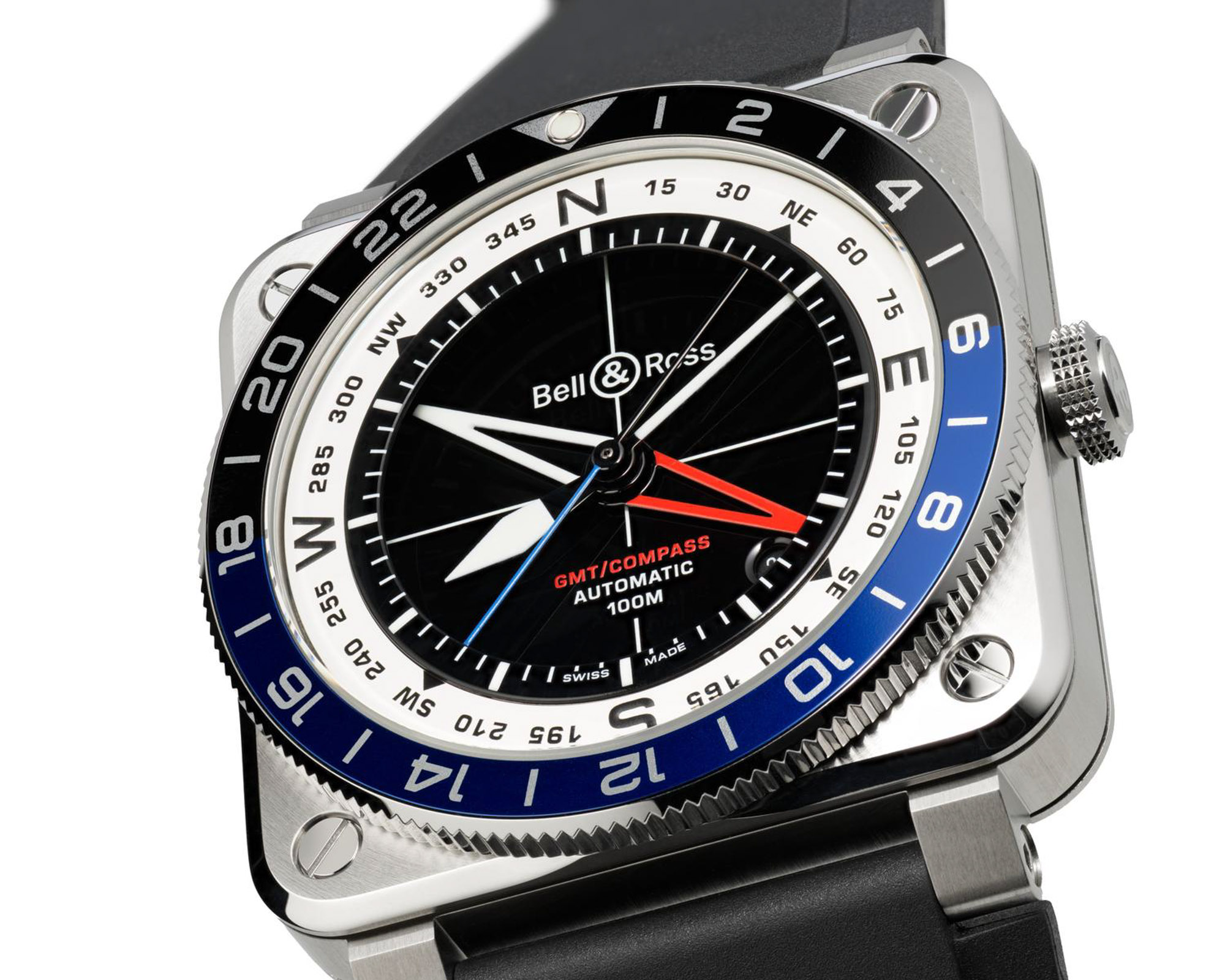
A blue seconds hand ties the dial to the bezel’s night sector, and a small circular date window at 4:30 keeps the calendar out of the main sightlines.
Framing the dial is a bold, black-and-white flange printed with a full 360-degree compass scale. The visual trick is effective: at a glance it feels like someone mounted a compass card inside a BR-03 case. Importantly, the flange appears to be fixed (not a rotating inner ring). That design choice matters for how much actual navigation utility you can squeeze out of the display – and we’ll come back to that.
Movement and GMT behavior
Inside is the BR-CAL.303 automatic movement, Bell & Ross’s take on the widely used Sellita SW330 platform. It’s a “caller”-style GMT: the 24-hour hand and date can be adjusted independently at the crown, whereas the local 12-hour hand does not “jump” in one-hour steps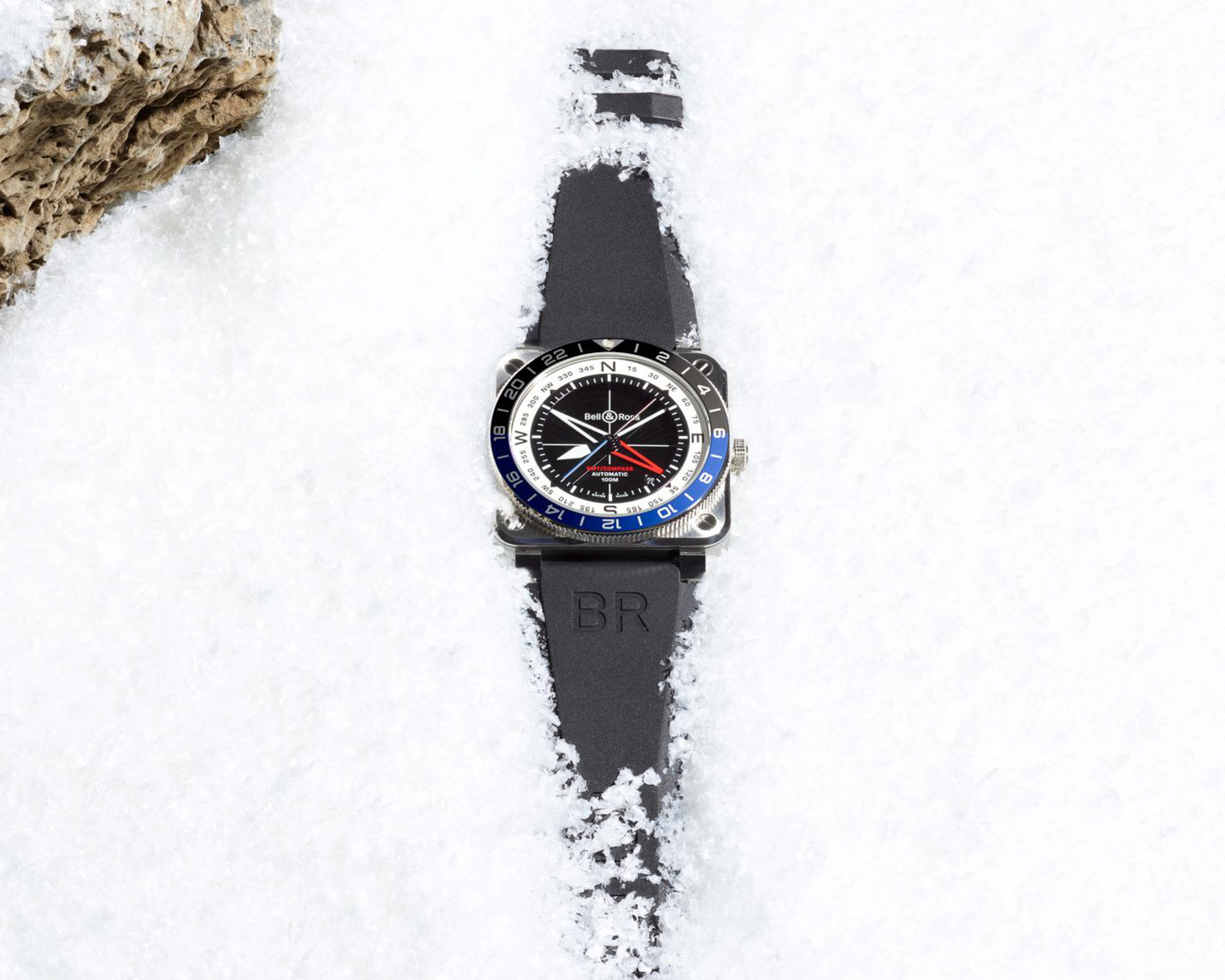
. For frequent time-zone hoppers, a “flier” GMT (jumping local hour) is more convenient at the airport; for callers – people who mostly stay put but track another zone – the BR-CAL.303’s behavior is perfectly logical. The movement runs at 28,800 vph (4 Hz) and stores roughly 56 hours of power reserve, aligning with the spec sheet you’d expect from this Swiss workhorse.
Can it work as a solar compass?
Bell & Ross notes that the BR-03 GMT Compass can be used as a solar compass. If you’ve never tried this trick, here is the practical how-to for a GMT watch with a 24-hour hand. First, set the time correctly for your location: both the 12-hour hands and the 24-hour hand must reflect your local time. Then use the Sun as a reference and keep the watch level. 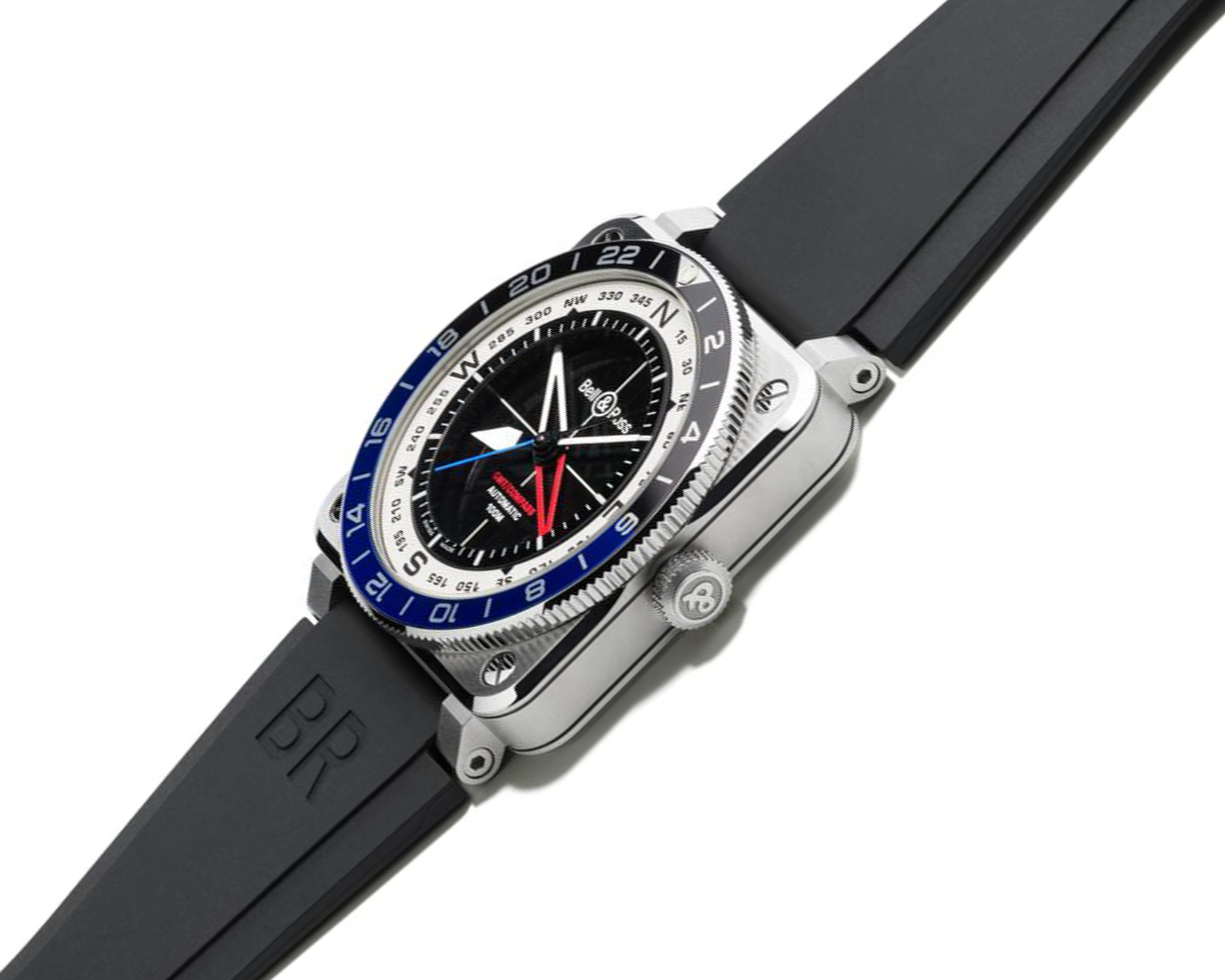
In the Northern Hemisphere, rotate the watch until the 12-hour hand points at the Sun; the 24-hour hand will then indicate true north. In the Southern Hemisphere, point the 12 o’clock marker at the Sun; the 24-hour hand will indicate true south.
That’s the classical method. So where does the BR-03’s internal compass flange come in? Since it appears fixed, you can’t align the degree markings to the hands the way you would with a rotating inner bezel. Practically, that means the scale is a reference index rather than a dynamic calculator. One workaround some travelers use on caller-GMTs is to momentarily move the 24-hour hand (instead of a compass ring) to align with intended bearings, then set it back to reference time; that sacrifices GMT tracking during the maneuver but achieves a similar visual effect. In other words, the printed 360-degree ring completes the cockpit illusion and offers a tidy way to read general headings once you’ve oriented the watch, but it won’t replace a proper orientable compass bezel for field navigation.
Design vs. function: where the BR-03 GMT Compass lands
Bell & Ross’s Flight Instrument watches have always been unapologetically thematic. The GMT Compass follows that path, but with an unusually balanced mix of fun and function. The 100-meter rating, sapphire crystal, and robust steel case put it squarely in daily-wear territory; the bezel gives you a legitimate two-time-zone readout; and the dial’s compass language delivers the theater. If you’re attracted to the idea of wearing a cockpit module on your wrist – but you still want to wear it to the office – this is arguably one of the series’ most integrated executions.
That said, there’s an honest conversation to be had about “wearability.” A wristwatch must first and foremost tell the time and sit comfortably; those are table stakes, not headline features. When any release is praised primarily as “one of the most wearable” in a lineup, it can sound like grading on a curve. Here, the compliment is meant relatively: among Bell & Ross’s more radical instrument pieces, the GMT Compass is the one that asks the fewest compromises to live with every day. The finishing softens the toolish edges, the bezel gives clear GMT utility, and the strap options make it adaptable. But yes – wearability alone is not a unique selling proposition at a premium price point; the emotional hook is the instrument aesthetic, and the limited-edition angle.
Details that matter on the wrist
A few practical touches stand out. The red-accented diamond GMT hand has strong legibility at a glance, especially against the crosshair dial. The 24-hour bezel print is crisp and evenly spaced, making third-time-zone tracking via the bezel straightforward. The 4:30 date window is small and intentionally recessive, which purists will appreciate. And the screw-bar strap system, while slightly slower to swap than spring bars, is stout and in keeping with the purposeful build.
What it isn’t
This is not a do-everything field instrument. The fixed internal compass scale looks fantastic but isn’t a substitute for a rotatable compass ring if you want fluid bearing calculations. The GMT system is the “caller” type, which some frequent flyers will find less convenient than a jumping local hour. And as a limited edition of 500, it’s not designed to be a widely available, baseline travel watch in the catalogue.
Pricing, positioning, and rivals
The BR-03 GMT Compass is priced at $5,000 USD, about a ten percent premium over standard BR-03 GMT references. That uplift buys you the limited-series treatment, the specialized dial and flange, the themed handset, and the split-color bezel tuned to the concept. Whether that premium feels warranted will depend on how much the cockpit-instrument narrative speaks to you. Enthusiasts inevitably will compare it with other SW330-based GMTs available for less – there are credible options at roughly a third of the price that deliver similar mechanical capability in less theatrical packaging. Those alternatives won’t look like a compass bolted into a square case, and that’s the real point: with Bell & Ross you’re paying for the design brief as much as the spec sheet.
How to actually live with it
Set local time on the main hands, set the 24-hour hand to home or office, and let the bezel do the quick mental math for a third time zone as needed. If you want to play at navigation, orient the 12-hour hand to the Sun and use the 24-hour hand for a north/south read; the degree scale can help you eyeball rough bearings once you’ve oriented the watch level. Use the rubber strap for sweat, water, and travel days; switch to the fabric strap when you want maximum comfort and the full “flight jacket” look. This is a watch that rewards being used – airport lounges, city breaks, and yes, your desk at 3 p.m. when you’re daydreaming about approach lights over Charles de Gaulle.
The verdict
The Bell & Ross BR-03 GMT Compass succeeds where many themed watches stumble: it sells the story without abandoning utility. The case finishing and 100-meter build make it easy to wear; the GMT architecture and two-tone bezel make it competent at its core task; and the dial treatment turns heads without turning the watch into costume jewelry. The main caveat is baked into the concept: the internal compass scale is more theatrical than tactical, and the “caller” GMT won’t be every traveler’s ideal. If you love the Flight Instrument series but want something that behaves like a proper daily travel watch, this might be the sweet spot. If you simply want maximum GMT capability per dollar, you’ll find more pragmatic choices elsewhere.
Limited to 500 pieces and offered at $5,000 USD, the BR-03 GMT Compass is more than a square case with four screws; it’s a lesson in how to translate an analog cockpit reference into a credible modern tool. It won’t replace a true orienteering compass or a flier-GMT in a seasoned road warrior’s kit, but as a characterful, well-built companion that nods to aviation history while tracking another time zone, it lands right on heading.
2 comments
Batman bezel works here. I usually hate theme watches but this one looks… usable. Rubber strap for the win
Random but: Pontiac deserved better. RIP. Also, yes, this B&R definitely has four wheels… metaphorically 😂