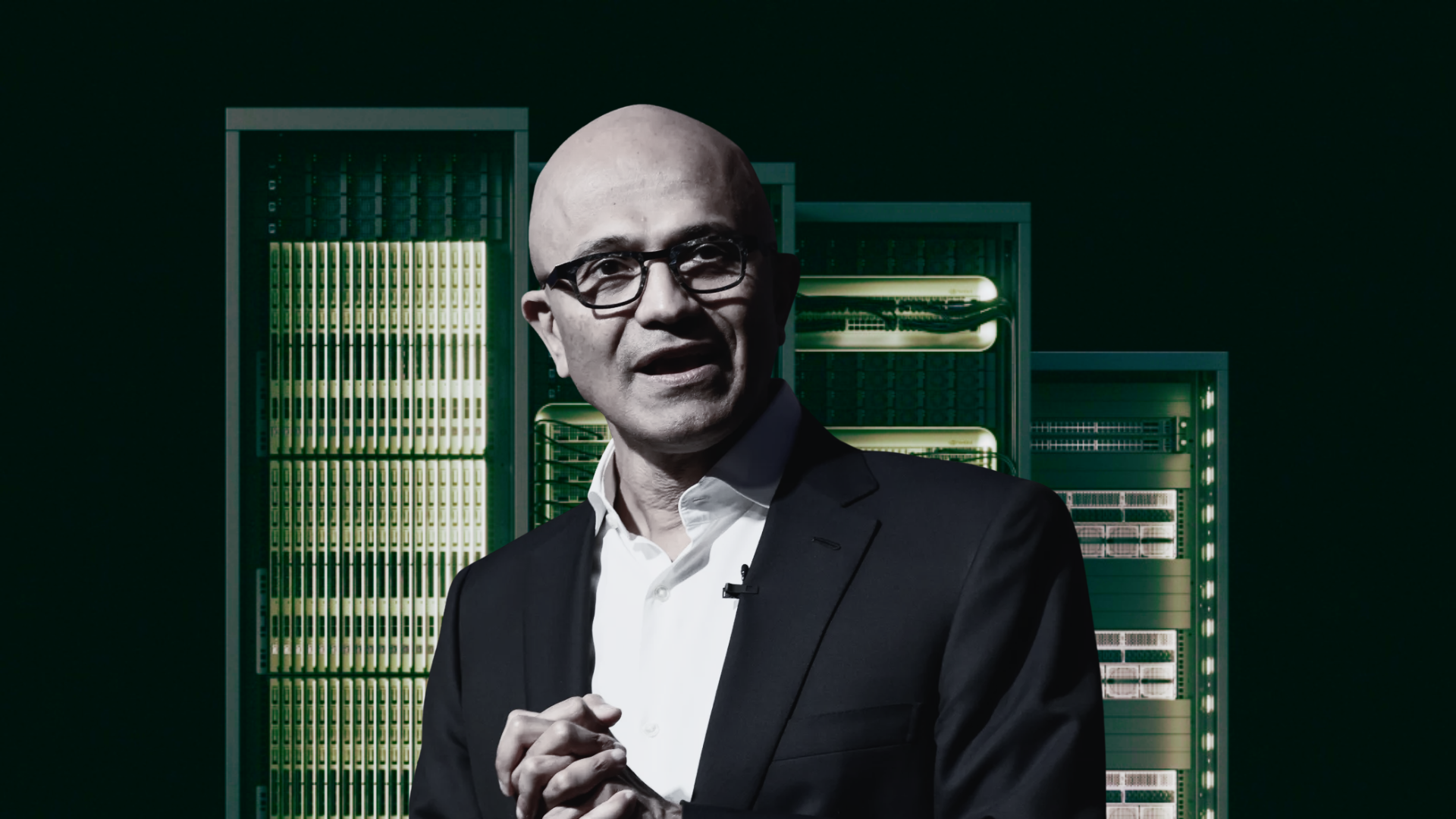
Satya Nadella says the AI bottleneck isn’t silicon – it’s electricity
Microsoft’s chief executive has offered a blunt diagnosis of where the AI arms race is really stuck: power and space, not chips. In a recent podcast appearance, Satya Nadella explained that the company could theoretically order more accelerators, but too many would sit idle because there aren’t enough energized, cooled, and code-ready places to put them. In other words, a power glut – insufficient electrical capacity and prepared data-center shells – can look and feel like a compute glut, with GPUs waiting in warehouses instead of training models.
That framing matters. For months, the market has assumed unquenchable demand for NVIDIA hardware and never-ending AI capacity growth. Nadella’s take reframes the conversation: the near-term constraint is not whether hyperscalers can buy chips, but whether they can plug them in and keep them fed with watts, water, and workloads. Without energized halls, substations, and high-capacity cooling, additional GPUs don’t translate into additional tokens generated or models deployed.
Warm shells, cold reality
Executives sometimes talk about “warm shells” – completed buildings with power, fiber, and cooling ready for racks. Nadella put it simply: the company doesn’t lack GPUs so much as places to plug them. Across the industry, grid interconnect queues stretch years, transformers are back-ordered, and local permitting timelines collide with AI roadmaps that refresh every 12–18 months. The result is a deployment mismatch: the silicon cadence outruns the construction cadence.
That mismatch is amplified by power density. Each generation of rack-scale AI systems increases total draw and heat flux. From earlier Ampere-class clusters to today’s flagship platforms – and to whatever comes next – operators are confronting racks that push into six-figure wattage territory per rack, demanding liquid loops, rear-door heat exchangers, or immersion. When power delivery and thermal budgets expand faster than buildings and grids, the bottleneck migrates from the foundry to the utility pole.
Compute glut vs. power wall
Is there really an impending compute glut, as some skeptics argue, or is this a logistics hiccup? Nadella’s view splits the difference: if energy and space lag, chips accumulate; if facilities catch up, those same chips disappear into production overnight. That makes forecasting treacherous. Short-term inventory can spike even while long-term demand stays intact, especially as inference workloads scale to billions of daily requests and fine-tuning proliferates across enterprises.
In practice, utilization hinges on three levers: energized megawatts, software efficiency, and workload mix. Better compilers, smarter schedulers, quantization, and sparsity can stretch each watt. Shifts from giant pretraining runs to high-throughput inference change the shape of demand. But none of that replaces the need for more electrons.
The gritty engineering: power delivery and heat
Community builders and data-center techs have been vocal about the mundane details that make or break uptime. High-current connectors run hot; cramped cable bays choke airflow; fans fight each other. Some argue a single, larger-format power connector would be safer than pushing extreme current through compact pins. Others prefer multiple conventional 8-pin style leads for redundancy and easier cable dressing. There are even tongue-in-cheek proposals to mount diagonal spot fans over high-power sockets or to ship “uncowled” connector variants to improve airflow. None of these are silver bullets, but they echo a serious point: as rack power climbs, every milliohm of resistance and every centimeter of airflow matters.
Beyond cabling, operators experiment with practical tactics: undervolting to recover efficiency, binning boards to run two slightly slower accelerators in the same power budget as one hot-clocked card, and redesigning aisles to avoid recirculation. These are band-aids, not cures – yet they can be the difference between hitting a service-level objective and throttling during a heat wave.
What big tech does next
Hyperscalers will pursue three parallel paths. First, capacity: on-site generation, long-dated power purchase agreements, and new builds sited near transmission. Nuclear (including SMR concepts), wind-solar-storage hybrids, and industrial-scale heat reuse are back on the table. Second, efficiency: model-level pruning, algorithmic advances, better interconnect topologies, and software that prioritizes utilization over peak headline FLOPs. Third, diversification: more edge inference, specialized accelerators for robotics and vision, and a better balance between capital spending on chips and capital spending on facilities.
For NVIDIA and its rivals, the message isn’t doom; it’s sequencing. Demand is real, but gated by megawatts. If facilities unlock, orders surge. If utilities stall, inventories rise and headlines about a “bubble” get louder. Even then, the mix may rotate – for example, growth in autonomous systems and robotics platforms could soak up compute differently than frontier-model training does today.
The bottom line
Nadella’s caution that Microsoft doesn’t want to buy AI GPUs “beyond one generation” right now isn’t a bet against AI. It’s a signal that the scarcest resource in the next phase of AI is power capacity, not silicon. Until the energy-compute gap narrows – with more warm shells, thicker power feeds, and smarter software – the industry will keep wrestling with the paradox of abundance: plenty of chips, and nowhere to plug them in.