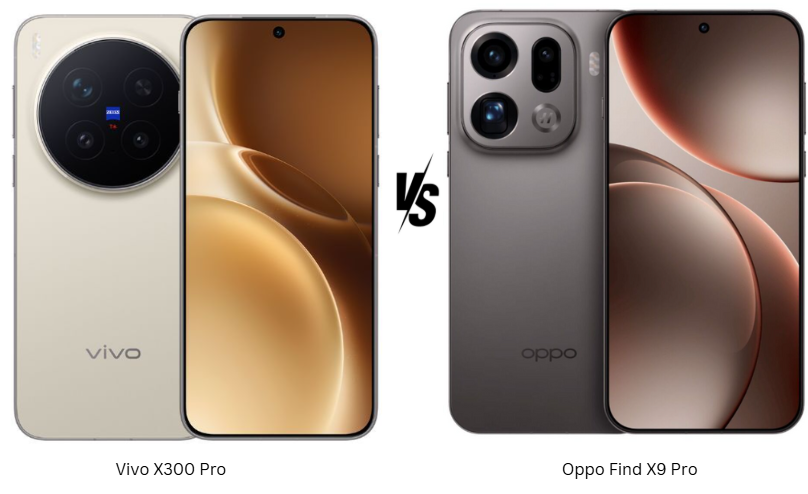
Oppo Find X9 Pro vs Vivo X300 Pro: The Ultimate Camera Clash Between Zeiss and Hasselblad
In the relentless race for smartphone photography dominance, two Chinese heavyweights have entered the ring: the Vivo X300 Pro and the Oppo Find X9 Pro. Both phones are unapologetically premium, packed with the latest hardware, and each backed by legendary camera partners – Zeiss for Vivo and Hasselblad for Oppo. What follows is not just a specs battle, but a deep dive into how these two approach the art of mobile imaging.
At first glance, both devices seem evenly matched. The main cameras on each boast a 50MP LYT-828 sensor measuring 1/1.28-inch, paired with wide apertures – f/1.5 for the Oppo and f/2.0 for the Vivo. These numbers might seem close, but that extra light-gathering capability of the Oppo’s lens gives it an edge in brighter, more contrasty shots. Meanwhile, Vivo’s slightly narrower aperture results in more controlled exposure and richer tonality, particularly under challenging lighting conditions.
The ultra-wide cameras are also strikingly similar: both 50MP with Samsung’s ISOCELL JN1 sensor. Here, the differences are mostly in software tuning. Vivo’s Zeiss Natural mode aims for realism – it suppresses excessive contrast and saturation for a more lifelike feel. Oppo’s Hasselblad-tuned color profile, on the other hand, leans toward artistic vibrancy with a noticeable boost in reds and blues. Whether you prefer the cool precision of Zeiss or the painterly punch of Hasselblad comes down to personal taste.
Things get fascinating when we move to the telephoto systems. Both smartphones use monster 200MP sensors – Samsung’s HPB for Vivo and HP5 for Oppo. Vivo offers a 3.5x optical zoom (85mm), while Oppo provides 3x (around 70mm), but with a wider f/2.1 aperture. The result? Oppo’s zoom shots often look brighter and crisper in daylight, while Vivo’s longer focal length produces more natural compression and detail in distant subjects. In practice, Oppo’s images tend to pop immediately, but Vivo’s telephoto excels when viewed up close – textures, fabric patterns, and subtle gradients appear more refined.
Then come the teleconverter accessories – the wild cards of this showdown. Both phones can be paired with optional lenses that extend their zoom up to the equivalent of a mini telescope, reaching as far as 1600mm and even 5400mm. When tested on a sign nearly 600 meters away, both devices managed the impossible: readable text from a distance where even a DSLR would struggle. However, Vivo retained better micro-contrast and color neutrality, while Oppo’s results were slightly brighter but sometimes washed out under direct sunlight.
The macro photography test showed another dimension of this duel. Vivo consistently preserved detail in petals and leaf textures, delivering a crispness that impressed even seasoned photographers. Oppo’s macros were sharper at the edges but occasionally pushed contrast too far, sacrificing the softer tonal transitions that make nature shots look organic. When shooting subjects like flowers and food, the Vivo’s restraint feels more professional, whereas Oppo’s vibrancy makes for punchier social media posts.
Portraits tell a similar story: both phones deliver beautiful bokeh, accurate edge detection, and flattering skin tones, yet Vivo’s Zeiss collaboration once again pulls slightly ahead in realism. Oppo’s Hasselblad tuning brightens faces and smooths skin aggressively – a style that flatters, but can sometimes verge on artificial. For those who prefer a cinematic, film-like character, Vivo’s results feel closer to what a mirrorless camera might produce.
Meanwhile, front cameras on both are excellent, boasting 50MP sensors with autofocus, ensuring selfies stay tack-sharp. The Oppo tends to produce cleaner HDR balance, while Vivo handles skin tones and background separation more delicately.
Ultimately, this battle is less about numbers and more about philosophy. Oppo’s Find X9 Pro favors drama, contrast, and instant visual punch. Vivo’s X300 Pro strives for subtlety, precision, and the kind of realism photographers crave. Both rely heavily on AI processing to interpret light, color, and motion, but their artistic goals diverge – one paints the world vividly; the other captures it faithfully.
In our side-by-side tests, most users found themselves gravitating toward the Vivo X300 Pro for its superior telephoto clarity and balanced color science. Still, Oppo deserves credit for its energy and boldness, producing images that demand attention. Sadly, both will remain niche in the U.S. due to limited carrier and service support, which is a shame given how close these phones have come to replacing dedicated cameras for many enthusiasts.
Whether you prefer Hasselblad’s flair or Zeiss’s precision, one thing is certain: Chinese flagship phones have redefined mobile photography – and this duel is a glimpse of what’s to come.
1 comment
both beasts, but I’m going Vivo this time ❤️🤗