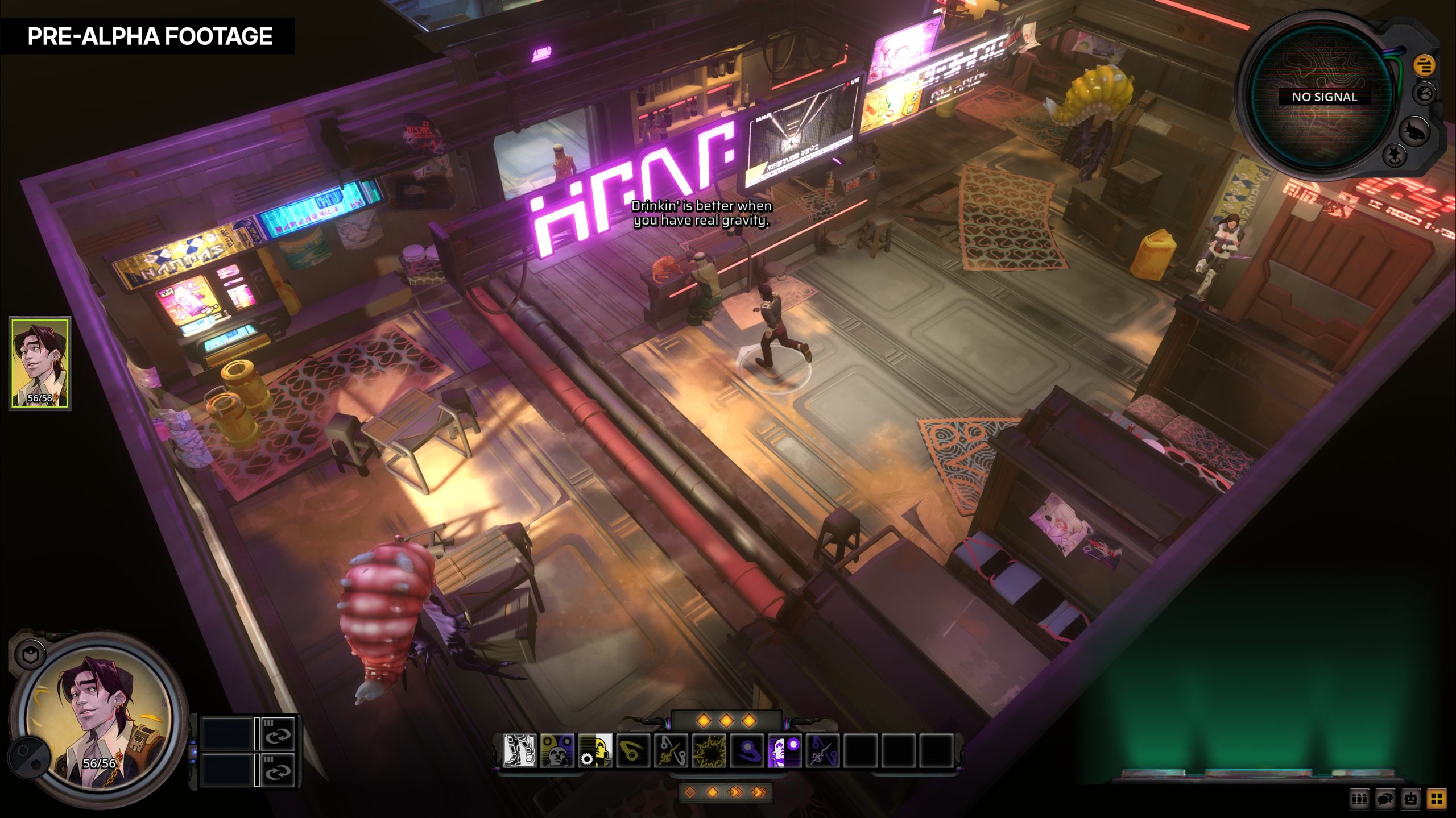
The Art and Ambition Behind Starfinder: Afterlight – An In-Depth Q&A with Epictellers Entertainment
When Barcelona’s independent studio Epictellers Entertainment announced Starfinder: Afterlight, many in the cRPG community leaned in. Here was a small, ambitious team tackling the often-neglected branch of computer role-playing games – and doing so under license from the tabletop publisher Paizo. With the Kickstarter campaign already passing the €530,000 mark and unlocking several stretch-goals, the game has turned heads in the genre. We sat down with co-founders Ricard Pillosu and Albert Jane Goset to dig into the studio’s origins, the challenges of adapting a science-fantasy IP, and how they’re aiming to deliver a deeply branching narrative with modern tools and mod-friendly ambitions.
From AAA Background to Indie Creation
Founded in 2023 by Ricard Pillosu and Albert Jane Goset, Epictellers Entertainment marks a conscious pivot away from the large-scale productions of their former homes. “Albert and I came from major studios – Crytek, Smilegate – where teams numbered in the hundreds, technology stacks were massive and scope was enormous,” Ricard explains. But deep down, what they really yearned to create was a classic computer role-playing game – something more personal, story-driven, and heartfelt.
“After the enormous success of Baldur’s Gate 3, we’ve seen lots of discussion about cRPGs, but very few studios are stepping into them,” Ricard says. “We asked ourselves: Why not us? Why not now?” Their motivation was clear: carve out a smaller studio (just 30 people) that could champion the genre rather than follow mainstream trends.
Rather than chase blockbuster budgets, they focused on autonomy and creative freedom. “We are fully independent – no publisher telling us what to do,” Ricard notes. “Everything is by ourselves. That was the idea.” The decision to go indie, for a team steeped in AAA production, signals both a bold move and a steep learning curve.
The Kickstarter Path: Funding, Community & Risks
Curiously, Epictellers opted to launch their community infrastructure only at the moment the campaign began. “We didn’t have a big Discord presence ahead of time,” Albert admits. The main thrust came when the team announced the game at the annual tabletop-game convention GenCon, coinciding with Paizo’s release of the second edition of Starfinder. That surprise timing generated buzz leading straight into the Kickstarter push.
“We were a little nervous going into Kickstarter,” Albert continues. “Even with 7,000 followers, you never really know what’s going to happen.” The campaign quickly skyrocketed past its minimum goal, gathering over 9,650 backers so far – clearly demonstrating market appetite. “For us the Kickstarter was less about the money and more about the community,” Albert emphasizes. “Yes, we are funded. But what’s more important is having people go with us along the whole journey.”
Indeed, Epictellers are keenly aware of Kickstarter’s pitfalls. “Stretch-goal inflation is real,” Albert says. “We’ve planned a finite number. We don’t want to keep piling stuff on and risk scope-creep.” The team set realistic goals – full voice-over, expanded companion mechanics – yet insisted that “this is what we’re shipping; everything else comes later.”
Why Partner with Paizo & Choose Starfinder?
One of the earliest strategic decisions for the studio was: new IP or licensed universe? While creating their own setting was on the table, Epictellers quickly gravitated toward the Paizo universe. “We love Paizo’s games,” Ricard says. “We knocked on their door and they were great. They gave us access across their IP catalogue, not only Starfinder.” But when it came to choosing a setting that blended something fresh yet resonant, Starfinder won out.
Why? Because the genre is underserved. “Most cRPGs are fantasy,” Ricard points out. “If you do sci-fi – or science-fantasy, in the case of Starfinder – you’re already in a niche inside a niche.” Yet that combination of spaceship travel, magic, gods and otherworldly creatures is precisely what drew them in. “It’s much closer to Guardians of the Galaxy than Star Trek,” Ricard smiles. “It’s fun, it’s crazy – but it’s still epic.”
With Paizo launching Starfinder’s second edition around the same time as the announcement, the timing simply felt right. “Everything clicked,” Ricard recalls. “From our team to Paizo to what the genre needed.”
Tone, Setting & Narrative: From “Afterlight” to Branching Paths
The subtitle of the game – Afterlight – hints at a dark event: “The Afterlight is a bad thing,” Ricard confides. “It’s an extinction-level phenomenon affecting the whole galaxy. You see it coming, yet nobody believes you. So you must gather your crew, find allies, and prevent the event before it happens.” The first playable area will be a planet called Aquiton; from there the stakes escalate as you discover the undead menace from Eox.
In terms of tone, Epictellers emphasise a blend of gravitas and levity. “This isn’t a comedy game,” Ricard clarifies, “but it doesn’t take itself super-seriously either. Think Guardians of the Galaxy – not slapstick, but fun epic adventure.” That tone permeates everything: from spaceship combat to branching dialogue, to the weird alien romance options.
When asked about narrative design, Ricard reveals the team built in a bespoke toolset for rapid writing and iteration. “We wanted the narrative team to keep tweaking while the game is live. They can write, rewrite, remove lines until it feels right.” The approach allows for robust branching: quests may trigger differently depending on your character’s ancestry (soldier, Borai, Ysoki), and the NPCs you influence.
Indeed, the team is committed to “multiple ways in, multiple ways out” for each major quest. “Four or five places might give you the quest. At least three ways to finish: fight, talk, or circumvent. We want people to say, ‘Wow – I did that? Really?’ Then their friend says, ‘Wait – there’s another way!’” Consequently, the studio currently estimates a 40-hour “completion” if you stick to the main path; however, behind the scenes they’re building enough content for 80-100 hours to ensure replayability. “What you experience might be 40-50% of what we actually build,” Ricard admits.
Mechanics: Class, Actions & Environment
Mechanically, the studio is adapting the core rules of Starfinder’s second edition, which itself borrows from the three-action system found in Divinity: Original Sin 2. “We tested the rules at tabletop and thought: ‘These are meant to be in a video game,’” Ricard says. “They’re balanced, thoughtful, mathematically solid.” While the foundation carried over cleanly, the studio recognised some features of the IP would pose animation or rigging headaches – for example, a tail-wielding Ysoki firing a gun. “We evaluate feasibility and decide where to fight battles,” Ricard admits.
Yes, the team is implementing reactions and opportunity attacks – defaulting to a configurable system similar to Baldur’s Gate 3’s reaction prompts. If your character has the proper feat or class, you’ll trigger reactions; if not, you can disable them entirely. “We’re giving players control,” Ricard explains.
On environmental interaction, the team says they can’t match Divinity’s full breadth. “We’re a small studio,” Ricard reminds us. “But sci-fi lets you do things fantasy can’t: hack computers, shoot across long distances, manipulate machines. Flying and zero-G? We had to cut that for scope, but we kept levitation and expect modders will add more later.” Push someone off a cliff and kill them instantly? They promise that feature too – it’s “table-stakes now” in the cRPG space.
Modding, Platform & Controller Support
An intriguing aspect: Epictellers chose the open-source engine Godot and Blender for their art pipeline. “From day one we built with modding in mind,” Ricard divulges. The ambition is clear: full Steam Workshop integration on PC, allowing new quests, organs, even full campaigns. “I dream of someone doing a pure Pathfinder campaign in our engine,” he says with a grin.
That said, console ports and cross-platform mod services like mod.io are left for later. “Right now we’re PC-centric – Windows and Linux. Steam Deck native build is on the roadmap. Controller support will follow,” Ricard confirms. The team recognises that cRPGs on gamepads pose a UI challenge, but they’ve heard the demand loud and clear.
Romance & Character Relationships
Romance has become a hot button in cRPGs – some studios shy away, others embrace it. Epictellers fall into the latter camp, but with careful design. “Romance is optional,” Ricard emphasises. “You can ignore your companions entirely or just treat them as teammates.” But if you do pursue that route, the experience deepens. Romance hooks into emotional narrative arcs: a companion you’ve romanced will speak to you differently, respond to your decisions, change their dialogue.
Complications abound, thanks to Starfinder’s diverse ancestries. “Take the Shirren: insect-like, telepathic. How do they do romance? How do you play that? There’s no easy answer. We’re working at it.” The team recognises that emotional investment is often what players remember most, even if they’re hardcore combat-optimisers at heart.
Views on AI in Game Development
Of course, any modern game developer gets asked about artificial intelligence. “We like to think of AI as the dishwasher, not the creative partner,” Ricard allows. “Game development is about inventing characters, worlds, emotions. We don’t want AI doing that. That’s our fun part.” His stance is clear: creative control lies with humans; AI tools may assist in ancillary tasks, but nothing replaces passion and craft.
Three Key Takeaways
- Scope = ambition + constraint: Epictellers are setting high design ambitions but keeping the project realistic and the scope firm.
- Branching means more than choice: The studio’s quest-design mandates multiple entry points and multiple outcomes – not just a branching tree but a branching web.
- Modding and community are baked in: From the Kickstarter to the engine to the pipeline, community empowerment and mod support are foundational, not afterthoughts.
Final Thoughts
In a time when large-budget AAA games dominate headlines, it’s refreshing to see a small-scale studio tackle an under-represented genre with both reverence and innovation. By marrying the vibrant science-fantasy world of Starfinder with modern cRPG structure and mod-friendly empowerment, Epictellers Entertainment are positioning Starfinder: Afterlight as more than a niche project – it could become the kind of cult-favourite long-tail title that cRPG fans have been waiting for.
Of course, the proof will be in the delivery. Branching narrative, class systems, mod tools – all of these are complex features. But if the Kickstarter results are any indicator, the audience is ready and eager. Stay tuned for more updates as development progresses – and keep an eye on the campaign to see which final stretch-goals unlock.
Interview conducted by Wccftech. All quotes subject to editing for clarity.
2 comments
Romance optional spoil-safe, nice! Too many games force it on you
Saw the Kickstarter campaign, backed it. Fingers crossed rock solid release